On October 9, 2026, Microsoft announced “Microsoft-Decision-1,” a compact AI model specialized in decision-making and task classification. Amid the ongoing automation of business processes driven by the spread of generative AI, the model is expected to simultaneously resolve bottlenecks in decision-making tasks and optimize AI usage costs.
- Key Points and Background of the Event
- Architecture of Judgment-Specialized Models That Do Not Generate Free-Form Text
- Massive cost reduction to
- Accuracy demonstrated across 36 benchmarks and astonishing processing speed
- Xbox and Copilot Verification Cases and Robustness Against Input Variance
- Business Process Implementation by Headwaters and Foundry
- Future Outlook and Key Points
Key Points and Background of the Event
On October 9, 2026, Microsoft released “Microsoft-Decision-1,” a decision-specialized AI model that rapidly executes routine decision-making and classification tasks without generating text. The model has been made available as a public preview in the model catalog of the company’s cloud infrastructure service, Microsoft Foundry, and is also accessible via the external API service OpenRouter. Until now, large language models (LLMs) capable of generating text and images have dominated the generative AI space; however, in business automation settings, AI agents must constantly perform massive amounts of rapid decision-making, such as task routing, acceptance/rejection determinations, and risk assessment. Relying entirely on high-precision, general-purpose LLMs for these decision-making tasks has posed major challenges, including processing latency and high token costs. Triggered by TypeSafe AI’s release of “Jev” in September 2026, attention toward decision-specialized models has surged, and Microsoft’s entry significantly expands the options available to enterprises for building AI infrastructure.
Architecture of Judgment-Specialized Models That Do Not Generate Free-Form Text
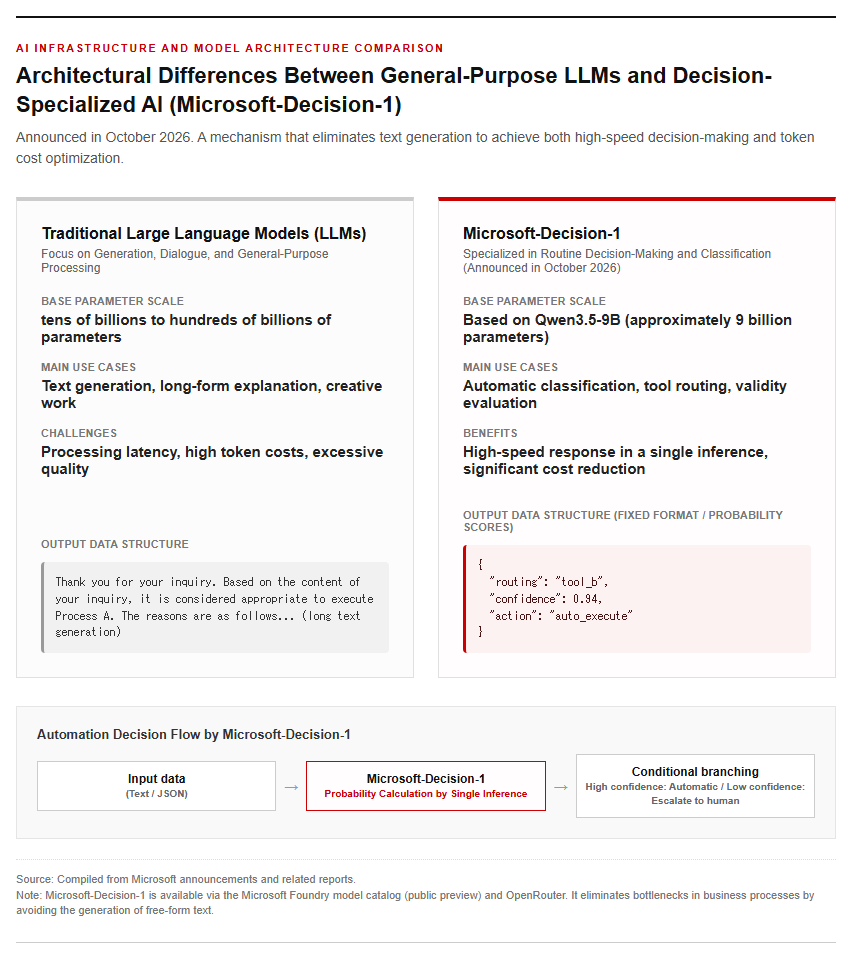
The most defining feature of Microsoft-Decision-1 is that it does not generate free-form text or long explanations at all, unlike traditional LLMs. This model has undergone post-training based on Qwen3.5-9B (approximately 9 billion parameters), and in response to tasks and predefined choices inputted in text or JSON format, it returns structured data with probability scores in a single inference process. Supported judgment formats include binary yes/no choices, routing among multiple candidates, and ranking or scoring. Specific use cases include automatic classification of customer support inquiries, selection from multiple processing tools, validity evaluation of answers generated by AI, and control over whether to continue a workflow or escalate to a human. The system is designed to easily build advanced decision logic, such as referencing the returned probability values to proceed with automated processing when the confidence level is high, and routing to a person for confirmation only when the confidence level is low. As shown in the diagram below, traditional LLMs and decision-specialized models differ significantly in their output data structures and processing flows.
Massive cost reduction to Massive cost reduction to $0.042 per 1 million input tokens
.042 per 1 million input tokens
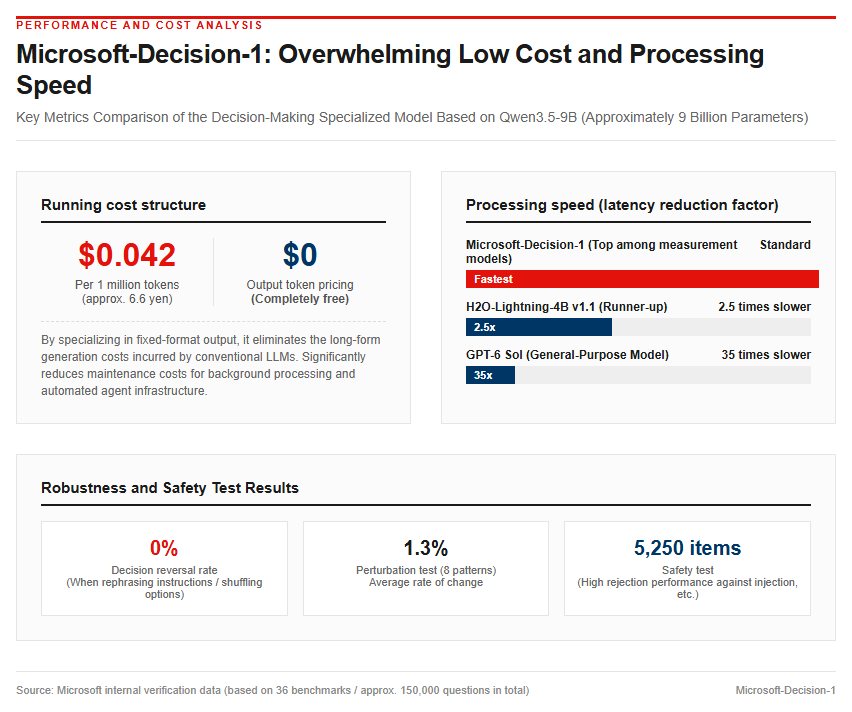
The biggest barrier for companies operating generative AI systems is the running cost associated with token-based pricing. Microsoft-Decision-1 is offered at an astonishingly low price of $0.042 USD per 1 million input tokens (approximately 6.6 Japanese yen). Furthermore, its most distinctive feature is that billing for output tokens is completely free. With standard LLMs, costs are incurred for both inputs and outputs, and utility fees skyrocket especially when having the model output long explanations along with judgment results. In contrast, Decision-1 is specialized for templated outputs that directly return numerical values, a design that keeps output costs down to zero. By replacing general-purpose models with this model for corporate AI agent infrastructures running massive automated tasks or continuous background processing, it becomes possible to drastically cut system maintenance costs compared to conventional levels. Transitioning from the current base model to next-generation versions built on Microsoft’s proprietary MAI model and OpenAI models is also planned for the future.
Overwhelming Performance Seen in Benchmark Evaluations and Internal Verification
Accuracy demonstrated across 36 benchmarks and astonishing processing speed
In validation tests conducted by Microsoft, accuracy was compared using 36 types of benchmarks (totaling approximately 150,000 questions) not included in the training data. As a result, Microsoft-Decision-1 achieved the highest accuracy among the competing models evaluated. In terms of processing speed, it also recorded the fastest speed among the measured models, achieving a phenomenal reduction in latency—2.5 times faster than the runner-up H2O-Lightning-4B v1.1 and 35 times faster than the general-purpose model GPT-6 Sol. Additionally, robustness tests against input variations, which are essential for the practicality of AI models, were conducted. Even when instructions or explanatory texts were paraphrased, and options were shuffled or rearranged, the decision reversal rate was zero. Furthermore, across eight perturbation tests incorporating various types of noise, the average change rate remained at a mere 1.3 percent. It also exhibited high refusal performance in 5,250 tests involving prompt injections and harmful requests, demonstrating safe and stable inference capabilities. The progression of the evaluation results is shown in the graph below.
Xbox and Copilot Verification Cases and Robustness Against Input Variance
Notable results have also been reported from internal trials within Microsoft. The Xbox Research team adopted Decision-1 to process and categorize over 10,000 pieces of free-form feedback collected from surveys and social media (X) into specific themes. As a result, while maintaining classification accuracy equivalent to the conventional GPT-6 Sol, processing speed increased by more than 14 times, and processing costs were reduced to less than 1/200th. Additionally, in evaluations of response quality measurement by the Copilot team, it recorded a processing speed 100 times faster while maintaining quality equivalent to GPT-5.6 Luna. Furthermore, in Microsoft Discovery, an AI supporting scientific experiments, the replanning feature for reviewing experimental designs achieved 46 times higher consistency and nearly 4 times the processing speed compared to LLM-based evaluations. It has also been demonstrated that in internal systems and incident response environments, it delivers accuracy and speed that surpass general-purpose LLMs when extracting knowledge from logs and tickets.
AI Integration into Corporate Operations and the Utilization of “Judgment Assets”
Business Process Implementation by Headwaters and Foundry
Practical application in Japanese companies is also progressing rapidly. On October 16, 2026, Headwaters Co., Ltd. and Headwaters Consulting, which operate AI platform businesses, launched an enterprise business judgment AI solution leveraging Microsoft-Decision-1. This initiative uses SyncLect Data Intelligence to structure judgment criteria such as company-specific internal regulations, past cases, and exceptional conditions, allowing Decision-1 to make determinations and a system to execute processing via Agentic Work Flow. It incorporates a Human-in-the-Loop mechanism where low-risk, repetitive tasks are fully automated by AI, while only low-confidence or exceptional cases are handed over to human operators. The existing Agentic Work Flow alone achieves a task execution accuracy rate of 99 percent, and by integrating Decision-1 with this, the solution simultaneously reduces verification man-hours, shortens processing times, and optimizes AI usage costs.
Future Outlook and Key Points
Looking ahead, decision-specialized AI models are attracting attention not just as labor-saving tools, but as elements that will fundamentally transform the overall architecture of enterprise AI. Headwaters has announced a policy to accumulate the implementation know-how acquired on Microsoft Foundry as reusable “decision assets” and deploy them horizontally across various industries, including finance, manufacturing, retail, and infrastructure. In an era where multiple AI agents collaborate to handle complex operations, configurations that rely on a single large-scale LLM for all judgments are reaching their limits, and hybrid configurations that optimally combine generative models, decision models, rule-based systems, and human intervention are becoming the standard. With the advent of Microsoft-Decision-1, companies can build high-speed, low-cost, and secure AI decision-making platforms while strictly maintaining security and access control, serving as a crucial key to the future expansion of business decision automation.
Reference Page
- 【Microsoft-Decision-1: Our model for fast decision-making】https://commandline.microsoft.com/microsoft-decision-1-model-foundry/
- Deploy and use Microsoft-Decision-1 in Microsoft Foundry
[#Microsoft #MicrosoftDecision1 #AIAgents #MicrosoftFoundry #GenerativeAI #DecisionMakingModel #Headwaters]

コメント