The Shoko Chukin Bank and eight regional banks have provided a total of 2 billion yen in syndicated loans to NEXTES, a startup that develops stationary storage batteries. Amid the growing demand for grid-scale storage batteries driven by the spread of renewable energy, the initiative is drawing attention as a pioneering case of regional financial institutions working together to support a tech startup.
- Overview of the Co-financing by Shoko Chukin Bank and 8 Regional Banks
- The Strengths of Financed Company NEXTES and Its Proprietary Control Technology “ACTIVA”
- The Importance of Grid-Scale Storage Batteries Amid the Expansion of Renewable Energy
- Business Evaluation and Risk Management Methods by Financial Institutions
- The Significance of Renewable Energy and Decarbonization Support through Collaboration Among Regional Financial Institutions
- The Future Potential of Grid-Scale Battery Storage Businesses and Key Points for Growth
Overview of the Co-financing by Shoko Chukin Bank and 8 Regional Banks
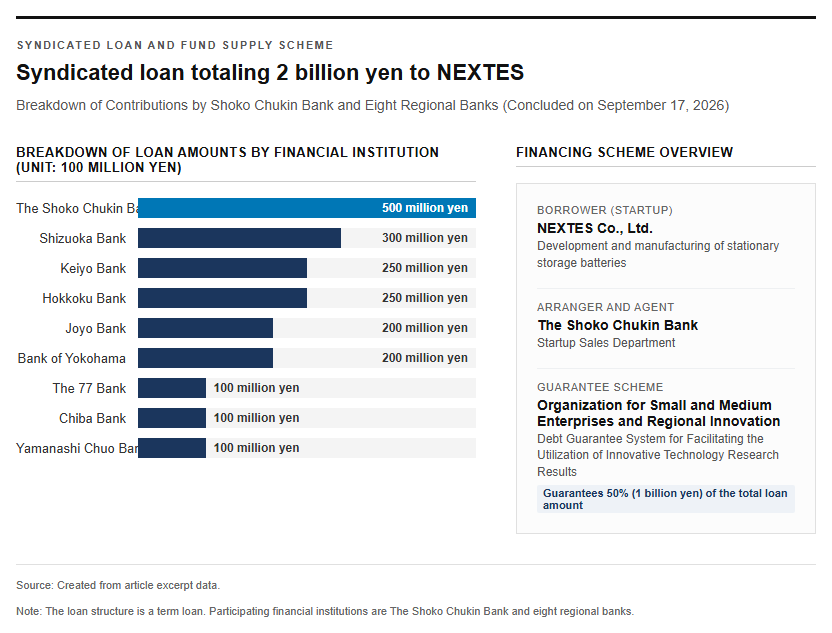
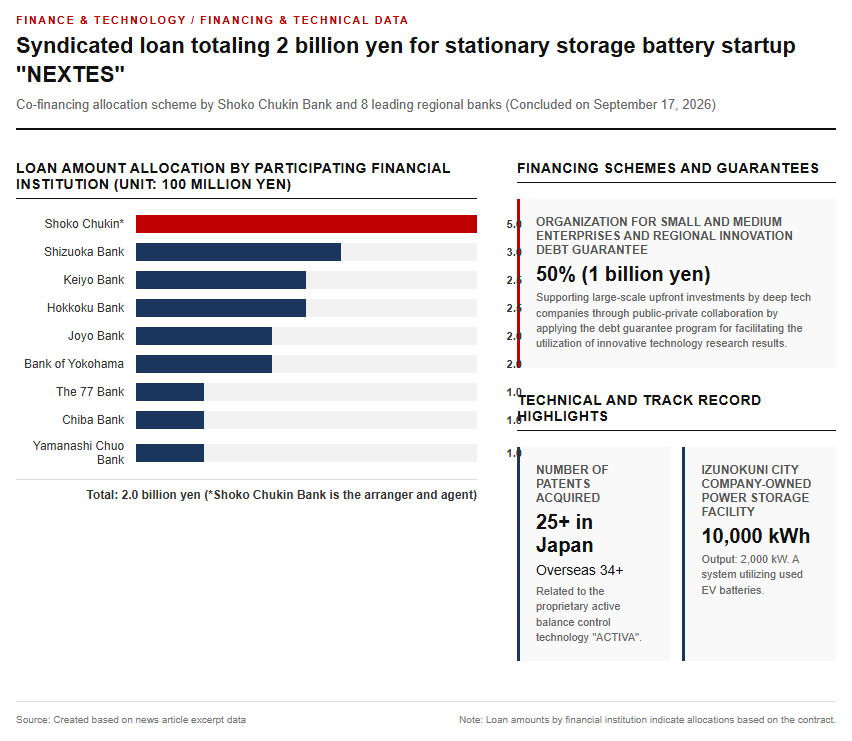
The Shoko Chukin Bank, Ltd. has announced that it has concluded a syndicated loan agreement totaling 2 billion yen with NEXTES, a startup that develops and manufactures stationary storage batteries. The agreement was signed on September 17, 2026, with Shoko Chukin’s Startup Business Department serving as the arranger and agent. The regional financial institutions participating in the co-financing are eight prominent regional banks: Shizuoka Bank, Keiyo Bank, Hokkoku Bank, Joyo Bank, Bank of Yokohama, The 77 Bank, Chiba Bank, and Yamanashi Central Bank. The loan takes the form of a term loan, with the funding allocation as follows: 500 million yen from Shoko Chukin, 300 million yen from Shizuoka Bank, 250 million yen each from Keiyo Bank and Hokkoku Bank, 200 million yen each from Joyo Bank and the Bank of Yokohama, and 100 million yen each from The 77 Bank, Chiba Bank, and Yamanashi Central Bank. This financing utilizes the debt guarantee system for facilitating innovative technology research results utilization projects by the Organization for Small and Medium Enterprises and Regional Innovation, Japan, with a debt guarantee set at 50% of the total loan amount. A major feature of this financing is that public and private financial institutions collaborated to provide funds to a deep tech startup requiring large-scale upfront investment.
The Strengths of Financed Company NEXTES and Its Proprietary Control Technology “ACTIVA”
NEXTES, which recently secured funding, was founded in May 2008 and is a storage battery startup headquartered in Setagaya Ward, Tokyo. In April 2026, the company changed its name from its former moniker, NExT-e Solutions, to its current name. Its major shareholders include major electric and gas companies such as Tokyo Electric Power Company Holdings, TEPCO Power Grid, Kyushu Electric Power, Shikoku Electric Power, Chugoku Electric Power, and Osaka Gas, alongside major trading houses like Toyota Tsusho and Sumitomo Corporation. The company’s primary core technology is ACTIVA, a proprietary battery control technology that provides advanced monitoring and management of lithium-ion batteries. While conventional passive balancing methods resulted in energy efficiency losses because cells with higher charge levels dissipated energy as heat to equalize their states, ACTIVA adopts an active balancing method that adjusts by directly transferring energy between cells. This enables energy to be effectively utilized without being wasted as heat, thereby achieving an extended battery lifespan and highly stable operation. The company has secured more than 25 patents domestically and over 34 patents overseas for this technology.
Market Expansion and Latest Financing Environment for Grid-Connected Storage Batteries
The Importance of Grid-Scale Storage Batteries Amid the Expansion of Renewable Energy
With the expanding adoption of renewable energy sources such as solar and wind power, adjusting for fluctuations in power generation caused by weather conditions and effectively utilizing surplus electricity have become nationwide challenges. Grid-scale storage batteries, which store electricity and charge and discharge to and from the grid as needed, are seeing rapidly growing demand as essential infrastructure for stabilizing power grids. The 2 billion yen recently raised by NEXTES will be allocated to strengthening the production system for stationary storage batteries to meet rapidly growing market demand, as well as to research and development concerning products and battery control technologies. The company’s flagship products include the NX-CE007, a water-cooled containerized energy storage system that packs a nominal capacity of 2,315 kWh into a 13-foot container, and the NX-CE009, a compact cabinet-type storage battery. The company’s deployment track record extends across Japan and into the Asian region; in Izu no Kuni City, Shizuoka Prefecture, it operates its own power storage plant with an output of 2,000 kW and a capacity of 10,000 kWh utilizing repurposed EV batteries, and it has also provided equipment for a power storage plant project in Mashiki Town, Kumamoto Prefecture.
Business Evaluation and Risk Management Methods by Financial Institutions
In structuring the loan for this project, Shoko Chukin Bank conducted a thorough business viability assessment through interviews with the management and related organizations. In addition to recognizing the company’s technological superiority and strengths and sharing a deep understanding of its financial challenges, the bank highly evaluated its business viability in supporting the spread of renewable energy. While carefully assessing technological and business risks, it mitigated credit risk by incorporating SMRJ’s debt guarantee program, thereby designing a syndicated loan structure that facilitates the participation of eight regional banks. In recent financial markets, publicly announced cases of project financing targeting grid-scale battery storage businesses and portfolio-type loans covering multiple properties are on the rise. The utilization of advanced financial schemes that properly evaluate and mitigate fluctuation risks in market values and revenue structures is the key to successfully executing large-scale financing for startups with limited track records.
Future Outlook for Regional Finance and Startup Support
The Significance of Renewable Energy and Decarbonization Support through Collaboration Among Regional Financial Institutions
Major regional banks playing core roles in their respective regions are participating broadly in this syndicated loan. Each bank shares the funding according to the status of regional renewable energy adoption and the expansion of power generation projects, establishing a financial network that supports the grid connection of regional solar and wind power generation. While it is not easy for a startup company on its own to secure massive conventional loans from financial institutions, Shoko Chukin Bank evaluated the business viability as an arranger, and by combining public guarantee systems with the financial capacity of regional banks, it has become possible to significantly lower the hurdles for capital supply. This kind of co-financing structure can be described as a pioneering model case that simultaneously achieves both the promotion of regional decarbonization and the support of growth industries by local financial institutions.
The Future Potential of Grid-Scale Battery Storage Businesses and Key Points for Growth
Grid-scale battery businesses are further increasing their independence as a business, driven by the establishment of multi-revenue models such as the balancing market and capacity market, in addition to trading in the wholesale electricity market. Meanwhile, financing trends in the global battery sector remain flat, with a growing tendency toward selective investment. Going forward, for the domestic grid-scale battery market to continue expanding, reducing product costs and further improving energy efficiency will be indispensable. A major point of focus moving forward will be whether development companies, starting with NEXTES, can utilize raised funds to solidify their mass production systems and technological development foundations, thereby achieving stable product supply. Furthermore, enhancing the ability of financial institutions to accurately evaluate business risks and technical characteristics and maintaining a sustainable financing structure will be critical challenges for achieving decarbonization across Japan and making renewable energy a primary power source.
Reference page
- [Shoko Chukin News Release] https://www.shokochukin.co.jp/assets/pdf/nr_261016_01.pdf
- [NEXTES News Release] https://nextes.jp/news/20261016/
[#ShokoChukin #RegionalBanks #GridBattery #NEXTES #SyndicatedLoan #Decarbonization #Startup]


コメント