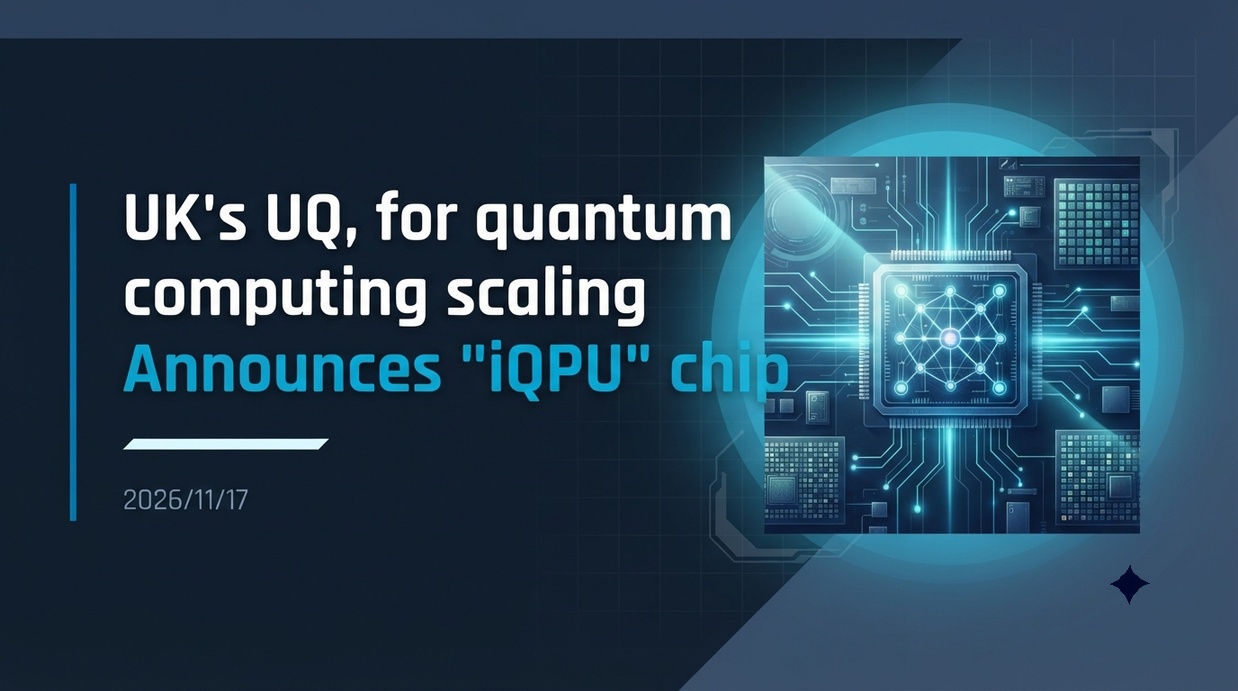
UK quantum computing company Universal Quantum has announced the “iQPU”, a scalable processor chip based on the trapped-ion approach. This is backed by a major development contract worth a total of €67 million with the German Aerospace Center (DLR), marking the full-scale implementation of large-scale quantum computers utilizing commercial semiconductor lines.
- Quantum chips exceeding 400 mm² manufactured in a 200 mm commercial foundry
- Adoption of the QCCD Method and an Integrated Control Circuit Solving Wiring Issues
- Multi-chip connection and error correction using proprietary UQConnect technology
- €67 Million Contract with DLR and Plans for Integration into Actual Systems
- Over 0 Million in Funding and an International Joint Development Network
- Prospects and Challenges for Practical Application Toward Achieving Utility Scale
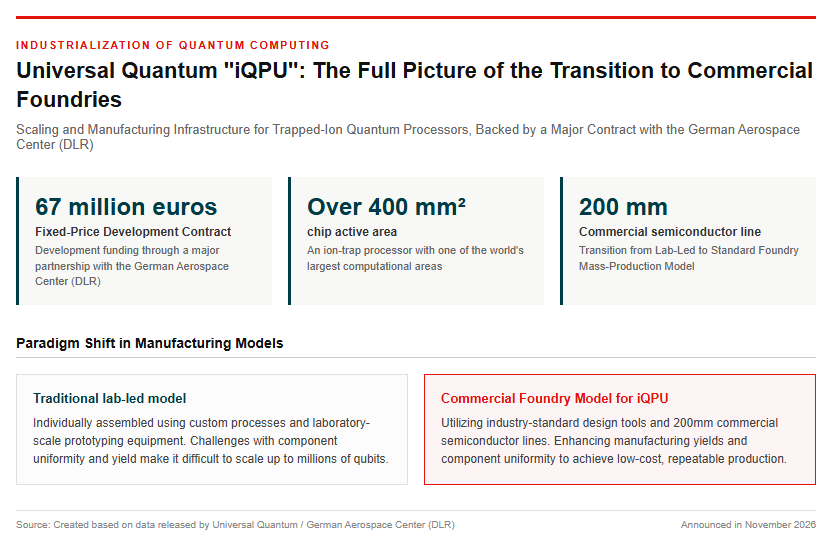
Quantum chips exceeding 400 mm² manufactured in a 200 mm commercial foundry
Headquartered in the UK, Universal Quantum announced its integrated trapped-ion quantum processing unit (iQPU) on November 3, 2026. Traditionally, many quantum processors have been individually assembled in lab-scale prototyping facilities or through custom processes; however, the iQPU is manufactured using commercial 200mm semiconductor foundry lines and industry-standard design tools. Its active chip area exceeds 400 mm², making it one of the largest computational-area ion-trap processors in the world. By leveraging mass-producible semiconductor manufacturing lines, it improves component uniformity and manufacturing yield, enabling low-cost, iterative production. In the quantum computing field, building a manufacturing infrastructure capable of scaling from tens or hundreds of physical qubits to a utility scale of millions of qubits has long been a challenge. The iQPU is positioned as a significant achievement representing the transition from R&D-stage experimental setups to an industrial manufacturing model. As shown in the configuration diagram below, quantum control mechanisms are densely arranged on the semiconductor chip.
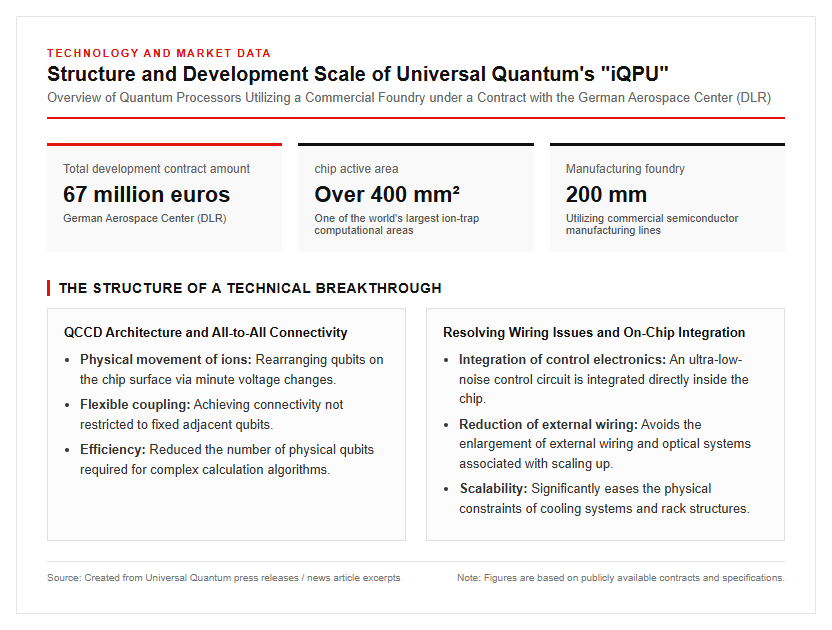
Adoption of the QCCD Method and an Integrated Control Circuit Solving Wiring Issues
A major technical feature of the iQPU is the adoption of the QCCD (Quantum Charge-Coupled Device) architecture and the on-chip integration of control electronics. In the QCCD method, ions (qubits) are physically moved and rearranged on the chip surface by minute voltage changes. This is not limited to nearest-neighbor coupling between fixed qubits, but realizes long-range and flexible all-to-all connectivity, reducing the number of physical qubits required to execute complex computational algorithms. In addition, addressing the proliferation of external wiring and optical systems associated with scaling up (the wiring problem), which has been an issue in conventional systems, the iQPU directly integrates ultra-low-noise control electronics inside the chip. By eliminating the need for a massive amount of external wiring and control equipment, it significantly eases the physical constraints of cooling systems and rack structures. The ion movement paths and the arrangement of control circuits within the chip are as shown in the schematic diagram below.
Multi-chip connection and error correction using proprietary UQConnect technology
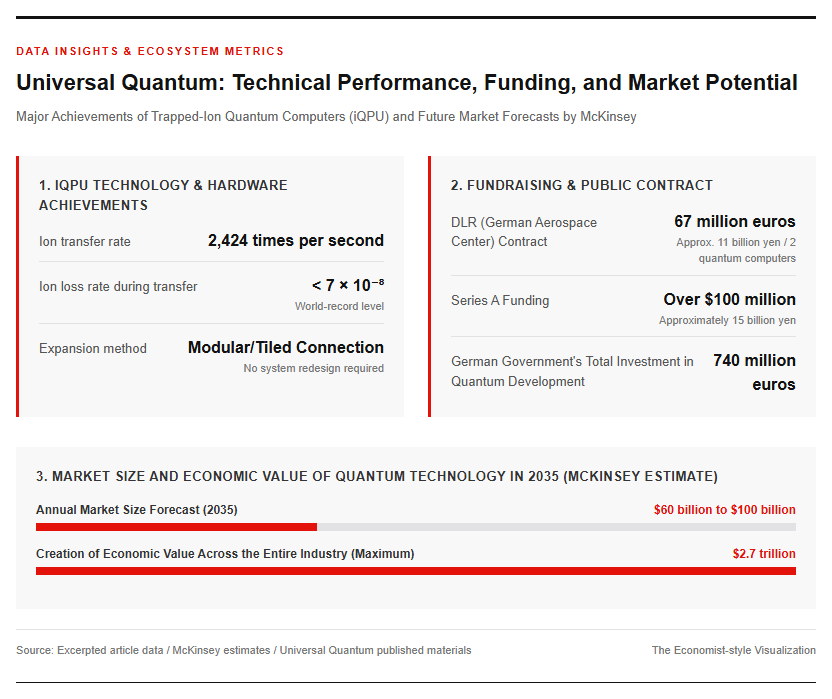
Because there is a physical limit to the number of qubits that can be formed on a single chip, Universal Quantum has developed “UQConnect,” a proprietary interface that directly links multiple iQpUs. UQConnect is an electric field-coupled interface that transfers ions between chips at high speed and with high precision, enabling multiple processors to operate synchronously as a single large-scale quantum computer. According to a 2023 research report, experimental results of world-record standards have been achieved, with an ion transfer speed between modules of 2,424 times per second and an ion loss rate during transfer of less than 7×10⁻⁸. Rather than aiming for the extreme scaling of a single processor, the approach of tiling and connecting/adding standardized iQPU modules makes it possible to continuously expand computing power without redesigning the entire system. This modular approach is also expected to enable efficient physical resource management in implementing the error-correction codes necessary for fault-tolerant quantum computing (FTQC).
Major Contract with the German Government and the Global Industrial Ecosystem
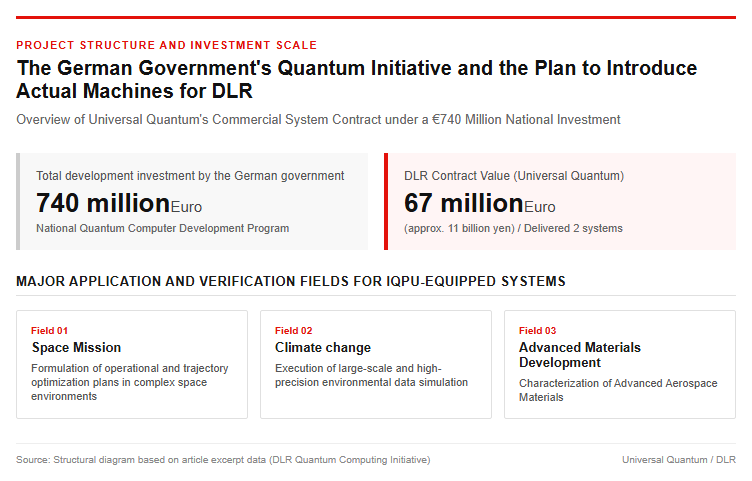
€67 Million Contract with DLR and Plans for Integration into Actual Systems
The iQPU is not limited to mere technological demonstration; its integration into actual customer-facing commercial and public systems is progressing. A prime example of its implementation is the “DLR Quantum Computing Initiative (QCI)” led by the German Aerospace Center (DLR). Universal Quantum has secured a large-scale contract worth a total of 67 million euros (approximately 11 billion yen) from DLR and is developing two scalable trapped-ion quantum computers for delivery. In the DLR project, the iQPU-equipped systems are scheduled to be utilized for advanced R&D challenges such as space mission optimization planning, climate change simulations, and the characterization of new aerospace materials. Against the backdrop of a massive 740 million euro development investment by the German government, field verification from R&D systems to practical systems is accelerating. The overall configuration concept of the computing platform to be introduced at DLR is as follows.
Over 0 Million in Funding and an International Joint Development Network
Universal Quantum is a UK-based deep tech company founded by Professor Sebastian Weidt and Professor Winfried Hensinger from the University of Sussex. To date, the company has secured over $100 million (approximately 15 billion yen) in Series A funding from a global syndicate consisting of sovereign wealth funds and quantum-focused investors. Its development operations are based in the UK, Germany, and the United States, working in collaboration with international supply chains. In particular, the company signed an agreement with Japan’s National Institute of Advanced Industrial Science and Technology (AIST) in 2025 for the joint development of scalable quantum computing subsystems, and is promoting cooperation to incorporate Japan’s ultra-precision machining technology. Furthermore, through receiving investment from Australia’s Main Sequence and partnerships with major institutions in Europe, the US, and Asia, it aims to build a global industrial foundation that does not depend on any specific country.
Prospects and Challenges for Practical Application Toward Achieving Utility Scale
According to McKinsey’s estimates, the quantum technology sector is projected to grow into a $60 billion to $100 billion annual market by 2035, generating up to $2.7 trillion in economic value across industries such as drug discovery, finance, and materials science. The iQPU serves as a critical technological milestone for reaching this commercial tipping point (utility scale). At the same time, challenges toward future practical application have also become clear. First is the demonstration of maintaining yield and reducing manufacturing costs during mass production on a commercial 200mm line. Second is whether it is possible to ensure effective quantum gate fidelity and the stability of error correction operations in a multi-chip connected actual system. Operational data from the actual machine for the DLR and academic verification results will hold the key to future evaluations. The future development roadmap and steps toward industrial application are organized in the figure below.
Reference page
- 【Universal Quantum Official Announcement: Universal Quantum launches the iQPU, a chip designed to take quantum computers to scale】https://universalquantum.com/knowledge-hub/universal-quantum-launches-the-iqpu-a-chip-designed-to-take-quantum-computers-to-scale
- [Universal Quantum Official Knowledge Hub: Building quantum computers should be a global effort] https://universalquantum.com/knowledge-hub/building-quantum-computers-should-be-a-global-effort
[#QuantumComputer #UniversalQuantum #iQPU #IonTrap #Semiconductor #QuantumHardware #DLR]

コメント