Google Cloud and NVIDIA have launched an enterprise AI infrastructure platform specialized for financial institutions. The backdrop to this is strong industry demand to achieve real-time fraud detection and risk assessment while meeting strict regulatory compliance and security requirements in financial operations.
- Key Points and Background of the Partnership Announcement
- Technical Specifications and Security of Infrastructure Specialized for Financial Institutions
- Top 3 Use Cases and Proven Results of 40% Faster Performance
- Surging AI Data Center Investment and 0 Billion in Debt
- Collaboration between 0 Billion Mega-Platforms and Financial Institutions
- Key Challenges in Supply Chain Concentration and Governance
- Future Outlook and Key Market Focus Areas
Key Points and Background of the Partnership Announcement
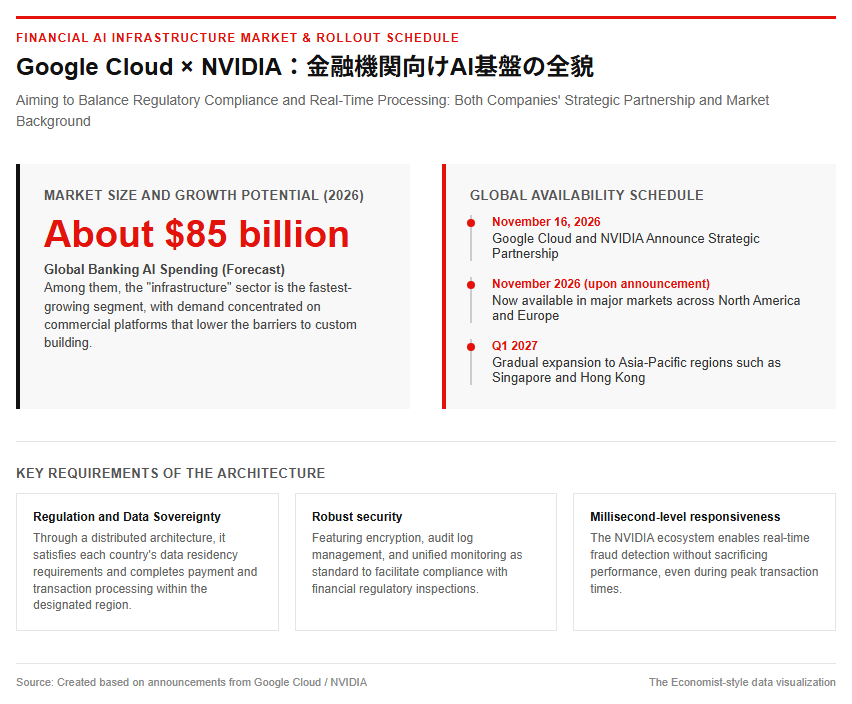
On November 16, 2026, Google Cloud and NVIDIA announced a strategic partnership to provide full-scale AI infrastructure for banks and financial services providers. This initiative integrates the advanced computing power of NVIDIA GPUs with Google Cloud’s robust data center foundation, delivering a commercial AI environment that financial institutions can utilize immediately without having to build systems from scratch on their own. Spending on AI initiatives by banks worldwide in 2026 is estimated to reach approximately $85 billion, making the infrastructure category the fastest-growing segment among them. The service became available in major markets in North America and Europe upon announcement, and is scheduled to gradually expand to the Asia-Pacific region, including Singapore and Hong Kong, starting in the first quarter of 2027. In the traditional financial industry, complex regulatory compliance and security reviews have been major barriers to cloud migration and AI adoption, but the collaboration between major tech companies is expected to significantly lower these hurdles to adoption.
Technical Specifications and Security of Infrastructure Specialized for Financial Institutions
The defining feature of the AI infrastructure for financial institutions is its pre-configured setup designed to meet the rigorous security requirements and regulatory standards demanded of financial transactions. By leveraging Google Cloud’s distributed architecture, it addresses the challenges of data independence and data residency (data sovereignty) demanded by financial authorities in various countries, making it possible to complete the processing of sensitive payment data and transaction records entirely within a designated region. Furthermore, advanced encryption functions, audit log management, and integrated monitoring capabilities are implemented as standard across the entire system, facilitating compliance with financial regulatory inspections. On the software front, the NVIDIA ecosystem is integrated, running frameworks optimized for large-scale real-time transaction data analysis and complex pattern recognition. This ensures a design that maintains millisecond-level responsiveness without performance degradation even during peak market trading times.
Top 3 Use Cases and Proven Results of 40% Faster Performance
The joint solution from the two companies is deployed focusing primarily on three areas. The first is a real-time fraud detection system that simultaneously analyzes millions of account transactions to prevent unauthorized access and impersonation. The second is a risk assessment model that comprehensively analyzes structured and unstructured data to improve the accuracy of credit decisions and loan screening. The third is the automation of customer service operations through call center support and automated response chatbots utilizing natural language processing. In initial pilot programs conducted with major Tier 1 banks, notable results were confirmed, showing a 40% reduction in fraud detection response time compared to conventional legacy systems. By adopting a usage-based pricing model, it has enabled not only major institutions but also mid-sized financial institutions to utilize the latest AI technology without requiring massive initial investments.
Expansion of AI Investment in the Financial Industry and Changing Fund Procurement
Surging AI Data Center Investment and 0 Billion in Debt
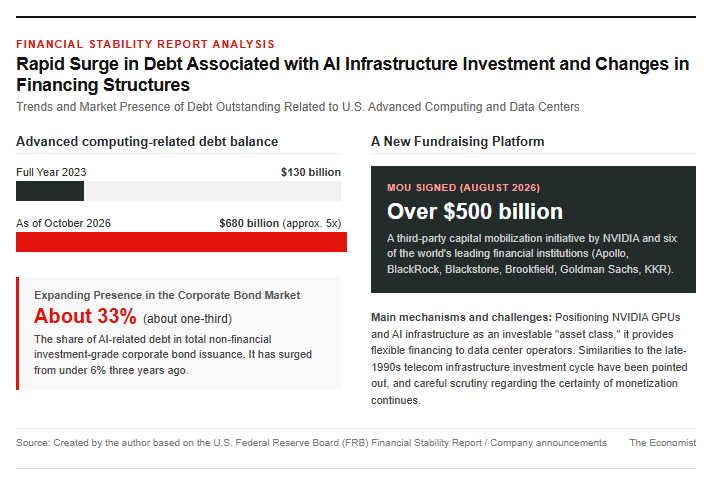
While the adoption of AI by financial institutions continues to grow, the massive funding for the underlying data centers and advanced computing facilities has become a point of close scrutiny within the financial system. According to the Financial Stability Report published by the U.S. Federal Reserve Board (FRB) in November 2026, the outstanding balance of debt issued for advanced computing and data center-related purposes reached $680 billion as of October 2026. This represents a rapid surge to an extraordinary scale—about five times the $130 billion recorded for the full year of 2023. Currently, this AI-related debt accounts for roughly one-third of the total investment-grade corporate bonds issued by non-financial firms, rapidly increasing its market presence from less than 6% three years ago. It is increasingly being compared to the broadband telecommunications infrastructure investment cycle of the late 1990s, and careful scrutiny is required regarding the rapidly expanding debt structure and the feasibility of monetization.
Collaboration between 0 Billion Mega-Platforms and Financial Institutions
To meet the funding demand for securing such computing resources, momentum is growing to establish new financing frameworks for AI infrastructure. In August 2026, NVIDIA partnered with six of the world’s leading financial institutions—Apollo, BlackRock, Blackstone, Brookfield, Goldman Sachs, and KKR—and signed a memorandum of understanding (MOU) to establish a funding platform that will mobilize over $500 billion (approx. 79.7 trillion yen) in third-party capital over time. This initiative envisions treating NVIDIA’s GPUs and AI infrastructure as an investable asset class, providing flexible financing to data center and cloud operators.
However, in actual financial transactions, there is a growing tendency to place greater emphasis not only on the mere collateral value of the hardware, but also on the customer’s long-term usage contracts and additional financial guarantees, with rigorous risk assessment and careful negotiation of terms continuing for each individual deal.
Financial Stability Risks and Future Outlook
Key Challenges in Supply Chain Concentration and Governance
While the adoption of AI in financial institutions brings significant benefits such as operational efficiency and improved customer convenience, concerns about systemic vulnerabilities are also mounting. International bodies like the Financial Stability Board (FSB) have warned against supply chain and vendor lock-in risks arising from increasing reliance on specific hyperscalers and foundation model providers. If numerous financial institutions adopt identical cloud infrastructures and common models, the ripple effects on the entire financial system in the event of an outage or cyber incident at a specific vendor would be massive. Furthermore, the ease of conducting cyberattacks using advanced AI is creating an attacker-favorable environment, strongly demanding that financial institutions establish multi-layered security measures, institutional AI governance frameworks, and advanced risk management structures.
Future Outlook and Key Market Focus Areas
Going forward, the joint solutions by Google and NVIDIA are expected to be rolled out globally in phases, beginning with their expansion into the Asia-Pacific region in the first quarter of 2027. Consequently, demonstrating implementation benefits and visualizing return on investment (ROI) for financial institutions will become critical challenges. Moreover, in credit transactions surrounding data center construction and GPU procurement, a shift is underway in credit screening from simple asset collateralization to a focus on the stability of long-term customer contracts, which is expected to drive polarization between financially robust major operators and emerging players. For financial authorities and market participants, it is essential to maintain a perspective that balances the conflicting requirements of promoting innovation through AI utilization and curbing systemic risk, while upholding responsible AI adoption and the stability of a sustainable financial system.
Reference Page
- 【Emergent News: Google and Nvidia Launch AI Banking Infrastructure】https://emergent.sh/news/google-nvidia-launch-ai-banking
- [NVIDIA: AI-Powered Banking] https://www.nvidia.com/ja-jp/industries/finance/ai-powered-bank/
- 【PR TIMES: NVIDIA Partners with Six of the World’s Leading Financial Institutions】https://prtimes.jp/main/html/rd/p/000000646.000012662.html
【#GoogleCloud #NVIDIA #AIInfrastructure #FinTech #FinancialRisk #DataCenter #FraudDetection #AIGovernance】

コメント