AMD has announced an expanded lineup for its “AMD Instinct MI400” series of GPUs targeted at AI and scientific computing. Behind this move is the growing demand for massive memory capacity and large-scale shared infrastructure, driven by the rapid advancement of agentic AI and large-scale models.
- Expansion of the product lineup through the introduction of the MI430X and MI450X
- The Innovation in Compute Performance Brought by the CDNA 5 Architecture
- Overwhelming Memory Bandwidth Enabled by HBM4 12-Stack Configuration
- The Overwhelming Scalability of the 72-Unit Integrated Pod “AMD Helios”
- “ROCm.ai”: A Software Environment Optimized for AI Agents
- Adoption by Major Cloud Providers and AI Labs and Its Market Impact
Expansion of the product lineup through the introduction of the MI430X and MI450X
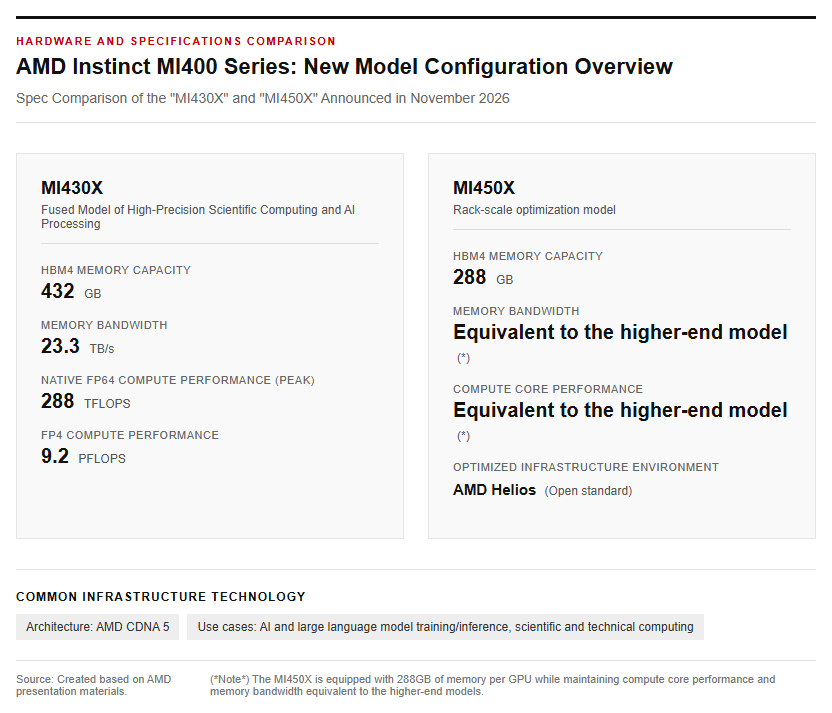
In November 2026, AMD announced enhancements to its “AMD Instinct MI400” series of GPUs for AI and high-performance computing (HPC), adding the new “MI430X” and “MI450X” models to its lineup. This announcement responds to the rapidly growing processing demands of large language model training and inference, as well as advanced scientific simulations. The MI430X is designed for the convergence of high-precision scientific computing and AI processing, and is built upon the AMD CDNA 5 architecture. It features a peak performance of up to 288 TFLOPS in native FP64 operations, combined with 432 GB of HBM4 memory boasting a high bandwidth of 23.3 TB/s and 9.2 PFLOPS of FP4 computation performance. Meanwhile, the MI450X is optimized for operation within “AMD Helios,” an open-standard rack-scale architecture for data centers, equipping 288 GB of HBM4 memory per GPU while maintaining compute core performance and memory bandwidth equivalent to the higher-end model. The expanded range of model deployment options enables flexible responses to users’ diverse infrastructure requirements. An overview of the product architecture is shown in the figure below.
The Innovation in Compute Performance Brought by the CDNA 5 Architecture
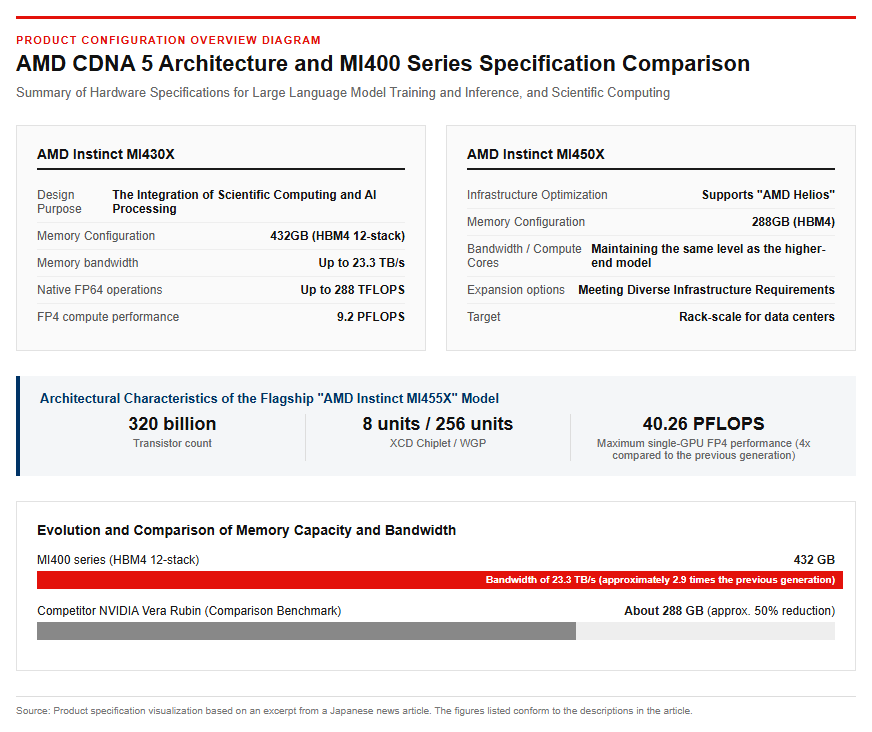
The AMD CDNA 5 architecture dramatically improves processing throughput by fundamentally revamping the conventional approach. As its main component, the AMD Instinct MI455X GPU is equipped with eight Accelerator Complex Die (XCD) chiplets and 256 active Work Group Processors (WGPs), consisting of 320 billion transistors. Compared to the previous-generation MI355X, peak FLOPS for MXFP4 and MXFP8—the microscale data formats of the Open Compute Project—have quadrupled, achieving up to 40.26 PFLOPS of FP4 computing performance on a single GPU. Furthermore, the transition from the traditional Wave64 structure to a Wave32 structure has significantly reduced penalties from instruction execution latency and branch divergence, as well as register pressure. In addition to native support for BF16 vector types, it achieves extremely high execution efficiency in both AI training and inference by, for example, doubling the processing throughput for transcendental functions (such as tanh) that are essential for calculating Softmax and activation functions.
Technology Foundation of the Memory Subsystem and Rack-Scale “Helios”
Overwhelming Memory Bandwidth Enabled by HBM4 12-Stack Configuration
As AI models have grown larger, memory capacity and memory bandwidth have become severe bottlenecks in conventional computing infrastructure. To address this challenge, the MI400 series significantly enhances its memory subsystem, moving from the previous generation’s HBM3E 8-stack configuration to the latest HBM4 12-stack configuration. As a result, the memory capacity of a single GPU has expanded from 288GB to 432GB, and the memory bandwidth reaches up to 23.3 TB/s, which is approximately 2.9 times that of the previous generation. This large-capacity 432GB HBM4 memory is about 50% greater than the memory capacity of competing NVIDIA Vera Rubin systems. In inference processing for models with long context windows, this enables data to reside entirely within a single GPU memory space for processing, without the need to split and distribute it across multiple nodes or networks. Furthermore, the combination of high-density native computation and large-capacity memory suppresses memory access overhead, significantly improving continuous response performance in long-duration inference tasks. The following diagram illustrates the structure of the memory arrangement.
The Overwhelming Scalability of the 72-Unit Integrated Pod “AMD Helios”
Going beyond merely improving single-GPU performance, “AMD Helios” has been introduced as an infrastructure that drives vertical integration across the entire rack scale. Helios is a large-scale rack system adopting the OCP (Open Compute Platform) “Open Rack Wide (ORW)” standard (1.2m wide, 44 OU high). It integrates 72 AMD Instinct MI455X GPUs and 18 6th Generation AMD EPYC 9006 SP7 CPUs (up to 256 cores/512 threads) based on the Zen 6 microarchitecture within a single rack. The GPUs are connected via UALoE (Ultra Accelerator Link over Ethernet) technology with a bidirectional scale-up bandwidth of 3.6 TB/s across 36 links, enabling the 72 GPUs to operate as a combined 31 TB shared memory pod. As a result, it achieves unprecedented scalability—up to 2.9 ExaFLOPS of FP4 AI compute performance and 1.7 PB/s of memory bandwidth in a single rack—providing an open standard blueprint for building gigawatt-scale mega data centers.
ROCm.ai and Future Focal Points in Ecosystem Expansion
“ROCm.ai”: A Software Environment Optimized for AI Agents
In parallel with hardware evolution, the optimization of the software environment is also advancing rapidly. At “Advancing AI 2026” held in July 2026, AMD announced its next-generation software stack extension, “ROCm.ai.” This is in response to the rise of “Agentic AI,” which performs multi-step trial-and-error and external tool calls. Agentic processing previously suffered from the issue where GPU memory (KV cache) was discarded and recalculated due to wait times during tool calls, but the newly introduced “SAGA” scheduling analyzes execution graphs to achieve cache retention and speculative prefetching. This has successfully reduced task completion time by approximately 1.64x and improved GPU memory utilization by 1.22x. Furthermore, by providing “AMD Skills,” which directly integrates AMD’s optimization know-how into major AI coding tools such as Claude and Cursor, and the automated optimization engine “Hyperloom,” AMD has established an environment where developers can push hardware characteristics to their limits simply by giving instructions in natural language. Please refer to the configuration diagram below.
Adoption by Major Cloud Providers and AI Labs and Its Market Impact
The advent of the AMD Instinct MI400 series and the Helios platform is bringing a definite shift to the competitive landscape of the AI semiconductor market, where NVIDIA has long maintained undisputed dominance. Of particular note is a major strategic partnership with cutting-edge AI lab Anthropic, resulting in an agreement to deploy MI455X GPUs equivalent to 2 gigawatts (GW) alongside an investment of up to $5 billion. Furthermore, major hyperscalers such as OpenAI, Microsoft Azure, Meta Platforms, and Oracle have also begun initial deployments of the Helios system, with full-scale operational rollout scheduled from the fourth quarter of 2026 through 2027. With the expansion of agentic AI, processing bottlenecks are shifting from mere GPU computing power to CPU integration, memory capacity, and network bandwidth. Featuring open standards, high-density memory, and a vertically integrated software environment, the MI400 series is emerging as a powerful option for companies seeking to mitigate their reliance on a specific vendor.
Reference page
- 【AMD Advances Instinct MI400 Series Press Release】https://newsroom.amd.com/news/amd-advances-instinct-mi400-series-ai-scientific-computing/
- 【AMD Delivers Full-Stack Compute for the Agentic AI Era Press Release】https://ir.amd.com/news-events/press-releases/detail/1294/aai-2026-amd-delivers-full-stack-compute-for-the-agentic-ai-era
- [SAGA: Workflow-Atomic Scheduling for AI Agent Inference on GPU Clusters – arXiv] https://arxiv.org/abs/2504.07347
【#AMD #InstinctMI400 #GPU #CDNA5 #Helios #ROCm #AIAgents #Semiconductors】


コメント