Seven local subsidiaries of Japan Tobacco Inc. (JT) in Russia have been placed under clearContext the temporary management of the Russian government, prompting JT to record an extraordinary loss of 1.377 trillion yen and decide to remove them from its scope of consolidation. This background involves the de facto seizure of foreign corporate assets amid sanctions against Russia following its invasion of Ukraine and the cooling of Japan-Russia relations.
- The Shock of Temporary Administration Tantamount to Asset Seizure and the Japanese Government’s Immediate Protest
- Stock price limit-down and management disciplinary action: Clarification of responsibility associated with the 1.37 trillion yen extraordinary loss
- The Financial Impact of the Downward Revision to a Net Loss of 724 Billion Yen and the Halving of the Year-End Dividend
- S&P’s Credit Rating Maintenance and Financial Capacity After Excluding Russian Business
- The Danon-Carlsberg Precedent and Tightening Russian Exit Rules
- Structural Differences from the Sakhalin Projects and Key Points to Watch in Future Japan-Russia Negotiations
The Shock of Temporary Administration Tantamount to Asset Seizure and the Japanese Government’s Immediate Protest
On November 5 and 6, 2026, Russian President Vladimir Putin signed a presidential decree placing all seven local entities owned by Japan Tobacco Inc. (JT)’s overseas subsidiary within Russia under the temporary management of Russian companies. The affected entities include LLC Petro, a finished-goods manufacturer with 1,042 employees, JTI Donskoy Tabak, and LLC JTI Russia, which handles sales. While ownership itself remains with JT, management rights such as executive appointments and fund management have been transferred to Russian administrators, resulting in the loss of substantive control. Based on IFRS, JT excluded these seven companies from its scope of consolidation as of November 6. In response, Japanese Finance Minister Katayama, Chief Cabinet Secretary Kihara, Economy, Trade and Industry Minister Akazawa, and others successively lodged strong protests with the Russian side through diplomatic channels, demanding the immediate withdrawal of the measures. The Japanese government is the largest shareholder, holding 33.34% of JT’s shares, and views this as an extremely serious situation concerning both national security and the national treasury. As shown in the diagram below, the impact on JT’s global supply chain is immense.
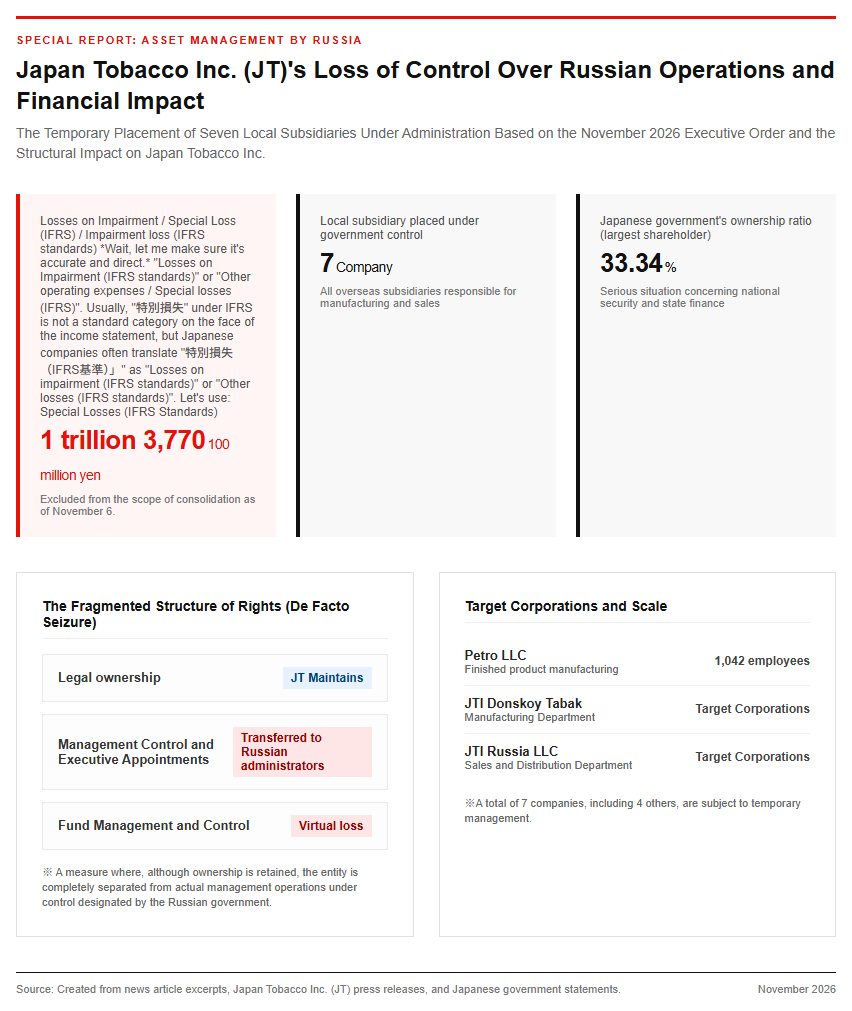
- Target legal entities: A total of 7 companies, including LLC JTI Russia, LLC Petro, JTI Donskoy Tabak, JTI Elets, and Cres Neva.
- Japanese government response: Protested to the Russian government through diplomatic channels and demanded the immediate withdrawal of the temporary administration measures.
Stock price limit-down and management disciplinary action: Clarification of responsibility associated with the 1.37 trillion yen extraordinary loss
Immediately following the announcement of the executive order, a flood of sell orders hit the stock market. On November 6, 2026, on the Tokyo Stock Exchange, JT shares hit their daily downward limit (stop-loss) with a plunge of 1,500 yen (19.3%) from the previous day to close at 6,269 yen, dropping sharply from the record-high of 7,769 yen set just the day before. On the Proprietary Trading System (PTS), selling pressure also briefly dominated, significantly falling below the reference price. On November 19, 2026, JT announced that it would record approximately 1.377 trillion yen as a loss on loss of control (extraordinary loss). In response, to clarify management responsibility, the company decided on disciplinary measures including a 50% reduction in the monthly base compensation of top executives—including the Chairman of the Board and Representative Directors—for a period of two months, and the complete withholding of executive bonuses for Representative Directors for the fiscal year 2026. Because the Russian market accounted for 13.7% of JT’s total cigarette shipment volume (59.9 billion cigarettes from January to September 2026), surpassing the domestic Japanese market of 46.4 billion cigarettes as a primary revenue generator, market turbulence was unavoidable.
- Stock price trend: From a record high of 7,769 yen on November 5, it hit a daily limit down (a 19.3% drop) to 6,269 yen on November 6.
- Executive disciplinary action: 50% reduction in monthly compensation for the Chairman, Vice Chairman, and Representative Director (for 2 months) and non-payment of performance-based bonuses for the Representative Director
Massive Deficit and Dividend Cut Shock: JT’s Financial Impact and Credit Ratings
The Financial Impact of the Downward Revision to a Net Loss of 724 Billion Yen and the Halving of the Year-End Dividend
The revision to JT’s consolidated financial forecasts for the full year ending December 2026 came as a major shock to individual investors and market participants. In a dramatic reversal from the previous full-year net profit forecast of 662 billion yen, it was downgraded by 1.386 trillion yen to a net loss of 724 billion yen. Operating performance also plummeted from a projected operating profit of 1.041 trillion yen to an operating loss of 368 billion yen. This significant deterioration in business performance forced a review of the shareholder return policy. The year-end dividend, previously planned at 136 yen, was halved to 68 yen, and the annual dividend was revised to 204 yen (a 25% dividend cut), falling well below the previous fiscal year’s 234 yen and the pre-revision forecast of 272 yen. A decrease in dividend income for the Japanese government, its largest shareholder, is unavoidable, dealing a direct blow to state revenues as well. With approximately 1.5 trillion yen in assets and about 200 billion yen in liabilities of its local Russian subsidiary deconsolidated from the balance sheet, JT’s earnings structure is forced into a fundamental restructuring. The following graph illustrates the changes in financial indicators.
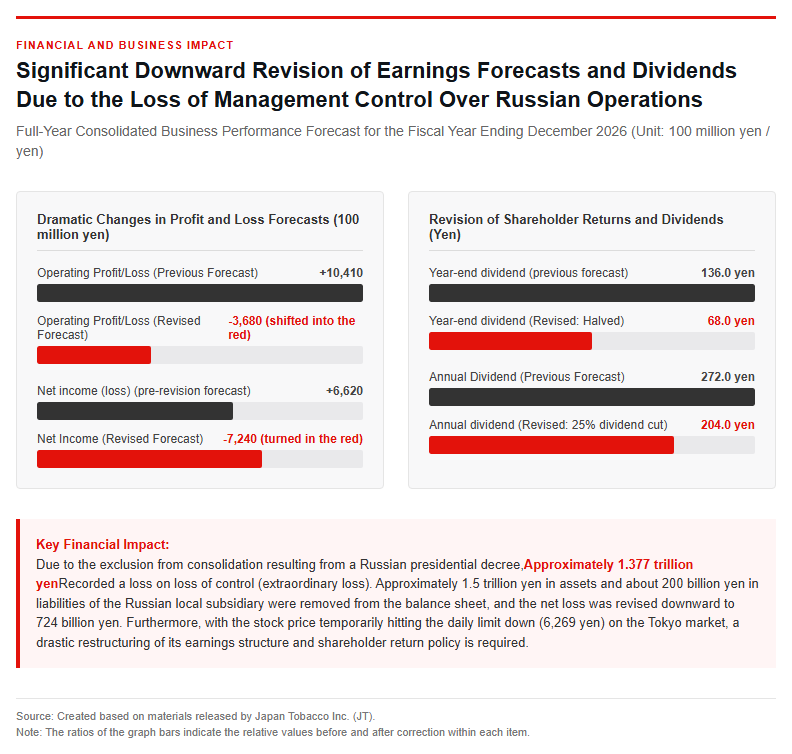
- Revenue Forecast: Reduced from 3.903 trillion yen to 3.84 trillion yen (a decrease of 63 billion yen)
- Annual dividend: Revised from a forecast of 272 yen to 204 yen (year-end dividend halved from 136 yen to 68 yen)
S&P’s Credit Rating Maintenance and Financial Capacity After Excluding Russian Business
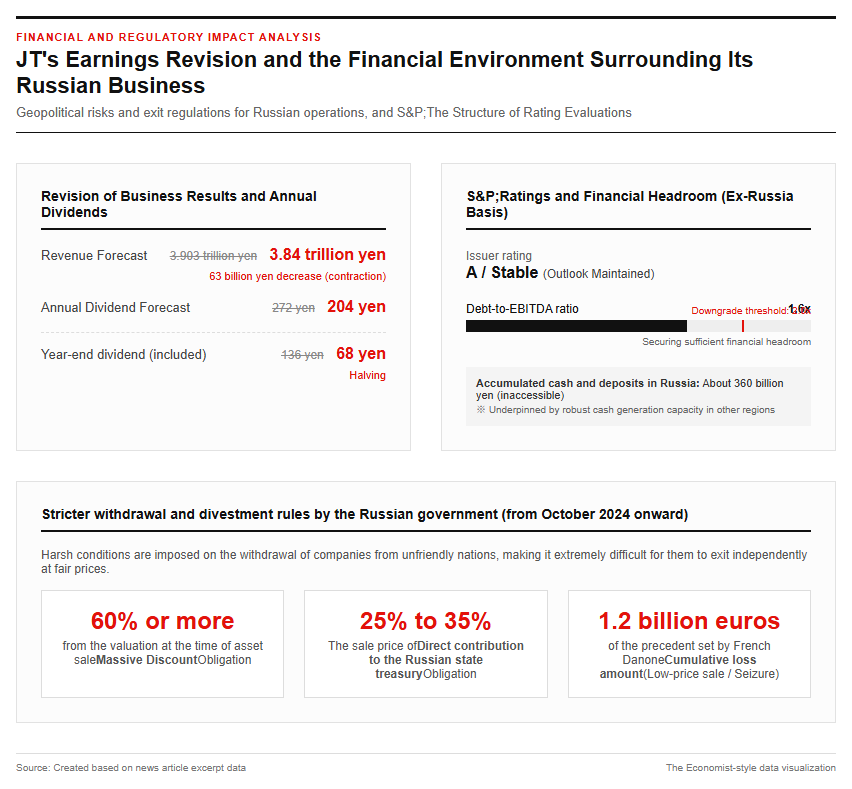
Despite recording massive accounting losses, major rating agency S&P Global Ratings announced on November 9, 2026, that it expects to maintain JT’s issuer credit rating at “A/Stable.” S&P pointed out that since the 2022 invasion of Ukraine, cash equivalent to approximately 25% of the adjusted operating income generated by its Russian operations has been difficult to remit abroad, explaining that geopolitical risks had already been factored into the rating. Furthermore, regarding the debt-to-EBITDA ratio—a key financial metric—it analyzed that even when calculated on a basis excluding the Russian business, the ratio remains at around 1.6x, leaving sufficient financial headroom against the 2.0x threshold typically considered for a downgrade. Although access to approximately 360 billion yen in cash and deposits remaining in Russia (as of the end of September 2026) has become impossible, strong cash-generating power in other regions will provide support, and a breakdown in creditworthiness is expected to be avoided.
- S&P Ratings: Affirms Issuer Credit Rating at “A/Stable”, Evaluates Geopolitical Risks as Already Factorized
- Financial indicators: The net debt-to-EBITDA ratio excluding the Russian business is approximately 1.6x, maintaining a level below the rating downgrade threshold (2.0x).
Risks Plaguing Foreign Companies and Future Outlook: The Barrier of Exit Rules and Japan-Russia Relations
The Danon-Carlsberg Precedent and Tightening Russian Exit Rules
The Russian government’s temporary management measures over foreign corporate assets have been implemented successively, focusing mainly on Western companies, since the issuance of Presidential Decree No. 302 in April 2023. In July 2023, French food giant Danone and Danish beer giant Carlsberg (its local subsidiary Baltika) were placed under temporary management, and after having their management teams replaced with Russian appointees, they were forced to sell their businesses to local companies at drastically low prices. Danone has suffered a cumulative loss of 1.2 billion euros. The Russian government has been tightening the withdrawal rules for companies from unfriendly nations year by year. Since October 2024, asset sales have required a steep discount of over 60% from the appraised value, as well as a mandatory direct contribution of 25% to 35% of the sale proceeds to the Russian state treasury. Due to such harsh conditions and the risk of expropriation, remaining companies, including JT, face an extremely difficult environment in achieving a voluntary withdrawal at fair prices.
- Precedent of Danone and Carlsberg: Management Replaced After Seizure, Sale Completed at Heavily Discounted Prices
- Russia’s Exit Regulations: A 60% or Greater Discount from the Appraised Value and a 25–35% Contribution of Sale Proceeds to the State Budget
Structural Differences from the Sakhalin Projects and Key Points to Watch in Future Japan-Russia Negotiations
For the energy interests “Sakhalin-1” and “Sakhalin-2”, whose operating companies were replaced by a Russian presidential decree in 2022, Mitsui & Co., Mitsubishi Corporation, and Sakhalin Oil and Gas Development Co. (SODECO) were permitted to join the new companies and retain their stakes. This was because Japan’s energy security needs aligned with Russia’s economic interests. However, because the tobacco business involves private consumer goods and the Russian government has little need to retain Japanese companies, it remains unclear whether it will reach a resolution similar to Sakhalin. In the background lie political pressure on Japan for participating in sanctions and intensifying confrontation. Moving forward, a range of scenarios is feared, from the Japanese government’s diplomatic negotiations leading to a return in about 11 months—akin to Italy’s Ariston—to prolonged external administration or being forced into a bargain-basement sale. Future negotiations and the spillover effects on other companies will be closely watched.
- Difference from the Sakhalin Project: Lacking Indispensability for Energy Security, Return Negotiations Expected to Be Difficult
- Future scenarios: 3 patterns including return through diplomatic negotiations, prolonged temporary administration, and forced low-cost sale to Russian companies
Reference Page
- [Japan Tobacco Inc. (JT): Consolidated Financial Results for the Third Quarter of the Fiscal Year Ending December 31, 2026 [IFRS]] https://www.jt.com/investors/results/forecast/pdf/2026/Third_Quarter/20261029_04.pdf
- [Official Internet Portal of Legal Information of the Russian Federation (Presidential Decree, November 5, 2026)] http://publication.pravo.gov.ru/document/0001202611050002
【#JT #RussianSanctions #GeopoliticalRisk #ExtraordinaryLoss #StockInvestment #JapaneseEconomy #AssetConfiscation】

コメント