
Customer information for up to approximately 15.72 million accounts was leaked externally at Rakuten Securities, and the Financial Services Agency has issued an order for report submission based on the Financial Instruments and Exchange Act. The background behind this incident includes operational issues, such as placing production data into an internal system’s test environment without masking, as well as unauthorized access that exploited vulnerabilities.
- Detection of Unauthorized Access and the Full Picture of the 15.72 Million Account Leak
- Issuance of Orders for the Submission of Reports by the Financial Services Agency and the Positioning of Supervisory Guidelines
- Why did raw customer data exist in the test environment?
- Comparative Analysis with Unauthorized Access Incidents in the Securities Industry
- Asset Leakage Concerns and Defenses Against Opportunistic Scams and Phishing
- Security Reassessment and Future Outlook in the Securities Industry
Detection of Unauthorized Access and the Full Picture of the 15.72 Million Account Leak
On November 17, 2026, Rakuten Securities announced that it had suffered unauthorized access by a third party, potentially resulting in the leakage of personal information for a maximum of approximately 15.72 million accounts to the outside. Although the unauthorized access itself was detected and blocked on November 16, the actual data leak is believed to have occurred in an internal test environment on November 11. The affected data includes not only current account holders but also the data of customers who have already closed their accounts, making it one of the largest-scale information leaks for securities accounts in Japan. The diagram below shows the classification of the leaked information and the configuration for damage prevention.
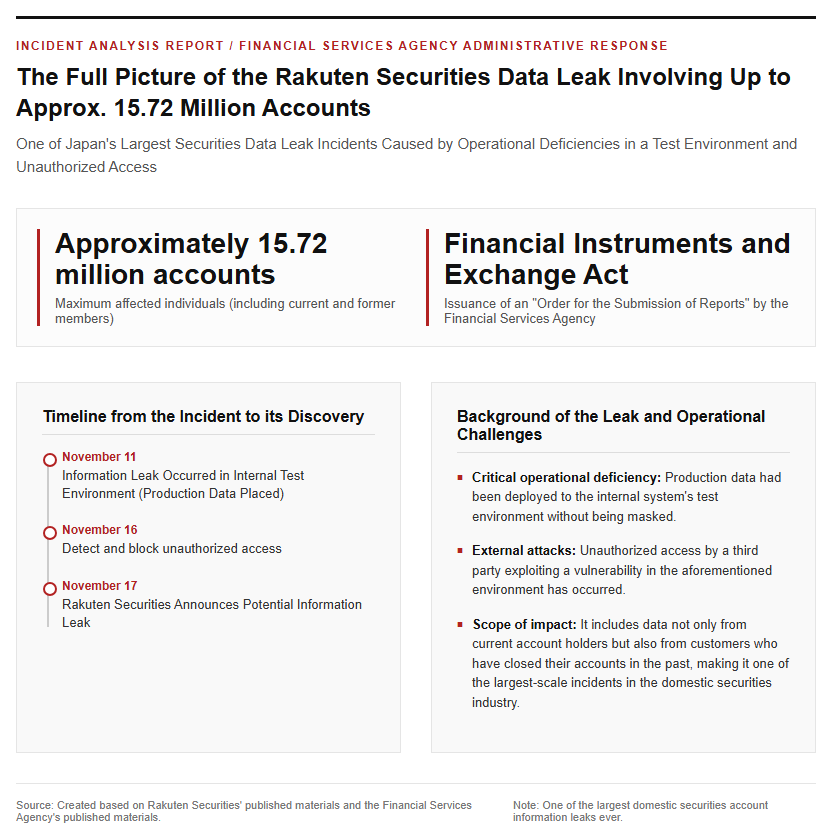
The leaked information is broadly divided into two groups. The first group covers a maximum of approximately 4.47 million accounts and includes extremely detailed data such as names, phonetic names, dates of birth, addresses, phone numbers, email addresses, employers, account numbers and account holders of withdrawal financial institutions, self-reported annual income and financial assets, and asset information by product. The second group covers a maximum of approximately 11.25 million accounts, targeting branch and customer codes as well as login IDs (securities-specific IDs separate from Rakuten IDs). Meanwhile, login passwords, transaction PINs, and My Number numbers were not included in the test environment, and no leaks have been confirmed. Furthermore, no unauthorized transactions or unauthorized withdrawal damages resulting from this incident have been confirmed at this time.
Issuance of Orders for the Submission of Reports by the Financial Services Agency and the Positioning of Supervisory Guidelines
Given the severity of the situation, on November 19, 2026, the Financial Services Agency (FSA) issued an order for the submission of a report to Rakuten Securities pursuant to Article 56-2, Paragraph 1 of the Financial Instruments and Exchange Act and the Act on the Protection of Personal Information. A senior FSA official took the massive scale of the leak and the inclusion of critical information—such as annual income and withdrawal destination account details—very seriously, ordering a full clarification of the facts, an analysis of the causes, and the reporting of effective preventative measures. Rakuten Securities also announced its receipt of the order on the same day, releasing a statement that it will make every effort to investigate the causes and rebuild its security framework.
The Comprehensive Guidelines for Financial Instruments Business Operators, etc., establishedby the Financial Services Agency (FSA), as well as guidelines on cybersecurity in the financial sector, mandate the strict management of customer information (thorough enforcement of the “need-to-know” principle, restriction of access privileges, and encryption/masking) and the establishment of a system risk management framework. In particular, robust defense measures to prevent information leaks are required regarding the handling of customer data during system modifications and updates, as well as at external contractors and in test environments. While this recent order for the submission of reports is positioned as a preliminary step prior to administrative actions (such as a business improvement order), it has the potential to develop into more resolute administrative responses depending on the content of the reports submitted in the future.
Deploying Production Data to Test Environments and Security Challenges
Why did raw customer data exist in the test environment?
The central focus of this information leak is the fact that raw customer data was placed not in the production environment, but in a test environment used for verification. According to an explanation by Rakuten Securities, in conjunction with an internal system upgrade, customer information from the production environment was copied to a test server for a certain period to conduct verification for the purpose of checking the operation of specific functions. Although it is a security golden rule to either use dummy data in test environments or apply masking procedures to obscure names and account numbers, unmasked production data was placed there this time as an exceptional measure.
The company explains that the operation was conducted through official internal procedures rather than the arbitrary decision of a single person, but it allowed third-party intrusion by exposing security vulnerabilities. External experts and analysts have repeatedly issued severe criticisms, stating that placing personally identifiable confidential information directly in a test environment goes against the principles of risk management. This effectively left unprotected customer data outside the robust defensive walls of the production environment, exposing a gap between system operations and compliance structures.
Comparative Analysis with Unauthorized Access Incidents in the Securities Industry
The autumn of 2026 was a period marked by a succession of unauthorized access incidents coming to light at major securities firms. On October 5, 2026, Daiwa Securities announced that an inquiry management system operated by an external contractor had been attacked, with a potential information leak affecting approximately 110,000 individuals, and on November 13, Monex Securities announced concerns regarding data leaks—including identity verification document images (approximately 1,592 items)—from an external contractor’s account opening system. The figure below compares the differences in the causes of the data leaks and the associated risks for each securities company.
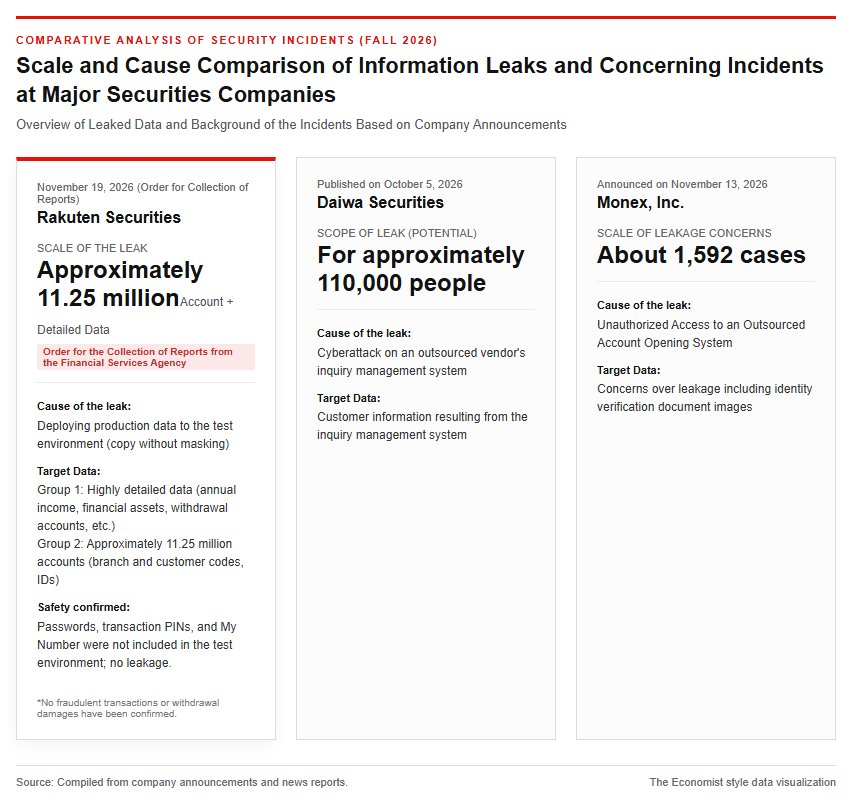
While Daiwa Securities and Monex Securities experienced incidents originating from third-party contractor systems, Rakuten Securities differed significantly in that the vulnerability lay within its own internal operational and management framework, specifically its testing environment. While contractor-induced incidents often limit the impact to users of specific services, incidents originating from a company’s own systems affect all customer segments, including former users who have closed their accounts. In the stock market, while the share prices of parent company Rakuten Group and Rakuten Bank plummeted, cybersecurity-related stocks saw broad gains as demand grew for a comprehensive review of security across the entire financial infrastructure.
The Risk of Secondary Damage to Users and Future Developments for the Industry as a Whole
Asset Leakage Concerns and Defenses Against Opportunistic Scams and Phishing
In this incident, since login passwords and PINs have not been leaked, the immediate risk of assets in securities accounts being fraudulently transferred is low. However, the greatest point of concern is sophisticated secondary harm (such as phishing scams and voice phishing) that exploits the leaked information, which includes names, annual income, employers, and the last 4 digits of withdrawal accounts. There is concern over tactics where attackers present genuine customer information while posing as part of “apology money or compensation procedures” or “identity verification for unauthorized access countermeasures,” attempting to extract passwords and PINs via phone calls or fake websites. Misinformation using past compensation screens is also spreading on social media, requiring caution.
Specific defensive measures that users should take include the following:
– Never open links included in emails or SMS messages; instead, log in through official apps or bookmarks.
– Setting up phishing-resistant passkey authentication (FIDO2) using biometric authentication
– If you do not trade regularly, enable “Transaction suspension (suspending everything except mutual fund purchases)” from the security settings.
– If you are reusing the same password as other services, change it to a random string immediately.
Rakuten Securities has a clear policy of not including URLs in the body of emails, and users are urged to strictly refrain from responding to suspicious communications.
Security Reassessment and Future Outlook in the Securities Industry
This recent incident involving the leak of 15.72 million accounts goes beyond a scandal at a single company, serving as a major wake-up call regarding the security management posture of Japan’s financial and IT infrastructure as a whole. After closely examining the content of the report submitted pursuant to the order for report submission, the Financial Services Agency is expected to consider disciplinary measures such as business improvement orders as necessary. Furthermore, attention will also be focused on future legal developments and discussions surrounding damages and compensation, including trends in investigations and guidance by the Personal Information Protection Commission, as well as movements toward class-action lawsuits by victims and attorneys.
Key points to watch in the future include the review of operational standards for test environments across the financial industry as a whole and the thorough implementation of security by design. It is expected that revisions to the Financial Services Agency’s guidelines and the strengthening of self-regulatory rules by industry organizations (such as the Japan Securities Dealers Association) will progress, with the mandatory anonymization and pseudonymization (masking) of personal data during the development stage and the standardization of risk assessments across the entire supply chain, including third parties, projected to be established. For individual securities companies, how to successfully balance the pursuit of convenience with advanced authentication and security measures will be a key challenge in regaining customer trust.
Reference page
- [Rakuten Securities, Inc.] Regarding the Receipt of an Order for Reports from the Financial Services Agency https://www.rakuten-sec.co.jp/web/company/newsrelease/pdf/press2026111901.pdf
- [Rakuten Securities, Inc.] Apology and Notice Regarding Potential Information Leak of Our Customers https://www.rakuten-sec.co.jp/web/info/info20261117-02.html
- [Financial Services Agency] Guidelines on Cybersecurity in the Financial Sector https://www.fsa.go.jp/
【#RakutenSecurities #FinancialServicesAgency #DataBreach #Cybersecurity #PrivacyProtection #AntiPhishing #Money】

コメント