
On June 25, 2026, the Japan Fair Trade Commission determined that 29 construction companies in Takamatsu City had repeatedly engaged in organized bid-rigging in civil engineering work commissioned by Kagawa Prefecture. Behind this fraud lie deep-rooted practices of stabilizing management by dividing public works within the industry, and the structural dilemmas faced by the current bidding system.
- The shock of the cease and surcharge order issued in June 2026
- The dark side of 12 billion yen in illicit orders and organized ‘regional division’
- Where did the lessons from 25 years ago go? Most disposal companies are “repeat customers”
- The custom of ‘social interaction’ that even electronic bidding could not prevent.
- Expectations for ‘random coefficients’ that make predicting the minimum price more difficult
- Restoring Community Trust and Impact on Future Nomination Suspension Measures
The shock of the cease and surcharge order issued in June 2026
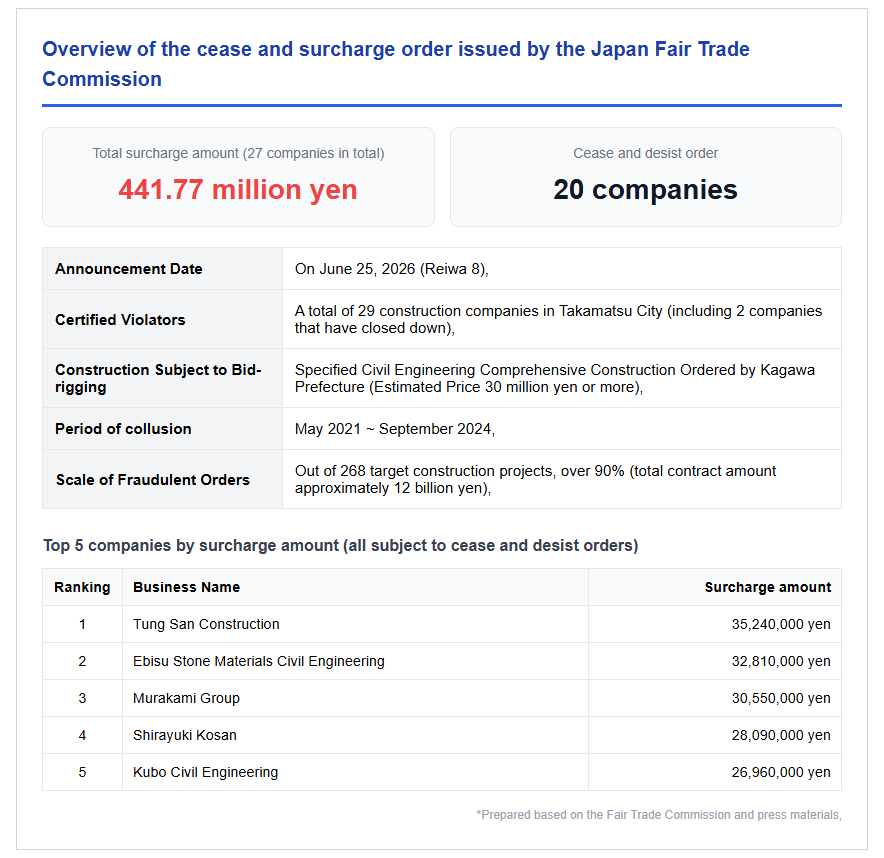
On June 25, 2026, the Shikoku Branch of the Secretariat of the Japan Fair Trade Commission issued an order to pay a total of 441.77 million yen in surcharges against 27 construction companies headquartered in Takamatsu City, for violations of the Antimonopoly Act (unfair trade restrictions) in the bidding for specific general civil engineering works ordered by Kagawa Prefecture,,。 Among these, 20 companies received exclusion orders requiring the cessation of bid-rigging and the formulation of measures to prevent recurrence. This time, 20 companies, including the following companies, have received cease and desist orders.
-
Tosan Construction (surcharge 35.24 million yen: highest amount)
-
Ebisu Stone Materials and Civil Engineering (32.81 million yen)
-
Murakami Group (30.55 million yen)
-
Shirayuki Kosan (28.09 million yen)
-
Kubo Civil Engineering (26.96 million yen)
-
Nozaki Group (26.62 million yen)
Companies that have only received the surcharge payment order include Nakano Construction Kogyo and Aoba Industries. The Fair Trade Commission fully exempted the surcharge for Tsubomi Construction, which voluntarily reported bid-rigging before the on-site inspection, and applied a reduction in the surcharge to nine other companies that cooperated with the investigation. On the other hand, regarding the companies that repeatedly engaged in bid-rigging, Takashi Shimizu, branch director of the Fair Trade Commission, expressed his strong stance, saying, “We deeply regret this and urge them to reflect deeply.” The following figure summarizes the summary of the order announced by the Fair Trade Commission.
The dark side of 12 billion yen in illicit orders and organized ‘regional division’
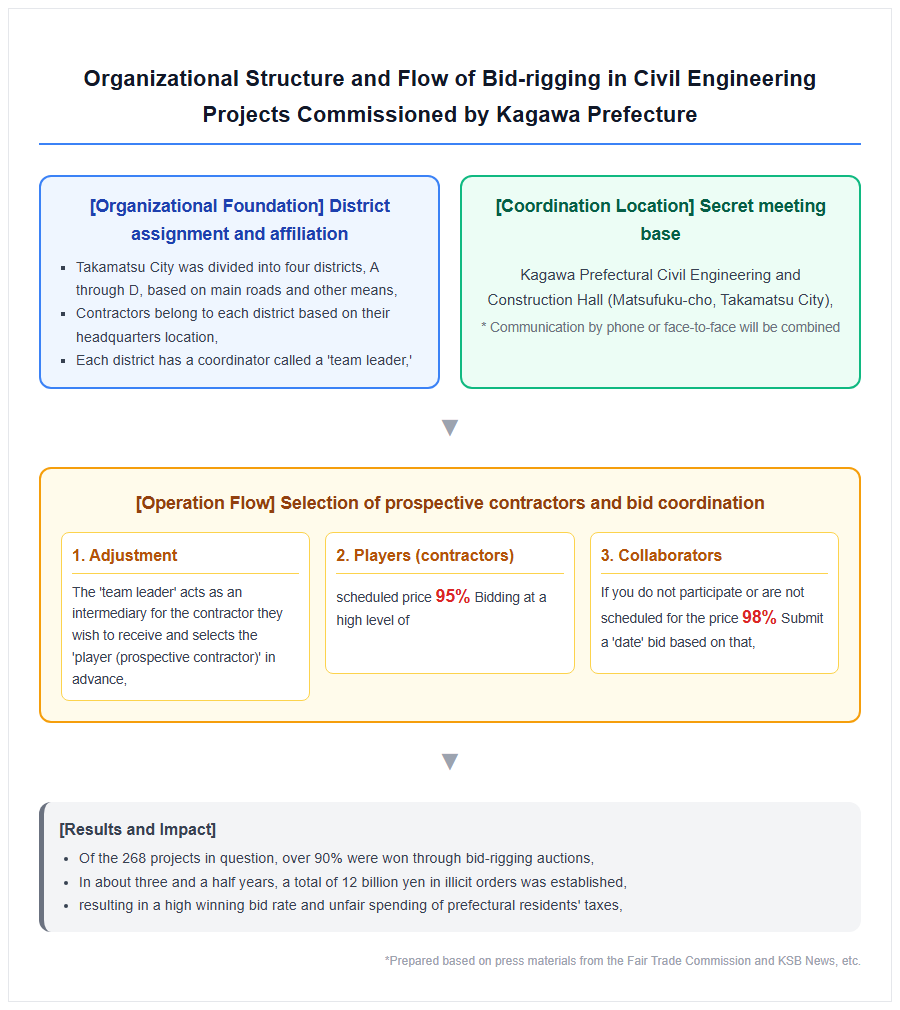
According to a Fair Trade Commission investigation, the 29 certified companies had been systematically engaging in bid-rigging for about three and a half years from May 2021 at the latest until the FTC conducted on-site inspections in September 2024,,。 The targets of bid-rigging were 268 specific general civil engineering projects ordered by Kagawa Prefecture, with an estimated price of 30 million yen or more, and over 90% of these projects were awarded as pre-arranged in advance. The total amount of illicit orders received reached approximately 12 billion yen.
The specific mechanisms of collusion were extremely sophisticated and organized. Takamatsu City was divided into four districts (A to D) based on boundaries such as main roads, and each company belonged to one of the districts depending on the location of its headquarters. Each district had a coordinator called a ‘team leader,’ who coordinated which contractors (players) wanted to receive each construction order. Prospective contractors would bid at a high level of about 95% of the estimated price, while other suppliers either refused to participate or bid at a higher price of about 98% of the planned price, engaging in a ‘transaction’ to ensure their successful bids. It has been confirmed that the bid-rigging meetings were held at places such as the Kagawa Prefectural Civil Engineering and Construction Hall in Takamatsu City. For details on how collusion works, please refer to the diagram below.
Repeated Soil of Fraud and the Formalization of the Bidding System
Where did the lessons from 25 years ago go? Most disposal companies are “repeat customers”
This is not the first time bid-rigging in civil engineering work has occurred in Kagawa Prefecture. In fact, in 2001, large-scale bid-rigging was recognized in public works ordered by Kagawa Prefecture and Takamatsu City, with 159 companies recommended for exclusion and 134 ordered to pay approximately 1 billion yen in surcharges. Surprisingly, among the 29 companies penalized this time, 26 were “repeaters” who had also been penalized for the incident 25 years ago.
The long-standing persistence of bid-rigging lies in the unique circumstances of the local construction industry. In response to the Fair Trade Commission’s questioning, one contractor explained, “Since the previous (2001) disposition, many contractors have gone bankrupt, and the public works budget has decreased. While work has been concentrated among major companies with strong capabilities, it was necessary to share jobs with local small and medium-sized enterprises.” This suggests that the pursuit of illegal profits is not merely a pursuit of illegal gains, but rather a distorted survival strategy of maintaining management through ‘job sharing’ within the local community. However, if the winning bid rate remains high due to collusion, the cost will be covered by taxes paid by the prefectural residents. The Fair Trade Commission takes very seriously the fact that important projects directly linked to the lives and safety of prefectural residents, such as levee development and the construction of new main roads as countermeasures against the Nankai Trough earthquake, have been targeted for bid-rigging and sharply criticizes the lack of industry ethics.
The custom of ‘social interaction’ that even electronic bidding could not prevent.
Following the large-scale bid-rigging in 2001, Kagawa Prefecture introduced an electronic bidding system in 2006 to enhance bidding transparency. The aim was to physically block bidding companies by reducing face-to-face encounters, thereby blocking the chance for collusion, but this incident has exposed the limits of that approach. The vendors continued to coordinate across digital barriers through phone calls and secret meetings in advance.
Additionally, changes to the bidding system itself may have contributed to encouraging bid-rigging against its intended intent. The system shifted from the former “designated competitive bidding” to a “comprehensive evaluation method” that evaluates technical capabilities beyond price. However, this method has the disadvantage of clearly distinguishing between companies that can win orders and those that cannot. A representative of the company that received the cease and desist order told interviews, “We understand that bid-rigging is bad, but distributing orders to more companies to prevent the overall industry downturn is also important.” In this way, institutional improvements to promote competition ironically fueled the sense of crisis among small and medium-sized businesses, and once again led to the so-called ‘mutual aid organizations’ under the name of collusion. The administration also seemed to believe that collusion could be prevented if face-to-face contact disappeared, and it is undeniable that the monitoring system aimed at grasping the actual situation was insufficient.
Future developments and challenges in restoring trust in public procurement
Expectations for ‘random coefficients’ that make predicting the minimum price more difficult
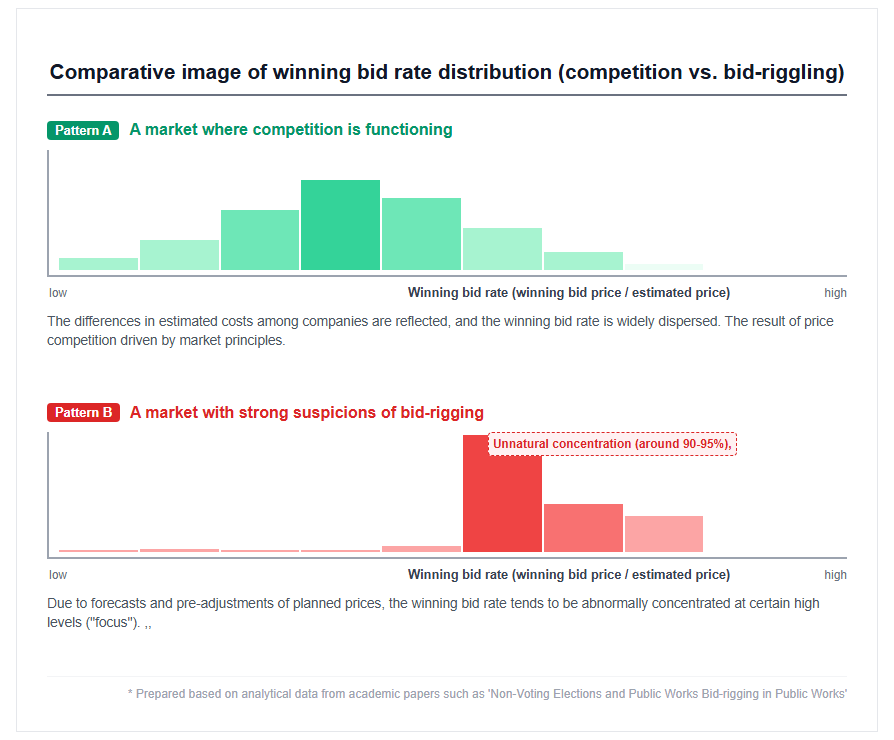
A new technique attracting attention for technically deterring collusion is the introduction of a “random coefficient” in bidding. One major factor in the success of collusion is that the estimated price and minimum limit price can be easily predicted among the dealers. Especially when the formula for calculating the minimum price is publicly available, dealers can make highly accurate forecasts and adjust prices without the risk of failed bids.
In contrast, some municipalities such as Osaka Prefecture have introduced a random coefficient that combines the minimum price limit by a random value. If this system is introduced, dealers will lose the precise minimum price limit, creating the risk that the winner trying to win at a low price will be disqualified, thereby reducing the reliability of bid-riggling. Empirical studies show that the introduction of random coefficients lowered the winning bid rate by about 4.7% on average, which is expected to promote competitive price formation. In Kagawa Prefecture as well, in addition to the traditional hardware measures such as electronic bidding and comprehensive evaluation methods, it is time to consider nationwide improvements to the software systems that make price forecasting difficult. The following diagram illustrates the distribution of winning bid rates in general bidding and the differences in situations where collusion is suspected.
Restoring Community Trust and Impact on Future Nomination Suspension Measures
In response to this incident, Kagawa Prefecture Governor Toyohito Ikeda strongly condemned it, saying, “Bid-rigging in public works not only harms the client but also undermines the trust of the residents. It must never happen.” The prefecture will promptly suspend the designation of the sanctioned contractor and is considering claiming compensation equivalent to 20% of the contract amount. However, while strict disciplinary measures are being enforced, the prefectural administration is required to navigate difficult paths.
It is said that about 30 companies in Takamatsu City could win contracts for construction projects of the same scale as those ordered by the prefecture, and 29 of them, the majority, were involved in bid-riggling. If these contractors are subject to a long-term nomination suspension of one to two years, there will be a shortage of contractors responsible for urgent public works such as countermeasures against the Nankai Trough earthquake, leading to repeated delays in construction and poor bidding. Administration faces the dual challenge of strict punishment based on law and steady execution of public works. Going forward, thorough compliance with laws and regulations through related organizations will be demanded from local businesses, and fundamental reforms of the bidding system to break the closed, collusive collusion structure unique to the “Yoriai society” will be re-examined.
[#香川県 #談合 #公正取引委員会 #公共工事 #独占禁止法 #高松市 #行政ニュース #南海トラフ対策]


コメント