On June 26, 2026, DeepReinforce released the open-source LLM family “Ornith-1.0,” which specializes in agents and coding. The background is the intensifying development competition aimed at achieving performance comparable to commercial closed models in specific specialized fields with open weight. ,
- Three different sizes and usage scenarios
- The vast context of 262K tokens and quantization support
- Outstanding generalization performance in Japanese environments
- A New Design Philosophy of Self-scaffolding
- Technical Lineage by a Reinforcement Learning Specialist Team
- The role of “blocks” that reveal thought processes
- Outstanding Achievements in SWE-Bench
- Efficiency and cost performance of the 35B class
- Solving the shortage of programmers and SEs: ‘Agent aptitude’
- Countermeasures to Chinese OSS Models and Their Geopolitical Significance
- Software Development Transformed by Autonomous Agents
Three different sizes and usage scenarios
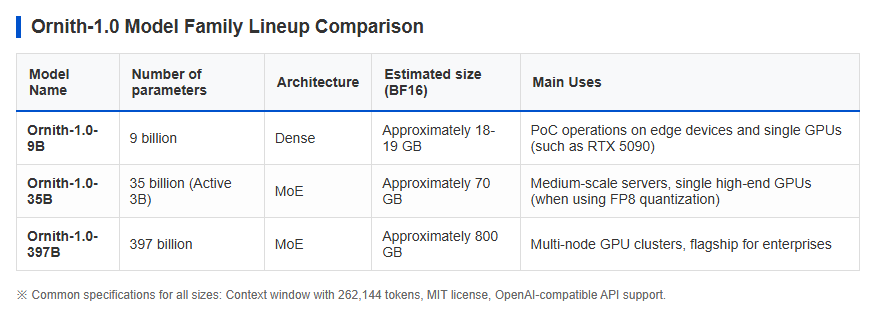
Ornith-1.0 is the latest family of LLMs specialized in agent-based tasks and coding, released by DeepReinforce on June 26, 2026. This model is available in three different sizes so users can choose according to their hardware environment and usage. First, the 9B (9 billion parameters) Dense model features a lightweight design that can run on a single 80GB GPU or the latest RTX 5090 (32GB VRAM), making it an ideal “edge/standalone machine” option for individual developers and small businesses running PoCs. Next, the 35B (35 billion parameters) Mixture-of-Experts (MoE) model achieves practical inference speeds (over 37.5 tok/s) in medium-sized server environments by keeping the activation parameter during inference to about 3B. The flagship 397B (397 billion parameters) MoE model assumes multi-node GPU cluster operation and delivers top-tier intelligence. All these models are provided under the MIT license, with no restrictions on commercial use, modification, or redistribution, which significantly lowers the barriers to adoption for companies. Please refer to the diagram below.
The vast context of 262K tokens and quantization support
One of the major features of the Ornith-1.0 family is its standard support for a vast context window of 262,144 tokens (about 262K) across all sizes. This enables refactoring by loading entire repositories of thousands of lines of source code at once, as well as complex agent-based tasks that refer to vast amounts of technical documentation. Additionally, to maximize operational efficiency, the latest quantized versions such as FP8 and GGUF formats are also available simultaneously. In particular, the FP8 version of the 35B model runs on about 36GB of VRAM, allowing it to handle long text contexts while maintaining high performance even in standalone GPU environments like the DGX Spark. For inference engines, vLLM 0.19.1 or later and SGLang 0.5.9 or later are recommended, making integration into existing OpenAI-compatible API environments easier. In this way, the design that balances advanced inference capabilities with operational flexibility embodies the key concerns for AI development in mid-2026: “compactness, speed, and agent compatibility.”
Outstanding generalization performance in Japanese environments
Ornith-1.0 was initially spotlighted as a model specialized for agent tasks, mainly in English, but independent testing of the actual device revealed that it also possesses remarkable capabilities in Japanese language performance. In the Japanese free writing evaluation metric “ELYZA-tasks-100,” the Ornith-1.0 9B model recorded an average score of 3.89, surpassing existing competing models that claim to enhance Japanese (such as Nemotron 9B-v2-Japanese and Qwen 3.6-35B) and topping the five tested models. Furthermore, in the “JCommonsenseQA v1.1,” which tests common Japanese knowledge, it achieved a 93.0% correct answer rate, showing results comparable to or even better than the Japanese-specialized model. This is attributed to the fact that the base models Qwen 3.5 and Gemma 4 learned abundant Japanese data during the pre-training phase, and even after DeepReinforce’s proprietary reinforcement learning (RL) process, their language proficiency was not compromised; rather, the deepening of the thought process improved the quality of output. This has established us as the “strongest open-source model for on-site local operations” even in domestic manufacturing and SI projects where precise instructions in Japanese are essential.
Innovative architecture supporting self-improvement
A New Design Philosophy of Self-scaffolding
The biggest and most distinctive technical feature of Ornith-1.0 is its “Self-scaffolding” design, which uses reinforcement learning (RL) to optimize not only the “solution rollout” but also the “scaffolding” itself that derives the solution. While traditional large language models are simply trained to output appropriate answers to inputs, Ornith learns the entire reasoning process of “how to break down problems, which tools to use, when, and in what order” within the model’s weight. This means the model itself continuously improves itself by constructing procedures and assumptions generated by agents when performing tasks. This approach allows the model to fully utilize its “strategic intelligence” when running on external agent frameworks such as OpenHands, Hermes Agent, or OpenClaw, reaching the correct answer with fewer attempts. This truly represents a new paradigm where AI has evolved from a mere tool into a “strategist who masters its own tools.”
Technical Lineage by a Reinforcement Learning Specialist Team
DeepReinforce, the developer of Ornith-1.0, is an elite research organization that originally applied reinforcement learning (RL) to optimize GPU kernels and accelerate matrix operations. In the past, they have launched projects such as “CUDA-L1,” which achieved an average speed of 3.12 times faster across 250 real GPU tasks, and “CUDA-L2,” which synthesizes an HGEMM kernel with performance surpassing cuBLAS. Additionally, at MLSys 2026’s NVIDIA Track, they announced “IterX,” which dramatically streamlines inference on H100 and B200 GPUs, demonstrating a global presence in hardware-level optimization. Ornith-1.0 is the latest culmination of their consistent technical know-how of “driving reinforcement learning into real-world problems” into the highly abstract realm of LLM self-improvement. Thanks to this powerful RL technology background, Ornith can achieve “intelligence density” comparable to closed super-large models for specific tasks without making the model size unreasonably large.
The role of “blocks” that reveal thought processes
Ornith-1.0 describes the internal logical deliberation process during inference as “
World-class performance proven by benchmarks
Outstanding Achievements in SWE-Bench
The most straightforward indicator of Ornith-1.0’s capabilities is the de facto standard for measuring practical software engineering capabilities, the “SWE-Bench Verified” score. The flagship 397B model recorded an extremely high accuracy rate of 82.4%, and despite being an open-source model, it has announced results that surpass the top-tier Claude Opus 4.7 (80.8%) as of 2026. Furthermore, in the more challenging “SWE-Bench Pro,” it reached 62.2%, which ranks among OSS (SOTA (State-of-the-Art: highest level) among OSS in the same size range. Notably, even the smallest 9B model achieved a 69.4% score in SWE-Bench Verified. This level rivals or even surpasses the Gemma 4-31B (52.0%) and Qwen 3.5-35B (70.0%), which have parameters several times their own, proving that DeepReinforce’s Self-scaffolding RL has successfully raised the capability ceiling of small-scale models.
Efficiency and cost performance of the 35B class
Among the Ornith-1.0 lineup, the cost performance of the “35B MoE” model, designed for production operation in industry, is particularly remarkable. Despite its 35B parameter size, this model recorded a 75.6% performance in the aforementioned SWE-Bench Verified, approaching the flagship Qwen 3.5-397B (76.4%). In other words, it can achieve task performance equivalent to ultra-large models, which have 11 times the number of parameters, all within a much lighter hardware configuration. In actual measured benchmarks, the Ornith 35B-FP8 leverages MoE efficiency to achieve fast inference of 37.5 tok/s, maintaining interactive responsiveness even when operating on a single GPU server node. This design philosophy of “efficient architecture that does not require large models,” alongside OpenAI’s proprietary chip strategy and DeepSeek’s inference efficiency improvement framework, is one of the strong answers to the “structural problem of inference costs” in AI development in 2026,,。
Solving the shortage of programmers and SEs: ‘Agent aptitude’
In Japan’s IT human resource market, a shortage of hundreds of thousands of people is predicted by 2040, making it an urgent issue to automate the tasks of SEs and programmers, who make up about 60% of all IT personnel. Ornith-1.0 is designed not just as a code completion tool but with an emphasis on its suitability as an “agent” that autonomously handles terminal operations and bug fixes spanning multiple files. In its proprietary “Terminal-Bench 2.1” rating, the Ornith 397B scored between 77.5% and 78.2%, demonstrating world-class capabilities in autonomous command line operation. Additionally, in “BFCL v4,” which measures tool usage ability, it is a 9B model with basic function calls (simple_ Python) achieved a high correct answer rate of 90.25%. Thus, AI reaching a level where it can autonomously manage the “entire development process” will be a promising move strongly supporting Japanese companies facing labor shortages in their transition to Service-as-Software-based businesses.
Future Developments and Impact on the AI Ecosystem
Countermeasures to Chinese OSS Models and Their Geopolitical Significance
In the 2026 AI market, powerful open-source models originating from China, such as Kimi K2.7-Code and GLM-5.2, are emerging but sometimes carry legal risks related to regional restrictions and data cross-border issues. In contrast, Ornith-1.0 is released under the highly flexible MIT license, following the flow of open technology development based in the United States. As geopolitical AI sovereignty battles intensify and export restrictions on certain high-performance models pose business continuity risks, models like Ornith—which combine “no regional restrictions, commercial freedom, and performance comparable to closed models”—are gaining prominence day by day. Especially for global companies and public institutions sensitive to licensing agreements with Chinese companies and data sovereignty, Ornith is becoming one of the most reliable infrastructure options. This event symbolizes that the open source ecosystem has entered a phase where it is no longer just a high-end budget but a leading role in specific domains.
Software Development Transformed by Autonomous Agents
The success of Ornith-1.0 is accelerating the shift in software development bottlenecks from “writing code” to “deciding what to build.” By building the optimal scaffolding and repeatedly self-improving capabilities, human engineers can focus on designing more abstract system architectures and reviewing agent behavior histories. Ornith’s self-scaffolding philosophy also has high compatibility with next-generation ‘self-evolving code’ frameworks like ‘AgentFactory,’ where agents store, reuse, and improve success patterns as code. In the future, it is only a matter of time before autonomous agents backend Ornith complete the “complementary” phase like GitHub Copilot and take on tasks from understanding the overall project structure to automatically managing CI/CD pipelines and even drafting post-event analysis.
[#生成AI #Ornith #コーディングAI #オープンソース #大規模言語モデル #エージェントAI #DeepReinforce #技術ニュース]


コメント