
On the U.S. stock market on November 20, 2026, driven by panic selling of artificial intelligence-related stocks, the S&P 500 and the Dow Jones Industrial Average dropped 10% from their record highs, entering a correction phase. This backdrop was compounded by concerns over the profitability of rapidly expanding AI capital expenditures, along with expectations of additional rate hikes by the Fed due to persistent inflation and policy uncertainty.
- Correction Phase for the S&P 500 and Dow, and Sharp Declines in Major Indices
- Panic Selling of Semiconductor Stocks and Plunge in Anthropic Shares
- Spillover to Asian Markets and Direct Hit to the Japanese Market
- Massive Capital Expenditure, Profitability Concerns, and Fed Inflation Vigilance
- Overseas Data Center Taxation and Policy Risks under the Trump Administration
- Shrinking Equity Risk Premium and Valuation Adjustments in the Era of 3% Interest Rates
- Rising Private Credit Default Rates and the 2027 Refinancing Risk
- Future Focus Points and the Importance of Stock Selection for Investors
Correction Phase for the S&P 500 and Dow, and Sharp Declines in Major Indices
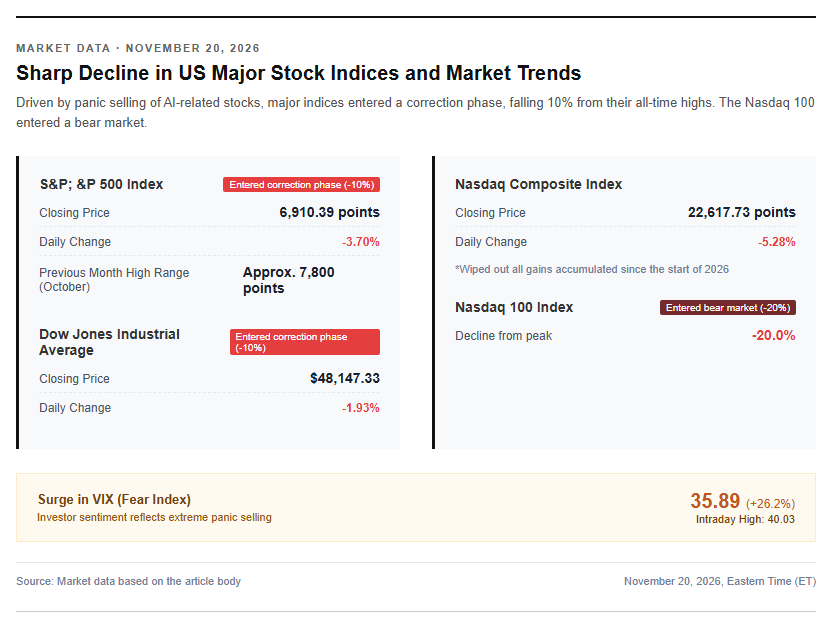
On November 20, 2026, during U.S. Eastern Time trading hours, severe selling pressure centered on AI-related stocks was triggered, causing major stock indices to fall sharply across the board. The S&P 500 index ended the trading session down 3.70% at 6,910.39 points, while the Dow Jones Industrial Average also fell 1.93% to 48,147.33 points, pushing both indices down into a technical correction phase 10% below their all-time highs. The tech-heavy Nasdaq Composite Index plunged 5.28% to 22,617.73 points, wiping out all of its gains for the year 2026. Furthermore, the Nasdaq 100 Index, composed of the top 100 companies, tumbled 20% from its high, forcing it into a bear market. The steep decline in the S&P 500—which was near record highs around 7,800 points just last month in October—marked a rapid correction, with the drop exceeding 10% over the past month. The Cboe Volatility Index (VIX), which measures investor sentiment, surged 26.2% from the previous day to close at 35.89, reaching as high as 40.03 during intraday trading in a display of panic selling. The chart below illustrates the trends of the major indices.
Panic Selling of Semiconductor Stocks and Plunge in Anthropic Shares
The semiconductor sector bore the brunt of the market plunge. The Philadelphia Semiconductor Index plummeted 10.73% in a single day, bringing its weekly cumulative decline to 17.13%. Among individual stocks, NVIDIA was heavily sold off, dropping 14.01% to $125.53, while Micron Technology fell 13.89%, AMD dropped 13.25%, and Broadcom declined 12.19%, with major stocks recording losses between 12% and 14%. This backdrop was driven by concerns over a slowdown in data center expansion and rising borrowing costs, as well as the uncertainty heightened by the resignation of former NVIDIA CEO Jensen Huang announced on November 12. Additionally, AI startup giant Anthropic—which made its debut on Nasdaq on November 19 and raised approximately $93.5 billion—fell 8.5% the day after its IPO to $88.91, pushing it back down near its initial public offering price of $83. Anthropic’s stumble highlighted the narrowing risk tolerance of investors toward the broader AI trade.
Spillover to Asian Markets and Direct Hit to the Japanese Market
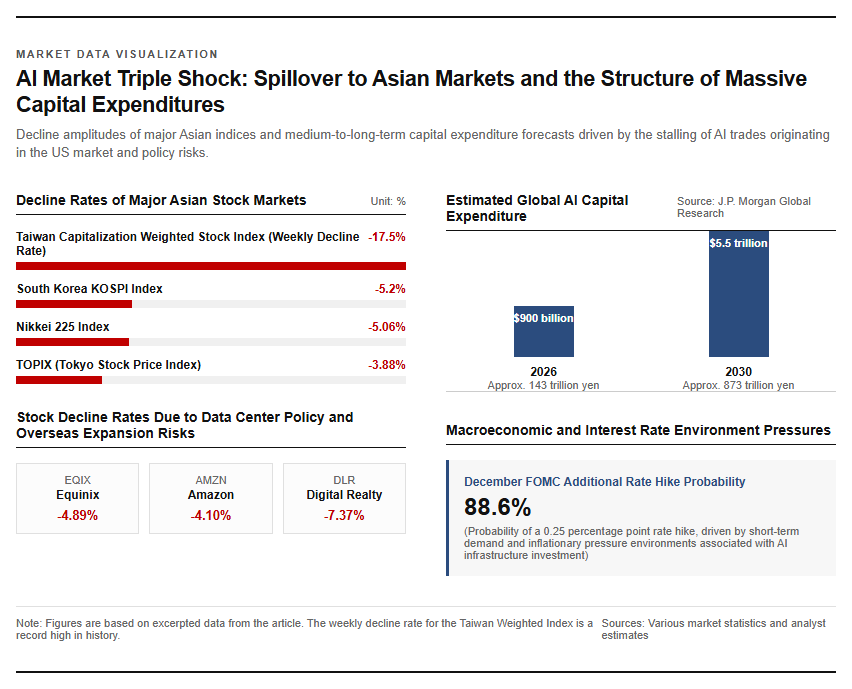
The sell-off in U.S. AI stocks instantly rippled across global markets, with Asian stock markets in particular recording declines exceeding those in the United States. Japan’s Nikkei 225 Index closed down 3,007.56 points (5.06%) at 56,436.65 points, marking its fifth-largest single-day point drop in history. The Tokyo Price Index (TOPIX) also fell 3.88% to 3,674.22 points in a broad-based sell-off that affected over 90% of stocks on the Prime Market. Because the Japanese market features many companies dealing in semiconductor manufacturing equipment and related components, the turbulence in U.S. AI infrastructure investment delivered a direct blow. Taiwan’s Taiex index also plunged 2,393.60 points (6.23%) to 36,033.29 points, recording its largest weekly decline in history at 17.5%. South Korea’s KOSPI index likewise dropped 5.2% to 4,869.96 points, spreading panic throughout the entire supply-chain-linked Asian region.
The Background of the AI Boom Turmoil: A Triple Shock of Overinvestment, Policy, and Rising Interest Rates
Massive Capital Expenditure, Profitability Concerns, and Fed Inflation Vigilance
The rapid correction in the AI market stems from skeptical views among investors regarding whether massive capital expenditures (CAPEX) on AI infrastructure can generate sufficient returns. According to estimates by JPMorgan Global Research, total global AI capital expenditure is projected to reach $900 billion (approx. 143 trillion yen) in 2026 and $5.5 trillion (approx. 873 trillion yen) by 2030. Much of this investment is being advanced with heavy debt, and IMF Managing Director Kristalina Georgieva has also warned of the risks of the global economy being overly dependent on the single pillar of AI. Furthermore, pressure from the monetary policy front has added insult to injury. Federal Reserve Vice Chair Philip Jefferson pointed out that the investment fever surrounding AI data center construction and advanced computing equipment is temporarily boosting demand and inflation. Because the deflationary effects of productivity gains will be delayed into the future, the probability of an additional 0.25 percentage point rate hike at the December FOMC meeting has reached 88.6%.
Overseas Data Center Taxation and Policy Risks under the Trump Administration
Not only financial factors, but also the emergence of policy risks from the administration accelerated the sell-off of tech stocks. In a press conference on November 20, 2026, U.S. President Donald Trump indicated the possibility of imposing massive taxes and heavy penalties on U.S. companies that build data centers overseas. Although detailed tax rates and timelines were not disclosed, concerns spread across the market that the optimal allocation plans for computational resources deployed globally by major IT companies would be disrupted. Following these remarks, the stock prices of hyperscalers fell across the board, with Alphabet down 2.70%, Microsoft down 2.77%, and Amazon down 4.10%. In addition, major data center operators Equinix and Digital Realty suffered steep drops of 4.89% and 7.37%, respectively. With overseas expansions aimed at securing power and cutting costs being halted, there is a growing awareness that the revenue structure of AI infrastructure could be fundamentally shaken. The following chart shows the relationship between policy risk and valuations.
Shrinking Equity Risk Premium and Valuation Adjustments in the Era of 3% Interest Rates
Changes in the macroeconomic environment are rapidly narrowing the tolerance for stock valuations. In Japan as well, with the normalization of monetary policy by the Bank of Japan, an era has arrived where long-term interest rates reach 3%, creating an environment where secure and reliable yields can be obtained from safe assets. Meanwhile, according to the Federal Reserve’s Financial Stability Report (published in May 2026), the U.S. equity risk premium stood at only about 2.8 percentage points as of April 2026, plunging to a 20-year low well below its long-term median of 4.59 percentage points. With the additional return of stocks over government bonds remaining extremely thin, almost no buffer is left to absorb the shock of rising interest rates. Consequently, AI-related stocks that have priced in future growth expectations at high valuations (P/E ratios) have been subjected to severe price adjustments accompanying the rise in discount rates. The difference in resilience between companies that can fund investments with internal capital and those dependent on external debt is becoming stark.
Financial System Risks and Future Outlook & Focus Points
Rising Private Credit Default Rates and the 2027 Refinancing Risk
The turmoil in the AI bubble is beginning to spill over not only into the real economy but also into the overheated non-bank financial (private credit) market. According to rating agency Fitch Ratings, the U.S. private credit default rate for the July-September 2026 quarter worsened to a record high of 6.3%. The application of “payment-in-kind (PIK)” terms, where interest payments are added to the principal rather than paid in cash, is increasing, causing companies’ substantive debt burdens to accumulate while being deferred. In its Financial Stability Report released on November 13, 2026, the Fed also expressed caution regarding the expansion of debt for AI data centers and the opacity of lending practices. Because debt raised at low interest rates during the period of monetary easing will reach maturity in large volumes between 2027 and 2028, refinancing risks at higher real interest rates are a concern. Credit spreads are widening, centered on companies with lower creditworthiness, and concerns exist that failures in private credit could trigger a chain reaction of risk-off sentiment.
Future Focus Points and the Importance of Stock Selection for Investors
The biggest variable swaying the future stock market is the Fed’s rate decision at the December FOMC and inflation trends. Amid prolonged upward pressure on interest rates, the key point for assessment is whether this remains a temporary psychological correction or progresses into a slowdown of the entire AI capital expenditure cycle. Based on past market data, there are multiple instances where a correction phase of 10% or more developed into a bear market, so optimism is prohibited. In such an environment, moving away from the conventional “blanket buying of AI themes” and performing stock selection that individually evaluates companies’ financial health and cash flow generation capabilities is essential. While polarization deepens between hyperscalers with solid internal capital and infrastructure companies relying on excessive debt, a capital shift toward defensive stocks with solid earnings, such as healthcare and food, is also accelerating. Investors are expected to maintain an attitude of carefully selecting companies equipped with genuine growth potential and financial foundations from a long-term perspective, without being misled by short-term stock price fluctuations.
Reference Pages
- [FRB Financial Stability Report (November 2026)] https://www.federalreserve.gov/publications/files/financial-stability-report-20261113.pdf
- [Bank of Japan Review (2026)] https://www.boj.or.jp/research/wps_rev/rev_2026/data/rev26j12.pdf
- [arXiv Systemic risk indicator based on implied and realized volatility] https://arxiv.org/abs/2307.06821
[#USStocks #AIBoom #SP500 #DowJones #RisingInterestRates #Inflation #DefensiveStocks]

コメント