
The US dollar-yen exchange rate plummeted temporarily to the mid-158 yen range, accelerating risk-off yen appreciation. This was driven by a cooling of investor sentiment due to a global stock market slump and the rapid unwinding of yen carry trades.
- Sharp yen-buying pressure accompanying the stock market plunge and risk-off sentiment
- Valuation adjustments in the AI and semiconductor sectors and a chilling of market sentiment
- Unwinding of yen carry trades and capital flight to safe-haven assets
- Intersection of US and Japanese monetary policy outlooks and expectations for additional rate hikes
- Intervention vigilance and technical battles surrounding the 160-yen defense line
- Future Outlook and Key Points for Market Participants to Watch
Sharp yen-buying pressure accompanying the stock market plunge and risk-off sentiment
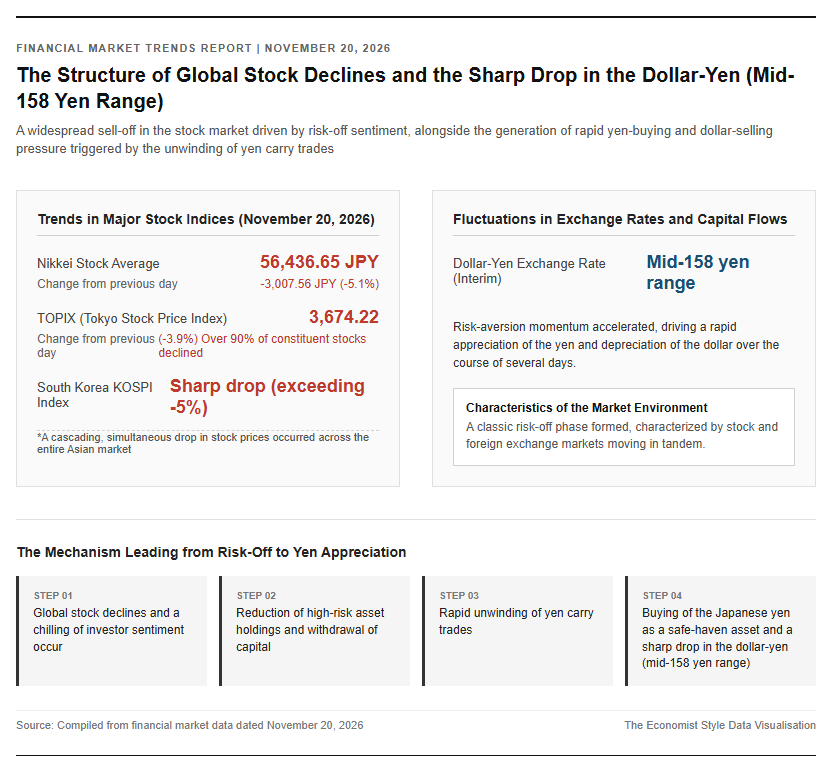
In financial markets on November 20, 2026, a sharp risk-off trend unfolded in response to a stock market crash, causing the US dollar-yen exchange rate to temporarily drop to the mid-158 yen range (yen appreciation progressing). On the same day in the Tokyo stock market, the Nikkei Stock Average fell by 3,007.56 yen from the previous day, reaching a decline rate of 5.1% and closing at 56,436.65 yen. Additionally, the Tokyo Stock Price Index (TOPIX) dropped 3.9% to 3,674.22, resulting in a broad-based decline where over 90% of constituent stocks lost value. Behind this large-scale global stock market slump was a rapid expansion in investment behavior to reduce holdings of risk assets and flee capital to safe-haven assets. In the foreign exchange market, capital was withdrawn from high-risk assets amid sudden market volatility, and pressure to buy back the Japanese yen—perceived as a relatively safe asset—intensified all at once. Across the broader Asian market, South Korea’s KOSPI index dropped by over 5%, linking a simultaneous global stock drop and forming a classic risk-aversion phase where the stock and foreign exchange markets moved in sync. Please refer to the figure below.
Valuation adjustments in the AI and semiconductor sectors and a chilling of market sentiment
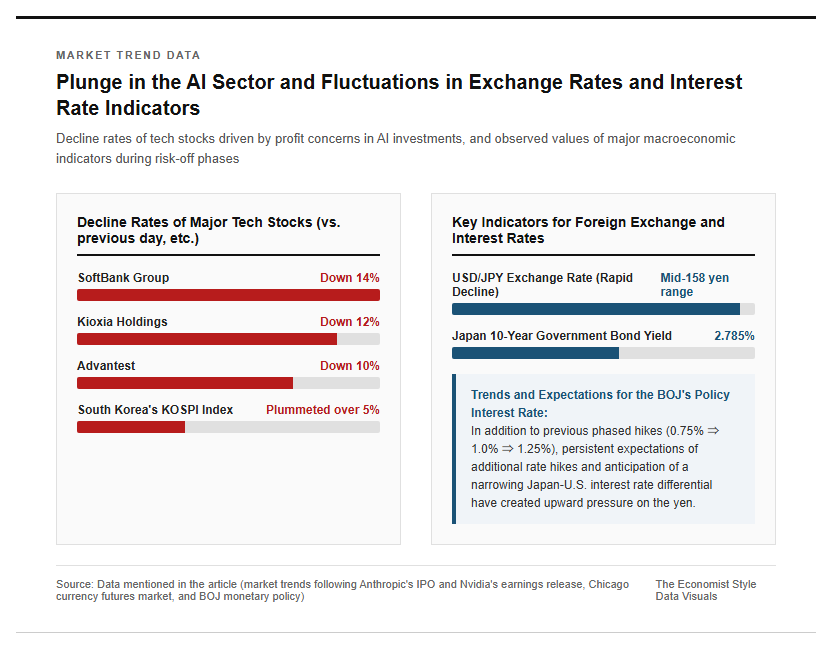
One of the primary factors directly triggering this global stock sell-off and risk-off movement was the reaction against excessive concerns over high stock valuations in AI and semiconductor-related sectors, leading to valuation adjustments. Even after US-based Anthropic’s post-IPO movements and NVIDIA’s earnings release, concerns regarding the profitability of AI investments and the financial burden of constructing large-scale data centers were not completely dispelled in the market. Consequently, selling pressure spread significantly to the Japanese market, which has a high proportion of tech stocks; SoftBank Group plunged 14%, Kioxia Holdings dropped 12%, and Advantest recorded a 10% decline. With doubts about the recovery of returns from AI-related companies taking precedence, institutional investors and hedge funds were forced to liquidate positions to prevent further losses. This deterioration in sentiment toward major tech stocks became a heavy drag on the overall stock market, developing into a movement where market participants reduced risk assets across the board.
Structural factors driving exchange rates and interest rate mechanisms
Unwinding of yen carry trades and capital flight to safe-haven assets
The rapid decline of the US dollar-yen exchange rate to the mid-158 yen range was deeply tied to the unwinding structure of yen carry trades, in which investors borrowed low-interest yen to invest in higher-yielding currencies and overseas equities. While selling the yen to purchase foreign currency-denominated assets promotes yen depreciation during stable market phases, investors simultaneously seek to reduce risk when stock prices plunge and market uncertainty rises. As a result, position adjustments occur where investors sell off held risk assets and repay or buy back borrowed yen, generating powerful yen-appreciation pressure in the market over a short period. The unravelling of speculative yen-short positions in the Chicago Mercantile Exchange (IMM) futures market and leverage unwinding by overseas hedge funds combined to push down the dollar-yen rate, which had been hovering near 160 yen, all at once. Furthermore, funds flowed into government bond markets perceived as safe havens, driving Japan’s 10-year government bond yield down to 2.785%, as bond buybacks and falling interest rates spilled over into the broader market.
Intersection of US and Japanese monetary policy outlooks and expectations for additional rate hikes
As a structural factor swaying the future of exchange rates, the conflicting directions of monetary policy between the Bank of Japan (BOJ) and the US Federal Reserve (FRB) can be cited. In the United States, uncertainty is growing regarding the pace of policy rate tightening due to economic indicators and concerns over a slowdown in AI investment. Meanwhile, in Japan, inflation concerns persist—as confirmed by rising service prices in the October National Consumer Price Index (CPI)—and hawkish stances by BOJ Governor Kazuo Ueda along with expectations for an additional rate hike at the next monetary policy meeting remain firmly rooted. Amid a history where the BOJ has raised its policy interest rate stepwise from 0.75% to 1.0% and further to 1.25%, expectations of a narrowing Japan-US interest rate differential are functioning as a solid factor supporting yen purchases. The intersection of expectations for lower US long-term interest rates and the BOJ’s policy normalization stance creates a structure that applies powerful corrective pressure to the previous trend of dollar appreciation and yen depreciation. The figure below illustrates the correlation structure between the Japan-US interest rate differential and exchange rates.
Battle over currency intervention and future market outlook
Intervention vigilance and technical battles surrounding the 160-yen defense line
The major focus moving forward is whether the dollar-yen exchange rate will break through the defensive line of the 160-yen range, or remain within the 158-yen to 159-yen range due to caution surrounding potential foreign exchange intervention. Regarding yen depreciation levels exceeding 160 yen, vigilance against yen-buying intervention by Japanese monetary authorities has intensified significantly. Historically, large-scale yen-buying interventions were implemented—amounting to approximately ¥11.7 trillion between April and May 2026, and approximately ¥15.4 trillion between July and August—making the 160-yen range widely recognized as a strong psychological milestone. From a technical perspective as well, the 200-day moving average located around ¥158.74 and the ¥19.30 level are viewed as critical support and resistance lines, and the battle at these milestones is intensifying. Market participants are closely monitoring upcoming inflation indicators, stock price trends, and statements from authorities, adopting a increasingly cautious stance amidst the intersection of risk-off waves and policy vigilance.
Future Outlook and Key Points for Market Participants to Watch
As for the future trajectory of the foreign exchange market, the biggest key will be whether a calming of global stock markets and a bottoming out of AI-related stocks are confirmed. Once the risk-averse yen-buying pressure associated with declining stock prices subsides, demand-driven dollar-buying and yen-selling—backed by the interest rate differential between Japan and the US—may once again support the downside. However, if concerns over a US economic slowdown and cautious outlooks on AI investment intensify, leading to further corrections in US stocks, there is a risk that additional yen appreciation could unfold, driven by a slowdown in retail investors’ foreign stock investment flows via programs like NISA and further unwinding of yen-carry trade selling. Market participants are required to analyze from multiple angles the timing of the Bank of Japan’s additional rate hikes and its dialogue with the administration, trends in US inflation indicators and employment statistics, and shifts in the tone of statements regarding FX intervention by authorities, in order to prepare for unexpected market fluctuations.
Reference Page
- [Bank of Japan] What is foreign exchange intervention (foreign exchange market intervention)? https://www.boj.or.jp/about/education/oshiete/intl/g19.htm
[#USDJPY #YenAppreciation #RiskOff #StockMarket #MonetaryPolicy #JapaneseEconomy]


コメント