On November 19, 2026, Microsoft announced “RDMA over USB4,” a technology that directly connects Windows PCs using USB4 cables to distribute and run large-scale AI models across multiple machines. This development is driven by the challenge that, while the widespread adoption of quantization technology has increased demand for local AI, it remains difficult to run massive models with tens to hundreds of billions of parameters using the memory capacity of a single PC alone.
- Key Takeaway: Announcement of distributed AI execution technology across multiple PCs via direct USB4 connection
- Technical Mechanism: Ultra-Low Latency Communication via NetworkDirect and RDMA
- Demonstration Results: Distributed Operation of a 235B-Parameter Model
- Network Configuration and Constraints: Ports and Cables Required for Full-Mesh Connection
- Environmental Requirements for Preview Usage: Secure Boot and Software Configuration
- Challenges toward Practical Application, Future Developments, and Points of Interest
Key Takeaway: Announcement of distributed AI execution technology across multiple PCs via direct USB4 connection
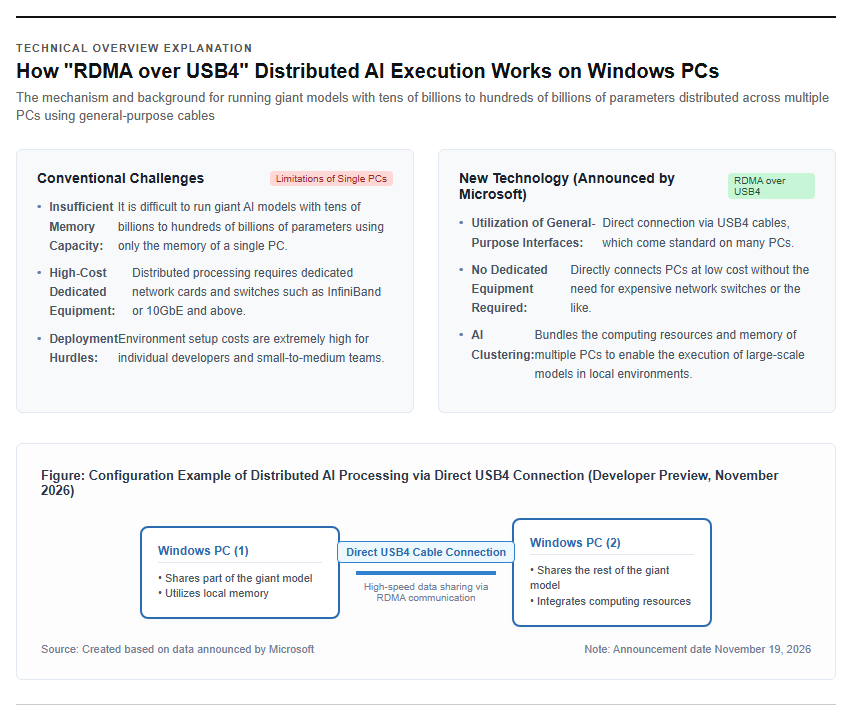
On November 19, 2026, Microsoft announced a developer preview of RDMA over USB4, a technology that directly connects Windows PCs with USB4 cables to bundle computing resources from multiple units and distributively execute massive AI models. In recent years, while open-source large-scale AI models have evolved rapidly, running models with tens to hundreds of billions of parameters in a personal environment has faced the challenge of insufficient memory capacity on single PCs. Conventionally, distributing processing across multiple computers required expensive specialized equipment such as InfiniBand, dedicated network cards of 10GbE or higher, and high-performance network switches, creating a high barrier to entry for individual developers and small-to-medium research teams. The newly announced technology is an innovative approach that utilizes USB4—a general-purpose interface found on many current PCs—to easily turn PCs into an AI processing cluster without adding specialized equipment. An example configuration is shown in the figure below.
Technical Mechanism: Ultra-Low Latency Communication via NetworkDirect and RDMA
The core of this technology lies in implementing RDMA (Remote Direct Memory Access) communication, which has been utilized in data centers and elsewhere, onto the USB4 standard. In standard network communication, protocol processing and software copying by the OS and CPU are involved during data transfer, which causes latency. In contrast, RDMA is a mechanism where data is exchanged directly between the memories of PCs with minimal CPU intervention. In Windows, the NetworkDirect API—used in network adapters for data centers—is adopted, performing memory-to-memory transfers using the DMA ring of the USB4 host router. According to measurements conducted by Microsoft between two PCs, the round-trip latency for a small 16KiB message was approximately 28 to 50 microseconds with RDMA over USB4, compared to 194 microseconds for Ethernet (UDP) communication over the same USB4 link. This achieves a dramatic reduction in latency to about one-fourth compared to conventional communication, serving as a tremendous advantage in distributed AI inference where data exchanges occur frequently.
Demonstration Experiment Data and Network Configuration Requirements
Demonstration Results: Distributed Operation of a 235B-Parameter Model
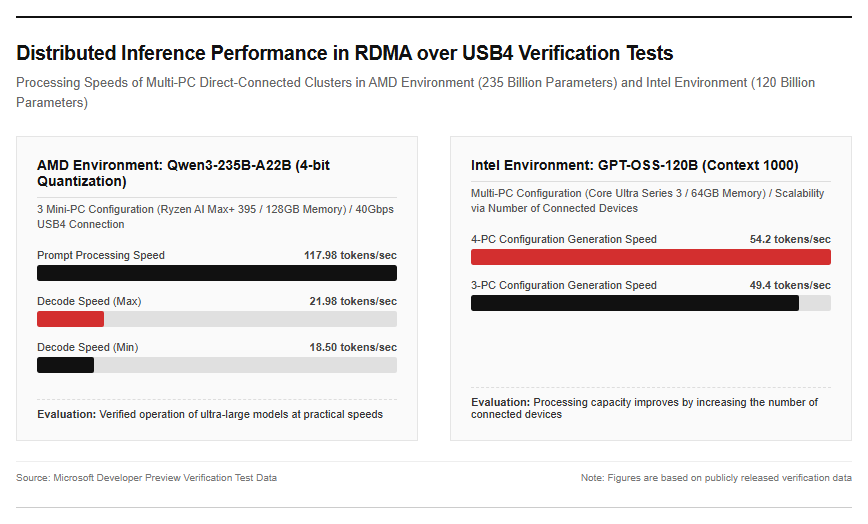
Microsoft has published demonstration data for distributed inference using PCs equipped with the latest processors from AMD and Intel. In the AMD environment, three mini PCs featuring Ryzen AI Max+ 395 with 128GB of unified memory and Radeon 8060S specifications were connected via 40Gbps USB4 to run Qwen3-235B-A22B (a 4-bit quantized version), an ultra-large model with 235 billion parameters. With this three-machine configuration, the decoding speed (indicating text generation speed) recorded approximately 18.5 to 21.98 tokens per second, and prompt processing recorded 117.98 tokens per second, confirming operation at practical speeds. Additionally, in the Intel environment, three to four PCs equipped with Core Ultra Series 3 and 64GB of memory were used to run the 120 billion-parameter model GPT-OSS-120B. At a context length of 1,000 tokens, it achieved generation speeds of 49.4 tokens per second with a three-machine configuration and 54.2 tokens per second with a four-machine configuration, demonstrating that processing capacity improves as the number of connected units increases. The connection topologies used in the experiments are shown below.
Network Configuration and Constraints: Ports and Cables Required for Full-Mesh Connection
To achieve high performance with RDMA over USB4, a full-mesh configuration where all PCs are connected directly to one another is considered a mandatory requirement. Daisy-chain connections, which link devices in a row, are not recommended because they increase communication overhead and significantly degrade processing performance. As a necessary condition for a full-mesh configuration, if there are $N$ PCs, each PC requires $N-1$ available USB4 ports, and the total number of cables required is calculated as $N(N-1)/2$. Specifically, a 2-device connection requires 1 port per PC and 1 cable, a 3-device connection requires 2 ports per PC and 3 cables, and a 4-device connection requires 3 ports per PC and 6 cables. Therefore, when attempting to build a cluster of 4 or more units, the number of ports on each PC and the number of DMA rings in the internal USB4 host router become limiting factors. Regarding bandwidth, 40Gbps provides sufficiently low latency, but an 80Gbps bandwidth standard works more advantageously in scenarios involving long input texts or massive data transfers.
Deployment Environment Requirements and Future Outlook
Environmental Requirements for Preview Usage: Secure Boot and Software Configuration
This feature is currently provided as a developer preview stage, and its use involves several environmental setup steps and safety precautions. To try it out, a special Windows Insider build participating in the Experimental channel of the Windows Insider Program is required. Furthermore, because RDMA over USB4 is disabled by default, enabling test-signed drivers is required in addition to modifying registry settings. Because Secure Boot must be disabled to enable test signing, Microsoft recommends testing on a dedicated test PC rather than a primary PC used for daily activities. On the software side, it is necessary to set up the NetworkDirect provider open-sourced by the company on GitHub and a verification fork of the distributed inference library llama.cpp. Each communication link requires a static IPv4 address and a separate subnet, and because features such as automatic retry upon communication disconnection are not yet implemented, it is currently an implementation intended for developers.
Challenges toward Practical Application, Future Developments, and Points of Interest
RDMA over USB4 holds the potential to bring about dramatic changes for individual developers and research environments by allowing them to combine existing PC assets on hand to run extra-large local AI models. However, challenges toward practical application have also become clear. While increasing the number of units improves output speed (decoding speed), the time to first token (TTFT) tends to increase slightly as the number of PCs grows. Therefore, selecting the optimal number of nodes according to the input length and output text volume, as well as optimizing load balancing on the software side, will be future technical points of interest. Moving forward, the specific release timing of the corresponding Windows Insider build and the announcement of official system requirements for the generally available version are anticipated. As general-purpose USB4 ports evolve from mere external storage or display output ports into interfaces for easily accessible distributed computing resources, the importance of port counts and communication bandwidth when purchasing future PCs is expected to increase even further.
Reference Pages
- [Microsoft Tech Community (Official Announcement)] https://techcommunity.microsoft.com/blog/microsoftusbblog/introducing-rdma-over-usb4%C2%AE-on-windows-run-larger-local-ai-models-across-pcs/4574602
- [GitHub – windows-usb4-rdma] https://github.com/microsoft/windows-usb4-rdma
- [GitHub – llama.cpp-nd-usb4] https://github.com/microsoft/llama.cpp-nd-usb4
[#Microsoft #USB4 #RDMA #LocalAI #Windows11 #DistributedAI #PCCluster]


コメント