
JFE Engineering has launched Japan’s first mass production plant for offshore wind power monopile, the “Kasaoka Monopile Manufacturing Plant,” in Kasaoka City, Okayama Prefecture. This enables the domestic supply of key components that previously depended on overseas imports, significantly advancing Japan’s energy security and supply chain toward achieving carbon neutrality by 2050.
- Operation of Kasaoka Monopile Factory and Japan’s Only Production Site
- Received the first domestic project for the Akita Prefecture offshore project
- Challenge to European Giant Manufacturers and JFE’s Position
- The Inevitability of Offshore Wind Power and Domestic Production as National Policy
- The technical advantage brought together by the full strength of the JFE Group
- Revenue Targets and Roadmap to Full Operation
- Full-scale entry into floating foundations and future prospects
Operation of Kasaoka Monopile Factory and Japan’s Only Production Site
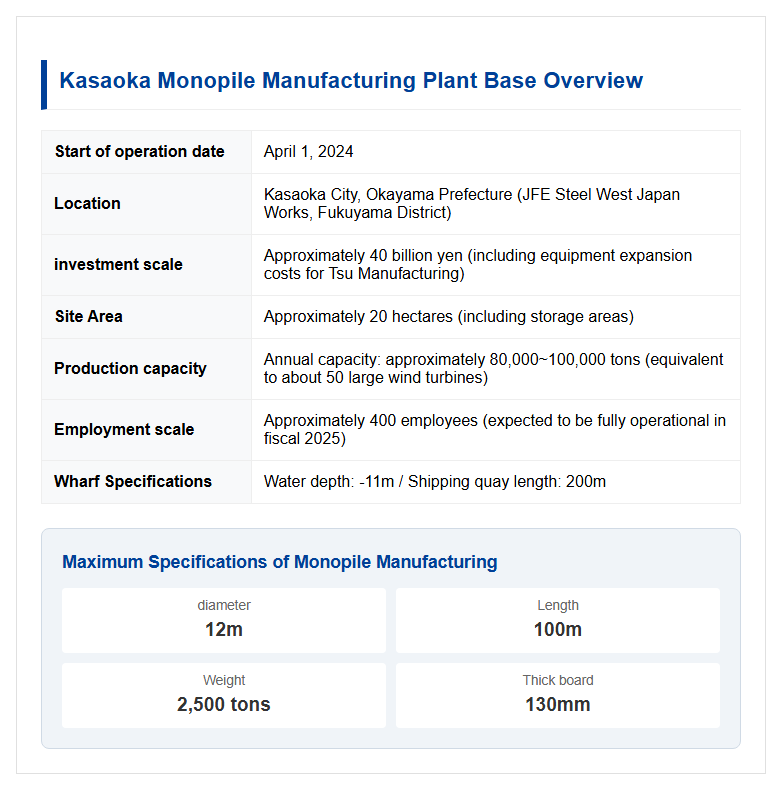
JFE Engineering began operations of the Kasaoka Monopile Manufacturing Plant in Kasaoka City, Okayama Prefecture, on April 1, 2024. This facility is a large-scale steel structure manufacturing plant, newly established for the first time in about 50 years since the company’s main factory, the Tsu Plant, with an investment scale of approximately 40 billion yen. The site boasts a vast area of about 20 hectares, boasting a robust stock capacity including storage areas. The factory is located within the premises of JFE Steel West Japan Works, providing an ideal location where everything from material procurement to manufacturing can be handled in an integrated manner.
Production capacity will reach approximately 80,000 to 100,000 tons per year, which is equivalent to about 50 large wind turbines of the 10MW class per year. With the completion of the factory, it is expected that approximately 400 new jobs will be created when the factory is fully operational within fiscal 2025, with significant ripple effects anticipated on the local economy. The following photo shows the entire factory.
Received the first domestic project for the Akita Prefecture offshore project
On December 26, 2025, JFE Engineering announced that it had received an order for monopile manufacturing and transportation for Japan’s first large-scale offshore wind power project in general sea areas. This project is located in Oga City, Katagami City, and offshore Akita City, Akita Prefecture, and is the earliest project scheduled to start operation among the round projects under the Renewable Energy Sea Area Utilization Act. This project, awarded by Kajima Corporation, holds historical significance as the first domestic project to adopt domestically produced monopile.
The scope of orders includes the manufacturing and transportation of 21 monopile and transition pieces, with a construction period scheduled from January 2026 to March 2027. The monopile produced weighs up to about 2,000 tons, has a diameter of 10.5 meters, and is about 80 meters long, making it a massive model. The steel used weighs approximately 43,000 tons, and the entire production is handled by the Kasaoka Monopile Manufacturing Plant, the only domestic manufacturing base.
Competitiveness and Strategic Background in the Global Market
Challenge to European Giant Manufacturers and JFE’s Position
The global monopile market is currently oligopolistic, dominated by European companies such as the Netherlands’ Sif Group and Germany’s EEW Group. For example, Sif Group has an annual production capacity of 500,000 tons and can manufacture over 200 units per year. In contrast, JFE Engineering’s production capacity is about 100,000 tons per year, but its product specifications reach the world’s highest standards.
Specifically, it is possible to manufacture ultra-large monopiles with diameters of 12 meters, plate thickness of 130 millimeters, lengths of 100 meters, and a single weight of 2,500 tons, delivering performance comparable to next-generation ultra-large windmill-compatible products (XXXL size) supplied by top European manufacturers. JFE has adopted a strategy of “product specifications are world-leading, and production volume starts with responding to domestic demand,” and its policy is to solidify its position as the core of the domestic supply chain by steadily meeting Japan’s strong domestic demand.
The Inevitability of Offshore Wind Power and Domestic Production as National Policy
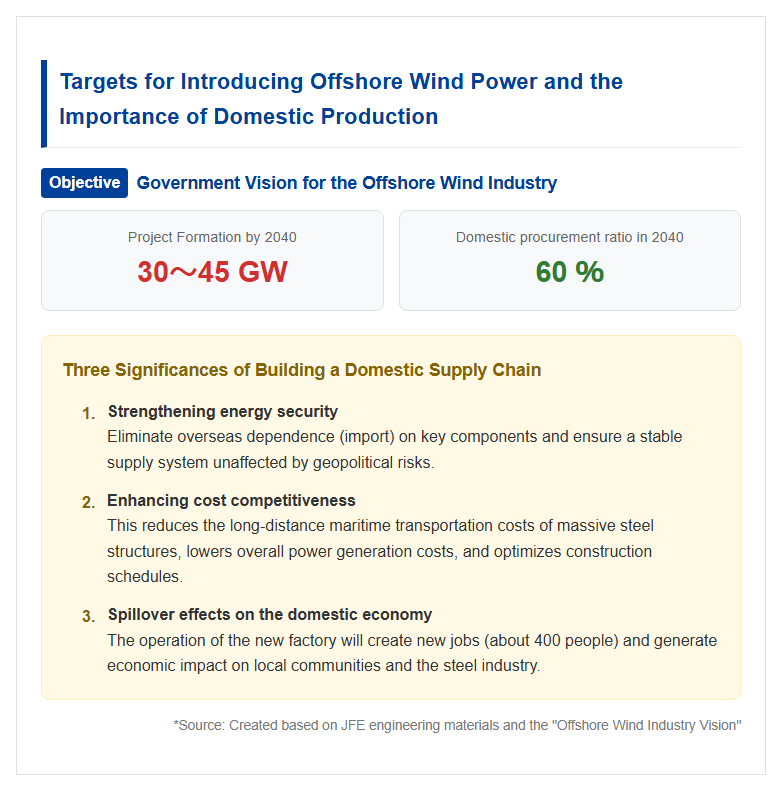
The Japanese government has set a goal to achieve net-zero greenhouse gas emissions by 2050, and offshore wind power is positioned as the trump card for this goal. The “Offshore Wind Industry Vision” announced in December 2020 set a goal to form projects of 30 to 45 gigawatts by 2040 and increase the domestic procurement ratio to 60%. To achieve this ambitious goal, a stable domestic supply of monopile, a massive steel structure, is essential.
Until now, Japan relied on importing monopile from overseas, but faced challenges such as rising transportation costs and geopolitical risks. Achieving domestic production carries three important significance: not only securing materials, but also strengthening energy security, improving cost competitiveness, and having ripple effects on the domestic economy. JFE Engineering’s entry can be seen as a strategic infrastructure development to realize Japan’s energy policy. The following diagram explains the targets for offshore wind power deployment and the importance of domestic procurement.
The technical advantage brought together by the full strength of the JFE Group
JFE Engineering’s monopile manufacturing incorporates the synergy of technologies cultivated over many years by the JFE Group. Its biggest feature is the use of the large, single, heavy, and heavy steel plate “J-TerraPlate®” supplied by JFE Steel for wind power generation. By using this steel, it became possible to significantly reduce weld extensions in massive structures, dramatically improving manufacturing efficiency and quality.
Furthermore, in addition to the latest European equipment, we have introduced world-class welding technology developed in collaboration with JFE Steel, offering high efficiency and quality. Based on over 100 years of experience in manufacturing large steel structures, we have combined expertise in processing and welding bridges and coastal structures with expertise in efficiently joining ultra-thick steel materials. One of our strengths is that the main body of the monopile is manufactured in Kasaoka, while transition pieces requiring interior parts are finally assembled at the Tsu Manufacturing Plant, establishing an optimal division of labor system with two locations.
Medium- to Long-Term Business Development and Business Scalability
Revenue Targets and Roadmap to Full Operation
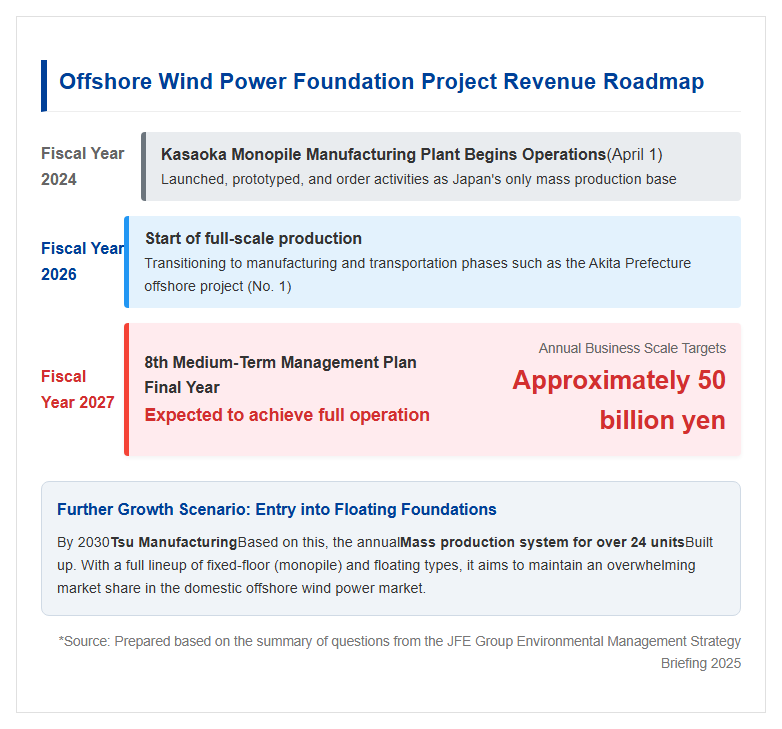
JFE Engineering expects its offshore wind power foundation business to be a major pillar of future revenue. Full-scale production will begin in fiscal 2026, and full operation is expected to be achieved in fiscal 2027, which is within the current 8th medium-term management plan. The scale of the business at full capacity depends on market prices, but it is estimated to reach about 50 billion yen annually.
This growth is supported by first-mover advantages from being the only domestic manufacturing site and high reliability in delivery times and quality. The company aims to secure additional projects by promoting the unique quality and commitment to delivery times unique to domestic products in various domestic projects, including round projects, and providing additional value. In the steel business as well, this strategy aims to maximize profits across the entire group by combining them with environmentally valuable products such as green steel materials. The following graph illustrates the future sales targets.
Full-scale entry into floating foundations and future prospects
JFE Engineering’s ambitions go beyond fixed-floor monopile. On January 29, 2026, the company announced its full-scale entry into the foundation manufacturing business for floating offshore wind power, which is expected to expand in the future. Following our selection for the Ministry of Economy, Trade and Industry’s “GX Supply Chain Construction Support Project,” we plan to develop Tsu Manufacturing as a manufacturing base for floating foundations, aiming for mass production of more than 24 units per year by 2030.
Tsu Manufacturing Plant possesses one of the largest offshore docks in Japan and a vast yard, establishing a system that can handle everything from modular manufacturing of floating foundations to assembly of finished products. By having two strong bases—the Kasaoka Monopile Plant with a fixed type and the Tsu Plant with a floating structure—we are the only company in Japan capable of handling all types of offshore wind power infrastructure. Through this, it is expected to lead Japan’s offshore wind industry and demonstrate unwavering leadership toward realizing a decarbonized society.
[#JFEエンジニアリング #洋上風力発電 #モノパイル #再生可能エネルギー #カーボンニュートラル #製造業 #経済 #脱炭素]


コメント