On November 16, 2026, NVIDIA, IBM, and the U.S. Fermi National Accelerator Laboratory announced the establishment of a co-creation platform integrating quantum computing and accelerated computing. The background to this initiative is a strong demand to improve processing capabilities for quantum error correction—the greatest practical barrier to the commercialization of quantum computing—and to achieve standard integration into existing supercomputing environments.
- Key points of the announcement and the establishment of a co-creation platform through tripartite collaboration
- A new decoding algorithm that dramatically accelerates quantum error correction
- A 79-fold improvement in calculation accuracy and molecular simulation demonstrated by quantum machines from RIKEN and IBM
- Standard integration into supercomputer operating environments using Slurm and QRMI
- Practical spillover effects on drug discovery and materials development, and the urgency of transitioning to post-quantum cryptography
- Future Roadmap and Key Focus Areas for Quantum Hybrid Technology
Key points of the announcement and the establishment of a co-creation platform through tripartite collaboration
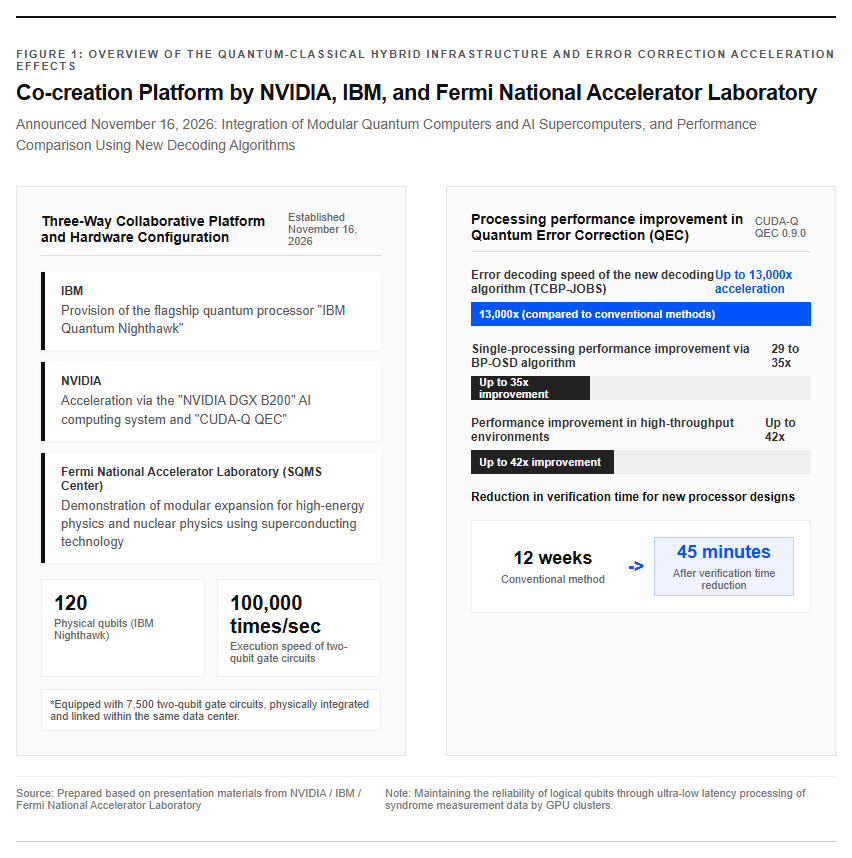
On November 16, 2026, NVIDIA, IBM, and the Fermi National Accelerator Laboratory (Fermilab), a facility under the U.S. Department of Energy, announced a comprehensive partnership for the development of next-generation modular quantum computers. As part of this partnership, the organizations will build a co-creation platform that physically consolidates and links a quantum computer equipped with IBM’s flagship quantum processor, “IBM Quantum Nighthawk,” and NVIDIA’s latest AI computing system, “NVIDIA DGX B200,” within the same data center facility. The IBM Nighthawk features 120 physical qubits and high performance capable of executing 7,500 two-qubit gate operations at a rate of 100,000 samples per second. In collaboration with Fermilab’s Superconducting Quantum Materials and Systems (SQMS) Center, the initiative will advance the modular expansion of multiple quantum processors for high-energy and nuclear physics, as well as demonstrations of large-scale quantum-classical hybrid distributed processing.
A new decoding algorithm that dramatically accelerates quantum error correction
The greatest challenge hindering the practical application of quantum computing is quantum state changes and calculation errors caused by environmental noise. To address this issue, NVIDIA has unveiled a new decoding algorithm, “TCBP-JOBS,” through the CUDA-Q QEC 0.9.0 library. Compared to conventional methods, it successfully accelerates error decoding speed by up to 13,000 times, shortening the period required for design verification of new processors from the conventional 12 weeks to just 45 minutes. Additionally, the BP-OSD algorithm built into CUDA-Q QEC achieves a 29x to 35x speedup in single-processing operations and provides up to 42x performance improvement in high-throughput environments. As shown in the system configuration diagram below, a foundation for maintaining highly reliable logical qubits is falling into place through ultra-low-latency processing of syndrome measurement data obtained from physical qubits using GPU clusters.
Improvement of effective performance and supercomputing integration technology
A 79-fold improvement in calculation accuracy and molecular simulation demonstrated by quantum machines from RIKEN and IBM
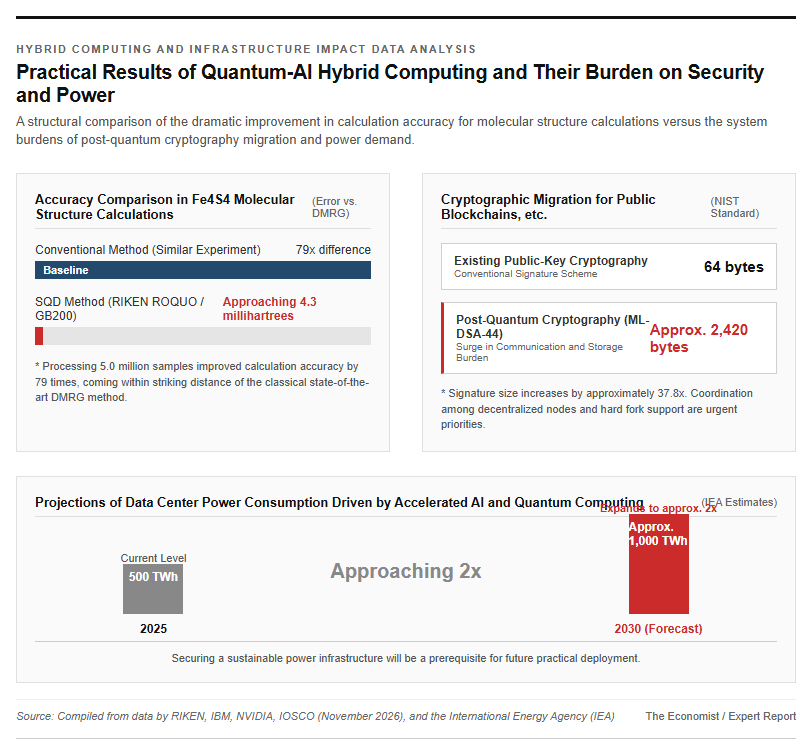
As a practical outcome of hybrid computing, an experiment on the molecular structure calculation of an in vivo iron-sulfur complex (Fe4S4) was conducted by IBM, RIKEN (the Institute of Physical and Chemical Research), and NVIDIA. The NVIDIA GB200 system installed in RIKEN’s GPU supercomputer “ROQUO” was connected to a 72-qubit quantum machine to process 5 million samples of data using the Sample-Based Quantum Diagonalization (SQD) method. As a result, calculation accuracy improved by 79 times compared to conventional similar experiments, achieving an accuracy coming within just 4.3 milli-Hartrees of DMRG, the highest-tier classical calculation method. Furthermore, in joint research with the Cleveland Clinic and RIKEN, the energy calculation of a protein-ligand binding structure on the scale of 12,635 atoms was successfully completed, making it a finalist for the 2026 ACM Gordon Bell Prize. Elucidating complex chemical reactions will serve as a stepping stone to dramatically reducing the processes required for drug discovery and the creation of high-performance battery materials.
Standard integration into supercomputer operating environments using Slurm and QRMI
To spread quantum computers among the IT infrastructure of researchers and enterprises, smooth connection with conventional High-Performance Computing (HPC) operating environments is essential. Until now, many data centers have individually operated quantum processors (QPUs) using proprietary plugins, which has been a major management challenge. In this initiative, the organizations have developed a feature that natively integrates quantum processors into “Slurm,” a job management software standardly adopted by super-large-scale supercomputers worldwide. By directly linking with Slurm’s Hierarchical Resources (HRES) functionality via the open-source interface “Quantum Resource Management Interface (QRMI)” provided by IBM, researchers will be able to perform QPU time allocation and reservation management using the exact same operational procedures as CPUs and GPUs.
Impact on industry and challenges and prospects toward practical application
Practical spillover effects on drug discovery and materials development, and the urgency of transitioning to post-quantum cryptography
While the advancement of quantum-AI hybrid computing brings massive R&D cost reductions to drug discovery and materials science, it also poses new threats to financial markets and information security. According to a report released by the International Organization of Securities Commissions (IOSCO) on November 19, 2026, there is a pointed risk that practical quantum computers capable of breaking existing public-key cryptography will emerge within the next 5 to 10 years. In particular, public blockchains risk delayed migration because they require hard forks and the coordination of decentralized nodes, and concerns are mounting over sudden surges in communication and storage burdens—such as signature sizes increasing from the traditional 64 bytes to approximately 2,420 bytes accompanying the transition to Post-Quantum Cryptography (ML-DSA-44) set by the US NIST. Furthermore, power consumption in data centers, accelerated by both AI and quantum computing, is projected by International Energy Agency (IEA) estimates to swell from approximately 500 terawatt-hours in 2025 to roughly double by 2030, making the securing of sustainable power infrastructure a prerequisite challenge.
Future Roadmap and Key Focus Areas for Quantum Hybrid Technology
The most anticipated aspect in future technological developments is the achievement status of milestones aimed at hardware expansion and fault-tolerance acquisition. According to IBM’s roadmap, the company plans to introduce “Nighthawk R3,” boasting 520 qubits, during 2026, and aims to build a system exceeding 1,000 qubits by interconnecting multiple R3 processors in 2027. Furthermore, it has set a goal to realize “Starling,” a fault-tolerant system that autonomously corrects errors, by 2029. Toward the 2030s when fully general-purpose quantum computers become established, hybrid configurations combining NVIDIA GPU supercomputers and quantum machines will temporarily serve as the mainstream standard infrastructure. Mathematical advances in quantum error correction, the expansion of practical application scopes, and responses to cryptographic migration will serve as key indicators determining future industrial competitiveness.
Reference Pages
- [IBM Official Announcement] https://newsroom.ibm.com/2026-11-16-ibm,-fermilab,-and-nvidia-announce-plans-for-new-co-design-platform-to-accelerate-the-development-of-next-generation,-modular-quantum-computers
- [NVIDIA Official Announcement] https://nvidianews.nvidia.com/news/nvidia-announces-collaboration-with-ibm-and-fermi-national-accelerator-laboratory-to-launch-quantum-classical-codesign-platform-plus-error-correction-breakthrough-to-advance-practical-quantum-computing
[#NVIDIA #IBM #QuantumComputing #QuantumErrorCorrection #CUDA-Q #Supercomputing #FermiNationalAcceleratorLaboratory #AI]


コメント