
On November 23, 2026, in the Tokyo foreign exchange market, the US dollar-Japanese yen exchange rate moved in a narrow range around 158.90 yen. The backdrop includes sluggish trading due to the domestic market closure for the Labor Thanksgiving Day holiday, conflicting with caution over currency intervention near the 160 yen mark and risk-averse sentiment following the previous weekend’s decline in US stocks.
- Key points on the narrow range around 158.90 yen and holiday trading
- Short-term spillover to foreign exchange driven by sharp stock price drops and risk aversion
- Expectations of additional rate hikes by the Fed and expanding US-Japan interest rate differentials
- Expansion of speculative yen-short positions and bubble concerns
- The 160-Yen Defense Line and Vigilance Against Intervention by Japanese Currency Authorities
- Market Main Scenario and Future Developments and Focal Points
Key points on the narrow range around 158.90 yen and holiday trading
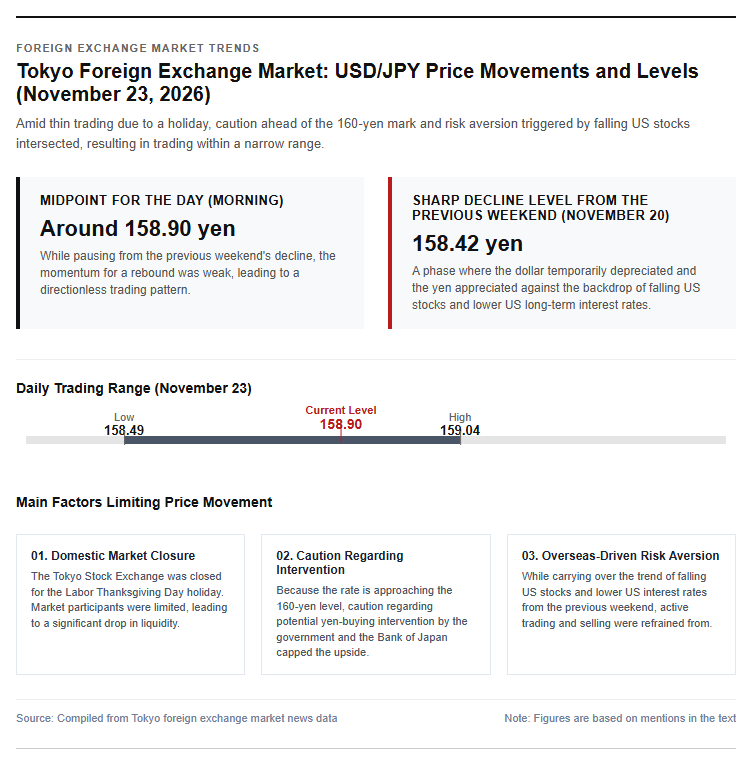
On the morning of November 23, 2026, in the Tokyo foreign exchange market, the US dollar-yen exchange rate showed a lack of clear direction within an extremely narrow range, centered from the 158.80 yen level to around 158.90 yen. The day’s trading range remained between 158.49 yen and 159.04 yen, falling short of forming a definite trend. The primary cause of the market stagnation was that Japan was observing the Labor Thanksgiving Day holiday, and with the Tokyo Stock Exchange closed, market participants were limited, leading to a significant drop in market liquidity. Regarding European currencies as well, the euro-yen peaked after being bought up to 174.61 yen before losing momentum, spreading a wait-and-see mood across the entire market. In the New York foreign exchange market on the previous Friday, November 20, the dollar briefly experienced rapid depreciation and the yen appreciation down to 158.42 yen amid falling US stocks and lower US long-term interest rates. Although that trend paused in the Tokyo market at the start of the week, the momentum for an autonomous rebound from the previous weekend’s decline was weak, resulting in prices being pushed back down. Market participants remained cautious, seeking to assess the preliminary November Purchasing Managers’ Index (PMI) figures for the US and Europe scheduled for publication after the holiday, as well as trends in major US stock indices.
Short-term spillover to foreign exchange driven by sharp stock price drops and risk aversion
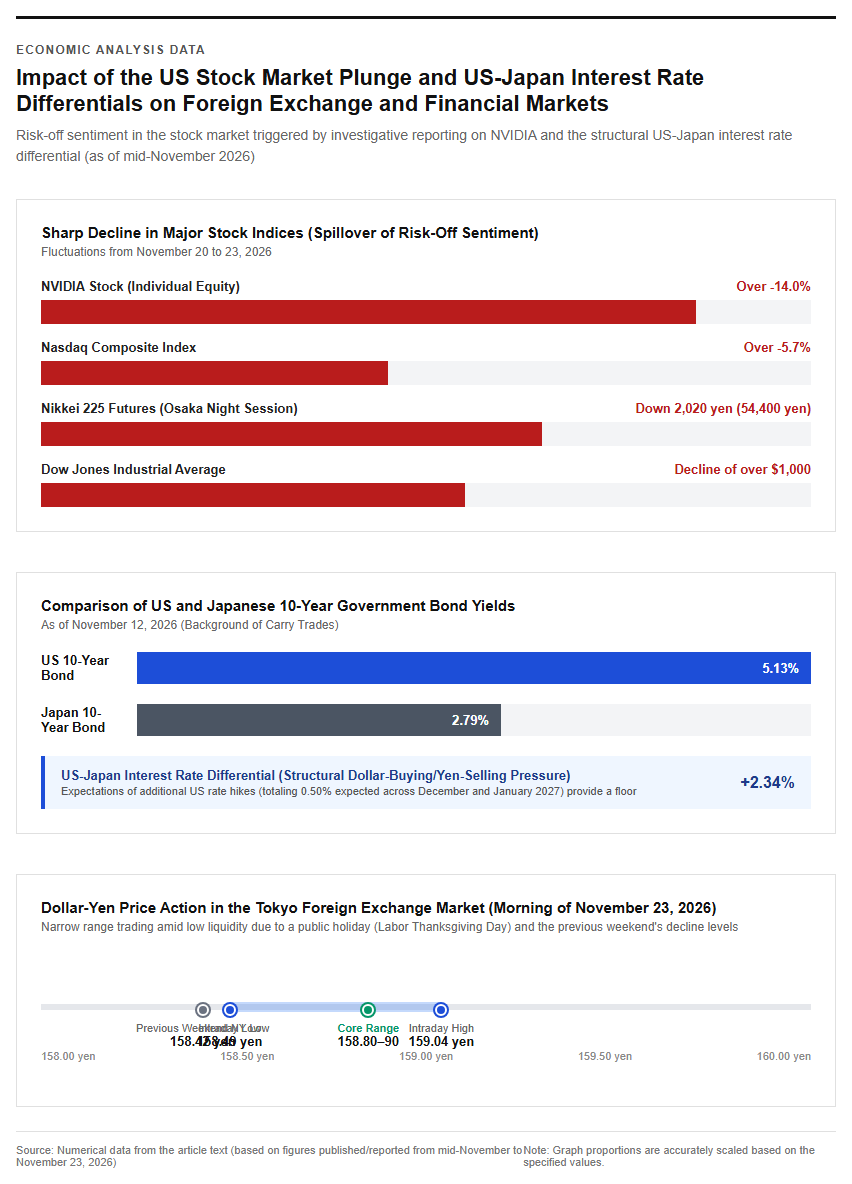
One of the major factors that dragged the dollar-yen exchange rate down to the mid-158 yen range was the sharp drop in stock prices, led by high-tech shares, in the US market on the previous Friday. In the New York market on November 20, reports that the US Securities and Exchange Commission (SEC) had launched an investigation into the accounting practices of major US semiconductor firm NVIDIA shocked the market. This caused NVIDIA shares to plunge by over 14%, spreading selling across artificial intelligence (AI)-related stocks in general. The Dow Jones Industrial Average recorded a drop exceeding 1,000 points at one point, and the Nasdaq Composite Index plummeted by more than 5.7%, giving the stock market the appearance of a selling climax. This sudden risk-off move in the stock market significantly lowered investors’ risk tolerance, rapidly increasing buying pressure to buy back the Japanese yen as a safe-haven asset. Furthermore, the decline in US long-term interest rates accompanying the drop in US stocks fueled dollar selling and yen buying. On the Osaka Exchange night session, Nikkei 225 futures collapsed to 54,400 yen—down 2,020 yen from the Osaka Exchange closing price—meaning that the turmoil in the stock market remains a subject of strong vigilance regarding its impact on the foreign exchange market.
US monetary policy and the structural background of speculative yen selling
Expectations of additional rate hikes by the Fed and expanding US-Japan interest rate differentials
The primary factors supporting the downside of the dollar-yen exchange rate and pushing it toward high price ranges over the medium to long term are expectations of continued monetary tightening by the US Federal Reserve (FRB) and the substantial interest rate differential between Japan and the US. The US Consumer Price Index (CPI) for October, released on November 10, 2026, exceeded market expectations, reconfirming the persistence of inflationary pressures within the United States. In response, high-ranking Fed officials made successive hawkish remarks aimed at curbing inflation, rapidly fueling the view that a total of 0.50 percentage points in additional rate hikes will be implemented by the December Federal Open Market Committee (FOMC) and January 2027. The US 10-year Treasury yield reached 5.13% as of November 12, presenting an overwhelming yield gap compared to Japan’s 10-year government bond yield of 2.79%. This striking divergence in interest rate levels continues to provide investors with a strong motive for carry trades—holding high-yielding US dollars while selling low-yielding Japanese yen. As long as the Bank of Japan maintains its cautious stance toward raising policy interest rates, structural dollar-buying and yen-selling pressure focused on the US-Japan interest rate differential is not expected to dissipate easily.
Expansion of speculative yen-short positions and bubble concerns
Another important aspect accelerating the appreciation of the US dollar and the depreciation of the yen is the establishment of large-scale yen-selling positions by speculative players such as hedge funds. According to trading data published by the Commodity Futures Trading Commission (CFTC), speculative net short yen (net long dollar) positions have reached a scale of 145,000 contracts. This level approaches the historic high of 180,000 contracts seen in July 2024—which was described in the market as a “yen-selling bubble” and triggered a subsequent sharp correction. Concerns about this speculation-driven yen depreciation, which diverges from the macroeconomic interest rate differential between Japan and the US, are growing day by day among market participants. As an empirical rule from the past, after yen-selling positions reached their limit in July 2024, the bubble burst, triggered by interventions in the foreign exchange market by Japanese authorities. As a result, the USD/JPY exchange rate suffered a severe yen-appreciation adjustment, surging by about 20 yen from the 161 range to the 141 range in less than a month. The current accumulation of excessive yen-selling positions carries the latent risk of inducing massive reverse trading (short covering) and causing sharp market fluctuations should the trend once again shift.
Foreign Exchange Intervention Risks and Outlook for the USD/JPY Exchange Rate
The 160-Yen Defense Line and Vigilance Against Intervention by Japanese Currency Authorities
As the USD/JPY exchange rate approaches the 160 milestone, market participants are most on guard for the actual execution of yen-buying, dollar-selling foreign exchange intervention by Japanese currency authorities. Even when USD/JPY temporarily rose to 160.05 and 160.18 on November 12, 2026, it was immediately pressured into selling due to intervention vigilance, falling back into the 159 range. Vice Minister of Finance Atsushi Mimura made a clear statement to check the market regarding recent market trends, strongly expressing the view that “the movement over the past few days feels too fast.” Furthermore, Finance Minister Satsuki Katayama has expressed the policy of responding appropriately to unilateral exchange rate fluctuations in close cooperation with the US Department of the Treasury. According to past performance data published by the Ministry of Finance, authorities have carried out massive interventions totaling 24.5113 trillion yen across a total of 7 days during successive yen depreciation phases since 2022. The method of covert intervention, specifically targeting thin trading hours when market volume is scarce—such as holidays or early mornings—instills strong uncertainty in speculative forces. If the depreciation of the yen accelerates further beyond 160, the view that intervention, potentially including US-Japan cooperation, will be implemented once again heavily suppresses the upper limits of the market.
Market Main Scenario and Future Developments and Focal Points
The keys to predicting future developments in the USD/JPY exchange rate are US inflation indicators, monetary policy decisions by major central banks, and the timing of actual intervention deployment. As a basic market scenario, if economic indicators such as the US core PCE price index and the Purchasing Managers’ Index (PMI) come in strong, and expectations for Federal Reserve rate hikes are reinforced, there are bullish projections eyeing a break past 160 toward the September high of 160.39 or the 164 level. On the other hand, if risk-averse yen buying accompanying stock price declines strengthens, or if actual intervention is implemented by Japanese authorities, there is a very plausible risk of a sharp drop to the 155 to 158 yen range. In particular, around the US Thanksgiving holiday on November 26, there is a seasonal anomaly where market liquidity drops extremely due to major institutional investors entering vacation. If sudden headlines or large orders are issued amidst thin trading, unnatural amplification of volatility and flash-crash-like wild fluctuations are prone to occurring, requiring investors to practice risk management through pre-position reduction and strict stop-loss settings.
Reference Pages
- [(Paper) Analysis of Trends and Determinants of Japan’s Exchange Rate] https://www.boj.or.jp/research/wps_rev/wps_2025/wp25j02.htm
[#USDJPY #TokyoForex #ForexIntervention #FedRateHike #JapanUSInterestRateDifferential]


コメント