
The Bank of Yokohama has announced that it has co-developed an “Heir Identification Support System” utilizing generative AI with Primagest Co., Ltd., and will begin operations in January 2027. The move is driven by the increasing volume of inheritance administration due to rising annual death rates and the reliance on specialized individual knowledge. The system aims to provide end-to-end efficiency across the entire review process, from family register analysis to seal verification and document storage.
- Key points of the announcement regarding the introduction of the “Heir Identification Support System” for its January 2027 launch
- Technical mechanism of automated family register analysis and inheritance relationship diagram creation realized by AI-OCR and generative AI
- A full digital workflow that automates everything from automatic seal verification to document storage in a single continuous process
- The background of resolving administrative burdens and reliance on individual expertise for financial institutions in the “Great Inheritance Era”
- Rigorous Information Security via In-Bank Server Operations and Human Inspection Governance
- Future Outlook and Key Points Opened Up by Horizontal Deployment to Regional Financial Institutions and Financial DX
Key points of the announcement regarding the introduction of the “Heir Identification Support System” for its January 2027 launch
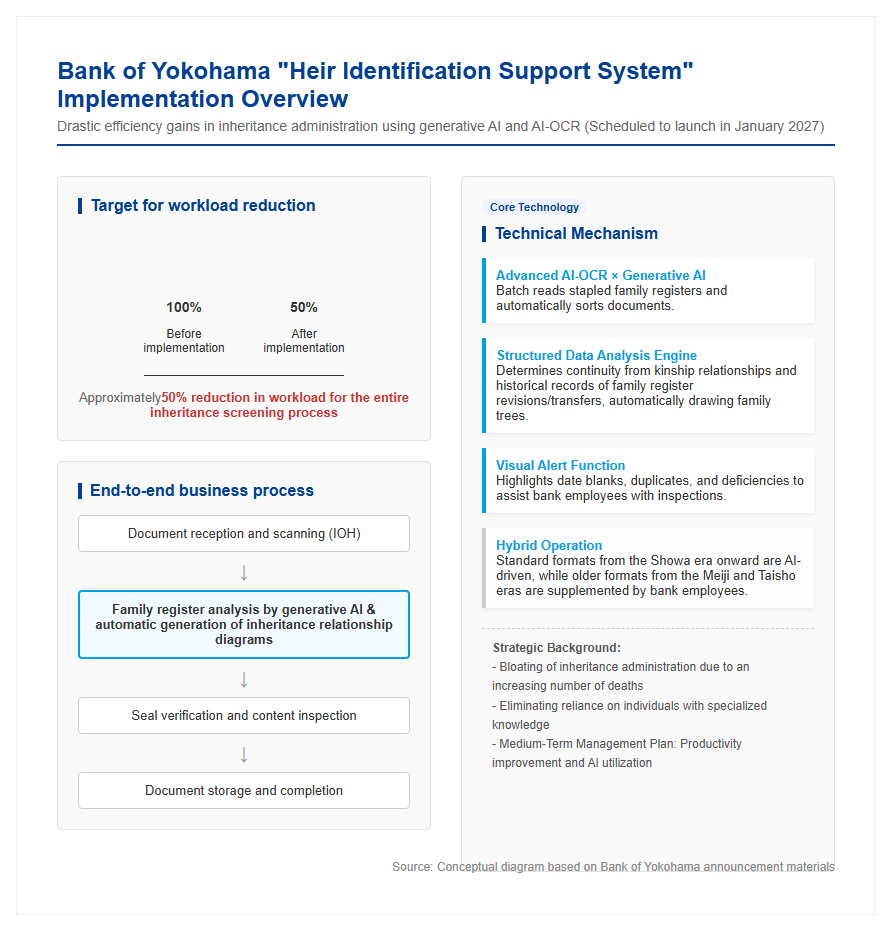
Based on the results of joint development and Proof of Concept (PoC) with Primagest Co., Ltd., the Bank of Yokohama has announced the implementation of an “Heir Identification Support System” utilizing generative AI starting in January 2027. This system is primarily designed for inheritance review operations at the inheritance support center of the Bank of Yokohama, the largest regional bank in Japan. As Japan’s aging population continues to grow, the number of inheritance procedures handled by financial institutions is steadily increasing. The task of deciphering continuous family register transcripts (koseki tohon) from a decedent’s birth to their death to identify legal heirs has become a bottleneck requiring highly specialized knowledge. This decision to implement the system is positioned as part of the “productivity improvement” priority in the bank’s medium-term management plan and the “advancement of AI and data utilization” led by its IT department. A key feature of the system construction is that it goes beyond simple character recognition technology to complete the entire inheritance administration process—which previously remained manual—on a single platform, encompassing everything from document reception and review to seal verification and post-completion document storage. Through the introduction of this system, the Bank of Yokohama aims to reduce the workload of the entire inheritance review process by approximately 50%.
Technical mechanism of automated family register analysis and inheritance relationship diagram creation realized by AI-OCR and generative AI
The core technology of this system is a structured data analysis engine that combines advanced AI-OCR with generative AI. Related documents, such as family register transcripts received by bank staff, are scanned in bulk using a specialized scanner (IOH) without removing staples, and the AI automatically categorizes the document types. For the ingested image data, generative AI determines the continuity of the family registers based on the recorded familial relationships and histories of revision or transfer, automatically generating an inheritance relationship diagram (family tree) centered on the decedent to identify the legal heirs. However, for old-style family registers from the Meiji or Taisho eras or documents written in difficult-to-decipher brush calligraphy, the system assumes supplementary work by bank staff; the logic is built so that the generative AI performs high-precision inference primarily on standardized formats from the Showa era onward. As shown in the figure below, the AI-generated draft data and the original image are displayed side-by-side on the screen, and deficiencies such as gaps in dates or overlaps are visually highlighted by an alert function, allowing personnel to conduct inspections efficiently and accurately.
A full digital workflow that automates everything from automatic seal verification to document storage in a single continuous process
In addition to supporting heir identification, the system implements comprehensive workflow functions that seamlessly link subsequent processes in the review workflow. For seal verification tasks required for procedures, the AI uses the seal impression image from the seal registration certificate as reference data, automatically extracts the impressions stamped on inheritance procedure request forms, inheritance division agreements, and powers of attorney, and executes high-precision verification. This allows the seal verification work, which was previously performed visually by experienced staff, to be completed quickly within the same system screen. Furthermore, if document deficiencies or omissions are discovered during the inspection process, the system includes a function to automatically output a “deficiency letter” to request resubmission from the customer. Once the final review is complete, document images are automatically converted to PDF and seamlessly linked to the existing electronic filing system operated by the financial institution for storage. This realizes end-to-end digitalization from reception to storage, eliminating the circulation costs of physical documents and the risk of loss associated with traditional paper-based operations.
Solving challenges in the financial industry and the future of generative AI governance
The background of resolving administrative burdens and reliance on individual expertise for financial institutions in the “Great Inheritance Era”
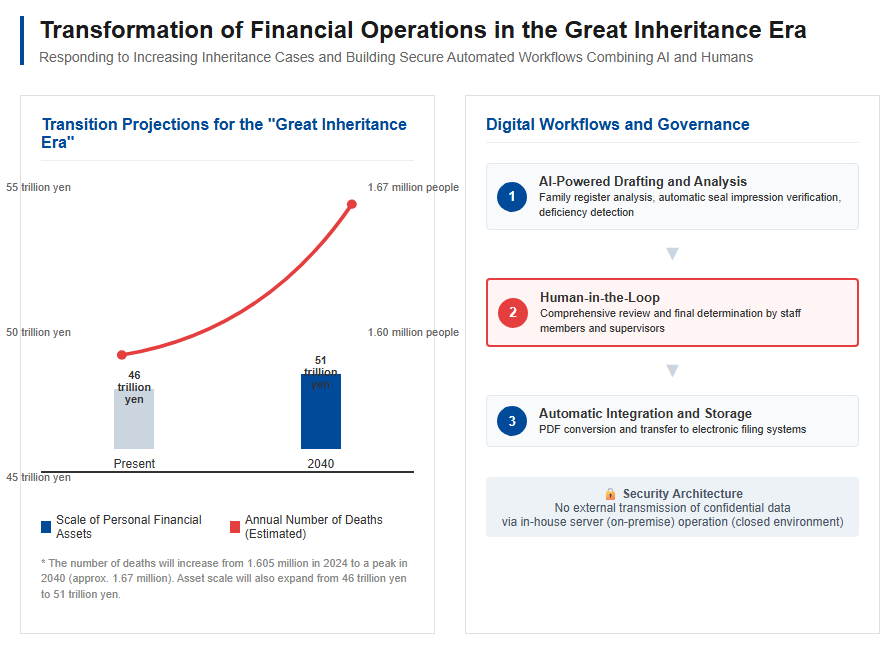
The number of deaths in Japan reached a record high of 1,605,378 in 2024, and according to estimates by the National Institute of Population and Social Security Research, it is projected to peak at around 1.67 million per year around 2040. Along with this, the scale of personal financial asset inheritance is set to expand from the current approximately 46 trillion yen per year to about 51 trillion yen by 2040, ushering in a full-scale “Grand Inheritance Era.” For regional financial institutions, the retirement of veteran employees with specialized expertise and a shortage of human resources in the face of a sudden surge in inheritance procedures have become serious challenges, and the reliance of heir identification tasks—which involve complex interpretations of the Civil Code—on specific individuals has caused operational delays. Manual family register decryption constantly carries the risk of input errors and oversights, and the long training period required for new staff to become fully independent has been a bottleneck in organizational management. The introduction of this system aims to standardize the know-how of experienced staff through on-screen navigation and checklists, enabling even inexperienced personnel to perform high-quality screening operations while simultaneously achieving both knowledge transfer and a significant reduction in training periods.
Rigorous Information Security via In-Bank Server Operations and Human Inspection Governance
Family register information is extremely sensitive personal data, and sending it directly to an external cloud-based generative AI service carries the risk of information leakage and privacy infringement. This system adopts an approach where the generative AI’s analysis engine and operational servers are built completely within the financial institution’s internal infrastructure (on-premises/in-bank network environment), establishing a robust security structure that prevents confidential data from ever leaving the bank. Furthermore, from the perspective of AI governance, the principle of “human-in-the-loop” is strictly enforced, ensuring that the AI’s output is not blindly accepted and that the final determination and confirmation tasks are always performed by humans (the responsible bank staff and supervisors). As shown in the system conceptual diagram below, the AI is dedicated to drafting and providing cautionary navigation, and by retaining a review flow for all cases by supervisors, a safety design is implemented that structurally prevents disadvantages caused by hallucinations (generation of misinformation) or misidentification.
Future Outlook and Key Points Opened Up by Horizontal Deployment to Regional Financial Institutions and Financial DX
The “AI Discussion Paper Version 1.1,” published by the Financial Services Agency in March 2026, designates 2025 as the “Inaugural Year of AI Agents” and emphasizes the importance of leveraging autonomous AI in financial institutions and establishing management-led governance. This initiative by the Bank of Yokohama and Primagest can be described as an advanced proof-of-concept example that applies sophisticated generative AI to customer-facing and practical examination processes ahead of financial regulatory guidelines. The developer, Primagest, plans to roll out this system widely as a common package to regional banks, shinkin banks, securities companies, and life insurance companies across Japan. Moving forward, expectations are high for automating account cancellation and refund procedures through Web reception integration at branch offices and data integration with core banking infrastructure systems, as well as expanding applications to will trusts and business succession operations. By having AI take over routine document examinations and establishing a framework where bank employees can focus on high-touch advisory services and customer consultations, a dramatic improvement in both productivity and customer engagement across regional financial institutions is drawing significant attention.
Reference Pages
- [Primagest, Inc. News Release] https://www.primagest.co.jp/news/2026-1015/
- [Financial Services Agency AI Discussion Paper] https://www.fsa.go.jp/
- [Bank of Japan Financial System Report Supplement] https://www.boj.or.jp/research/brp/fsr/data/fsrb250930.pdf
[#BankofYokohama #GenerativeAI #InheritanceDX #Primagest #FinancialDX #AIAgent #FamilyRegisterAnalysis #Governance]


コメント