
On November 23, 2026, European stock markets saw major indices rebound sharply across the board, with the UK’s FTSE 100 rising 1.30% and Germany’s DAX gaining 2.15%. This was driven by buying back of AI and semiconductor-related stocks following a sharp drop triggered by the return of US-based NVIDIA’s CEO, as well as improving regional economic indicators.
- The sharp rise in major European stock indices on November 23, 2026
- Return of US Semiconductor Giant’s Head and Market Drive by AI-Related Stocks
- Surge in High-Tech Stocks Led by Semiconductor Equipment Giant ASML
- Improvement in Eurozone Macroeconomic Indicators and Repurchasing of Defensive and Defense-Related Stocks
- ECB monetary policy stance and growth support through a shift toward active fiscal policy
- Attractive valuations and key points to watch in the market moving forward
The sharp rise in major European stock indices on November 23, 2026
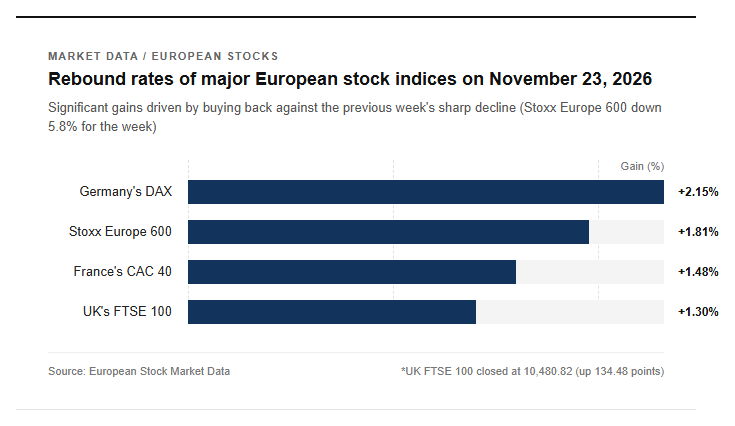
On November 23, 2026, European stock markets experienced a strong and synchronized rebound across major national stock indices, rapidly recovering the ground lost the previous week. The UK’s FTSE 100 index closed up 134.48 points, or 1.30%, at 10,480.82 compared to the previous Friday’s close. Germany’s benchmark DAX index surged significantly by 2.15% (or 2.26%), while France’s CAC 40 index also showed a broad-based rally with a 1.48% gain. The broader STOXX Europe 600 index rose 1.81% (1.8%) at the close, achieving its largest gain in just over two weeks. The Netherlands’ AEX index also showed solid momentum, up 2.15%. In the previous week, the STOXX Europe 600 had recorded a weekly decline of 5.8%, marking its largest drop since April 2025. A significant factor driving the rebound was a reaction formation against the excessive selling pressure from the previous week, which induced buybacks. As overall market sentiment improved, buying spread across a wide range of sectors. The list below shows the changes in major indices during this rally.
- UK FTSE 100 Index: Up 1.30% (10,480.82)
- German DAX Index: Up 2.15%
- French CAC 40 Index: Up 1.48%
- STOXX Europe 600 Index: Up 1.81%
The chart below illustrates the magnitude of the rebound for major indices on November 23, 2026.
Return of US Semiconductor Giant’s Head and Market Drive by AI-Related Stocks
The primary direct catalyst behind this significant surge was changing sentiment surrounding US semiconductor giant Nvidia. The announcement that CEO Jensen Huang—who had temporarily stepped down amid an affair scandal and other issues—would resume his duties effective immediately instantly alleviated investors’ excessive concerns regarding the company’s governance and the AI investment cycle. In the US financial market, the Nasdaq 100 Index rose by over 6%, and Nvidia’s own share price saw a record-breaking surge of over 31%. This revival of AI enthusiasm and risk-on sentiment in the US market exerted a direct spillover effect on European markets across time zones. The reassessment of growth expectations related to artificial intelligence (AI) reignited aggressive capital inflows into semiconductor manufacturing equipment makers and high-tech stocks. European asset management sources commented, “The return of the top executive confirmed that there are no critical issues surrounding AI infrastructure circular financing, leading to a great sense of relief.” The market’s regained confidence in the sustainability of the AI boom served as a powerful driving force for the broader market.
Factors Boosting Stock Prices and Individual Stock Movements
Surge in High-Tech Stocks Led by Semiconductor Equipment Giant ASML
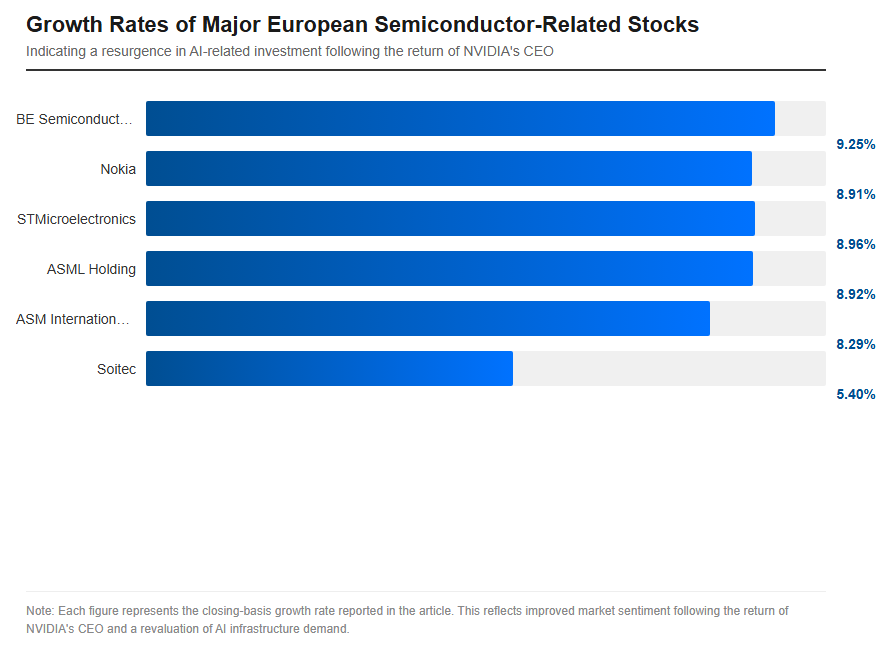
Among individual stock groups, shares of Dutch advanced semiconductor lithography system maker ASML Holding surged 8.9% (up 8.92%) at the close, drawing market attention. Fellow Dutch firm ASM International NV also recorded an 8.29% gain (with phases observing a 5.5% surge reaching €707), and BE Semiconductor (BESI) jumped 9.25%, with the semiconductor manufacturing equipment sector seeing broad-based buying. Additionally, broad technological gains stood out, including French semiconductor materials maker Soitec up 5.40%, STMicroelectronics up 8.96%, and Finnish telecommunications equipment giant Nokia up 8.91%. The semiconductor sector had faced selling pressure right up until this point due to tightening US export controls and rising geopolitical risks, but the return of Nvidia’s CEO triggered a rush of dip-buying. Furthermore, shareholder return initiatives by individual companies—such as ASM International NV’s €300 million share buyback program initiated on November 11, 2026—acted as a supporting factor for stock prices. The price recovery of key companies driving advanced technologies significantly contributed to lifting the entire European stock market.
The figure below shows the growth rates of major European semiconductor-related stocks.
Improvement in Eurozone Macroeconomic Indicators and Repurchasing of Defensive and Defense-Related Stocks
The rise in stock prices was not limited to tech stocks; it was strengthened by improving macroeconomic indicators and the rotation of funds into other sectors. Economic data, such as the Purchasing Managers’ Index (PMI) for private sector activity in the Eurozone for November 2026, showed that growth remains resilient. In particular, investor sentiment in Germany improved more than expected, offsetting economic weakness in France and supporting investor psychology. Additionally, there was broad buying in defensive stocks such as food, beverages, and healthcare, which had seen concentrated profit-taking in the previous week, as well as in defense and mining stocks amid geopolitical tensions. Key trends among major countries and companies include the following:
- A recovery in financial stocks, led by major German lender Deutsche Bank
- Inflow of funds into European defense and infrastructure-related stocks following the trend of increased defense spending
- Swiss industrial giant ABB announces the acquisition of a German cooling systems company ($2.2 billion scale)
The synergy between the resilience of the macroeconomy and the autonomous rebound of sectors that had undergone prior adjustments drove a broad-based lift in the overall stock market.
Medium-to-long-term outlook for the European economy and structural tailwinds
ECB monetary policy stance and growth support through a shift toward active fiscal policy
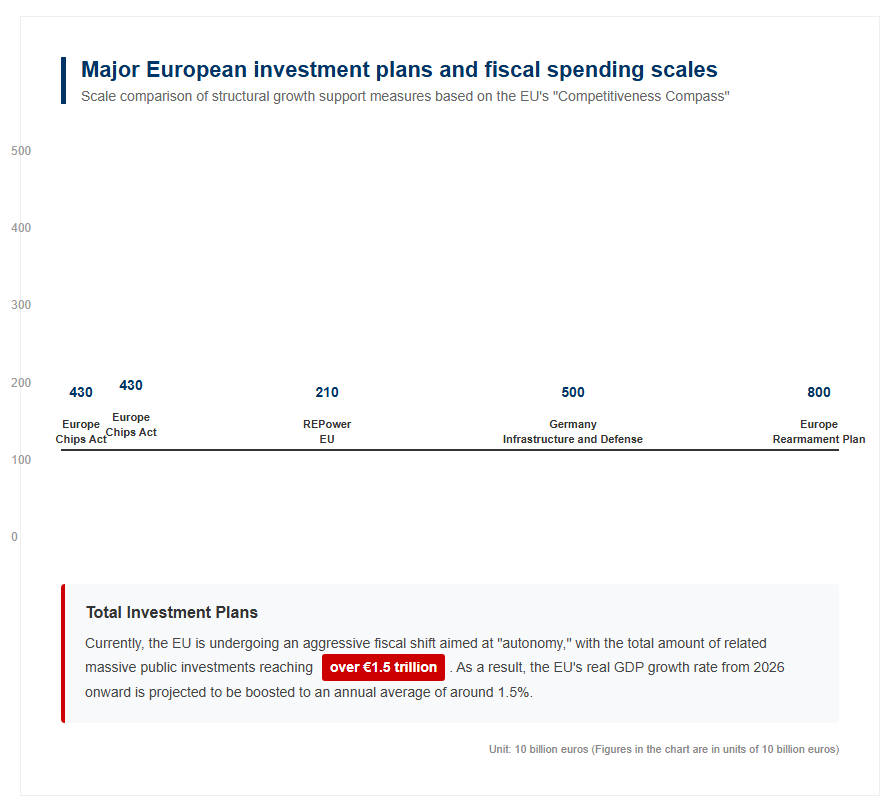
Regarding the medium-to-long-term outlook for the European economy, structural changes are occurring from both the perspective of central bank monetary policy and government fiscal policy. The European Central Bank (ECB) has raised its policy rate, the deposit facility rate, to 2.25%, reaching the upper end of the neutral rate range (1.75%–2.25%). Although it is expected to reach approximately 3.00% by March 2027, analysis suggests that the risk of the economy falling into severe negative growth is low due to the light net interest payment ratios of regional companies and the outlook for achieving inflation targets. Meanwhile, the EU has shifted toward active fiscal policy aimed at “autonomy” in economy and defense under the “Competitiveness Compass” led by European Commission President von der Leyen. Massive public investments totaling over 1.5 trillion euros are underway, including Germany’s 500 billion euro infrastructure and defense investment plan, the European rearmament plan (800 billion euros), REPowerEU (over 210 billion euros), and the European Chips Act (over 430 billion euros). These large-scale fiscal expansions are expected to raise the EU’s average annual real GDP growth rate to approximately 1.5% from 2026 onwards.
The following figure shows the scale of European investment plans and fiscal expenditures.
Attractive valuations and key points to watch in the market moving forward
Among international investors, the attractive valuation of European equity markets is emerging as a compelling investment rationale. The 12-month forward Price-to-Earnings (PER) ratio of the MSCI Europe Index stands at 14.9x, remaining at a significantly undervalued level compared to 19.5x for the U.S. S&P 500 Index. Furthermore, in terms of dividend yield, European stocks are approximately 2.7%, significantly outperforming U.S. stocks at approximately 1.0%, offering an advantage in both income and capital gains. Key points to watch in future developments include the tightening of U.S. semiconductor export restrictions to China and the geopolitical implications following changes in the U.S. administration. Additionally, it remains to be seen whether corporate AI-related capital expenditures will translate into actual profits, and how companies will address structural challenges, such as the move by the UK’s Compass Group to change its listing from London to New York. While remaining cautious of short-term risks, investors are entering a phase of reconsidering capital allocation to European markets against the backdrop of fiscal expansion and a growth recovery scenario.
Reference Page
- [European Equities: Broad-based sharp rebound = UK up 1.30%, Germany up 2.15% (23rd)] https://finance.yahoo.co.jp/news/detail/3e591b0cbb7309db4472fb99e164cffb0bfb2b3e
[#EuropeanEquityMarket #StockRebound #SemiconductorStocks #Nvidia #EconomicOutlook]


コメント