Itochu Techno-Solutions (CTC) has launched a new feature for “StageCrew™” that uses AI to extract and document the tacit knowledge of skilled experts. This initiative comes in response to the growing crisis of technology transfer and increasing pressure on frontline staff caused by the retirement of experts and increased labor mobility.
- CTC Announces StageCrew’s AI Interview Feature and the Background Behind It
- Kikuvi’s AI Hearing Technology and Offline Video Processing System
- Management Risks Caused by Expert Retirements and the “Loss of Knowledge”
- Limitations of Traditional Knowledge Transfer Methods and the Turning Point for Generative AI Utilization
- Practical Application and Ripple Effects for Manufacturing Sites and Essential Workers
- Future Developments, Focus Areas, and Prospects for Knowledge Transfer
CTC Announces StageCrew’s AI Interview Feature and the Background Behind It
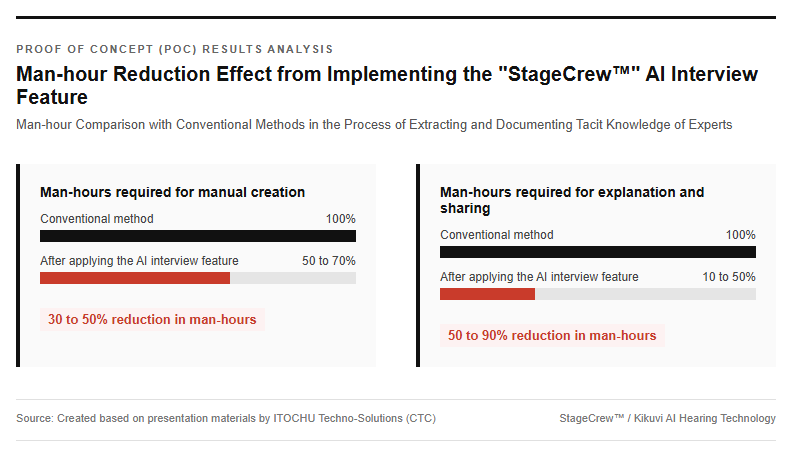
On November 24, 2026, Itochu Techno-Solutions Corporation (CTC) announced the addition of a new AI interview feature to “StageCrew™,” a cloud service designed to streamline system development and operational tasks, which extracts and documents the tacit knowledge of skilled experts. This feature utilizes AI hearing technology provided by Kikuvi Inc. to extract the judgment criteria and reasoning held by experts through dialogue. In Proof of Concept (PoC) testing, the feature achieved significant results, reducing the man-hours required for manual creation by 30–50% and the man-hours required for explanation and sharing by 50–90%. As shown in the figure below, the AI structures field-based knowledge.
Furthermore, CTC has established a support system where Field Deployment Engineers (FDEs)—specialized engineers who drive business operations on-site until results are achieved—provide end-to-end support, from selecting target tasks to implementation and rollout to other departments. Additionally, the technology is being utilized in the “GENIAC-PRIZE 2026” program conducted by NEDO, promoting business process reforms aimed at addressing labor shortages among essential workers.
Kikuvi’s AI Hearing Technology and Offline Video Processing System
The core AI interview technology of this feature is designed to multi-dimensionally analyze operational videos and existing documents to automatically generate questions for experts. By analyzing work scenes at manufacturing sites, worker-perspective footage captured by wearable cameras, and audio, the system asks precise questions appropriate to the situation. This enables the systematic extraction and documentation of tacit knowledge—such as points of focus, judgment criteria, and the underlying reasons or context during tasks—which was difficult to record using traditional work procedure manuals. Additionally, as a security measure, CTC also provides “StageCrew Studio,” which automatically masks faces and text appearing in videos. This masking process is executed in an offline environment, ensuring that only the processed footage is transmitted to the cloud. Advanced video processing is performed as shown in the figure below.
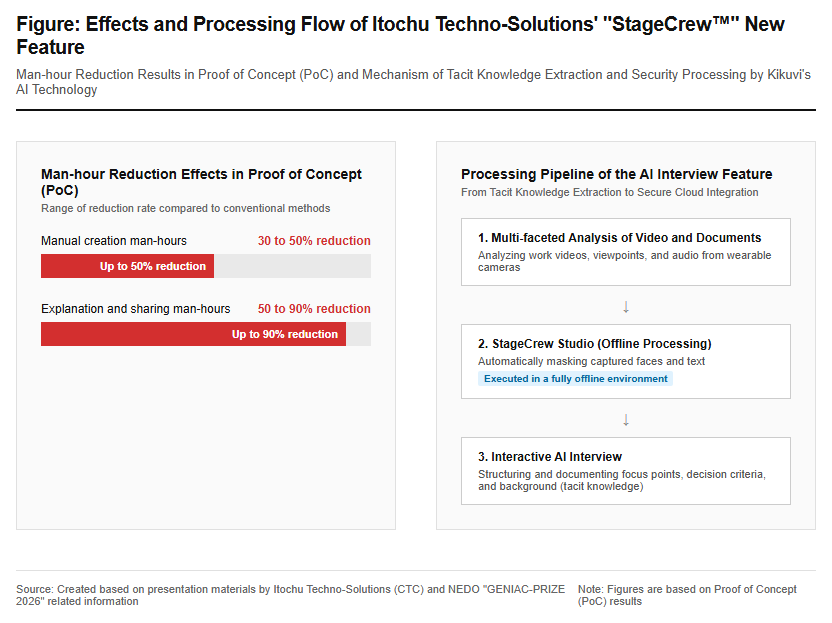
Even with on-site footage containing confidential information, operations are realized that minimize the risk of leakage as much as possible.
The Importance and Challenges of Converting Tacit Knowledge to Explicit Knowledge on the Frontlines
Management Risks Caused by Expert Retirements and the “Loss of Knowledge”
In many industrial settings, the judgment and expertise of skilled veterans, backed by years of experience, form the core of a company’s competitiveness. However, traditional manuals often only record superficial procedures, while the essential criteria for why a particular judgment was made remain trapped in the individual’s mind. As the working-age population declines and expert retirements coincide, the “loss of knowledge”—where this expertise disappears without being passed down—has become a major management risk that leads to declining product/service quality and the recurrence of errors. In the “Externalization” stage of the “SECI model” of knowledge creation theory, there is a difficulty in converting sensory expertise, which is hard to express in words, into explicit knowledge; traditional one-on-one OJT (On-the-Job Training) and interviews have faced resource limitations. The immense amount of time required for interviewing experts and performing documentation tasks serves as a structural barrier to technology transfer.
Limitations of Traditional Knowledge Transfer Methods and the Turning Point for Generative AI Utilization
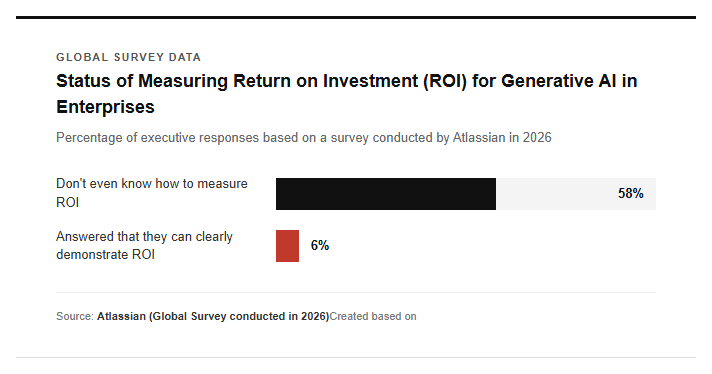
The use of generative AI in enterprises has often been limited to simple task efficiencies, such as summarizing meeting minutes or drafting documents. According to a global survey conducted by Atlassian in 2026, only 6% of executives responded that they could clearly demonstrate the Return on Investment (ROI) of AI technology, while 58% responded that they did not even know how to measure ROI. This highlights that many organizations lack the necessary knowledge infrastructure suitable for AI utilization. Simply feeding internal documents into an AI results in vague descriptions like “make a comprehensive judgment,” which fails to cultivate the judgment necessary to handle exceptional circumstances. In response, an approach is required where the AI acts as a catalyst for dialogue, digging deeper by using specific past cases and counterfactuals to ask questions like, “Under what conditions would you change your judgment?” A shift toward new knowledge management is necessary to convert individual tacit knowledge into reusable organizational data.
Expected Social Significance and Future Developments
Practical Application and Ripple Effects for Manufacturing Sites and Essential Workers
The visualization of tacit knowledge through StageCrew™’s new features is expected to bring innovation to diverse industrial sites, including manufacturing. By articulating, structuring, and manualizing the decision-making criteria of experts, it accelerates the early onboarding and capability building of new employees and young workers. As shown in the diagram below, an environment is established where humans and AI teach and learn from one another.
Furthermore, the accumulated knowledge not only functions as educational content for humans, but is also utilized as a knowledge base when AI agents assist and execute tasks. Through this, insights that were once locked within individual human capital are elevated into “AI organizational capital” that can be reused across the entire enterprise. Especially in essential worker environments facing severe labor shortages, this is expected to significantly contribute to fundamental reforms in business processes and improvements in productivity.
Future Developments, Focus Areas, and Prospects for Knowledge Transfer
Since developing StageCrew™ in 2023, CTC has built a track record of global delivery, including expanding into the North American market. On December 10, 2026, CTC is scheduled to host a seminar titled “—Embedding Tacit Knowledge in the Organization, Not the Individual— From Individual AI Utilization to Organizational AI Utilization,” where it plans to share practical use cases and know-how. The mechanism by which the tacit knowledge of experts is elicited and AI autonomously asks questions using videos and documents as a starting point is attracting attention as a potential standard model for future knowledge transfer. Building a co-evolutionary learning ecosystem where humans and AI mutually enhance each other’s capabilities, rather than merely storing knowledge temporarily, is the key to sustainable corporate growth. The evolution of initiatives to digitize the valuable know-how dormant in operational sites and reliably pass it on to the next generation is eagerly anticipated.
Reference Pages
- [Itochu Techno-Solutions Corporation News Release] https://www.ctc-g.co.jp/news/release/20261124-02172.html
- [StageCrew™ Official Website] https://stagecrew.ai/
- [Kikuvi Inc. Official Website] https://kikuvi.com/
[#CTC #StageCrew #TacitKnowledge #AIInterview #KnowledgeTransfer #GenerativeAI]

コメント