As surging infrastructure costs and data security concerns surface amid the rapid adoption of generative AI, an increasing number of companies are migrating their production AI inference workloads from public clouds to private clouds. Hewlett Packard Enterprise (HPE) is advancing a unique AI infrastructure strategy that simultaneously achieves drastic reductions in token costs and enhanced governance through the deployment of its turnkey solution, “HPE Private Cloud AI,” and the use of internal agentic AI.
- The “Limits of Public Cloud” Triggered by the Surge in AI Spending and Market Events
- The Definitive Shift in Inference Processing and the Demand for Data Sovereignty
- The Complete Picture of the Turnkey “HPE Private Cloud AI” Platform
- Demonstration of Model Routing and Up to 60% Token Cost Reduction
- Redesign of Internal Finance Operations and Evolution into the “AI Factory”
- Expansion of the AI Server Market Toward 2030 and Future Key Points
The “Limits of Public Cloud” Triggered by the Surge in AI Spending and Market Events
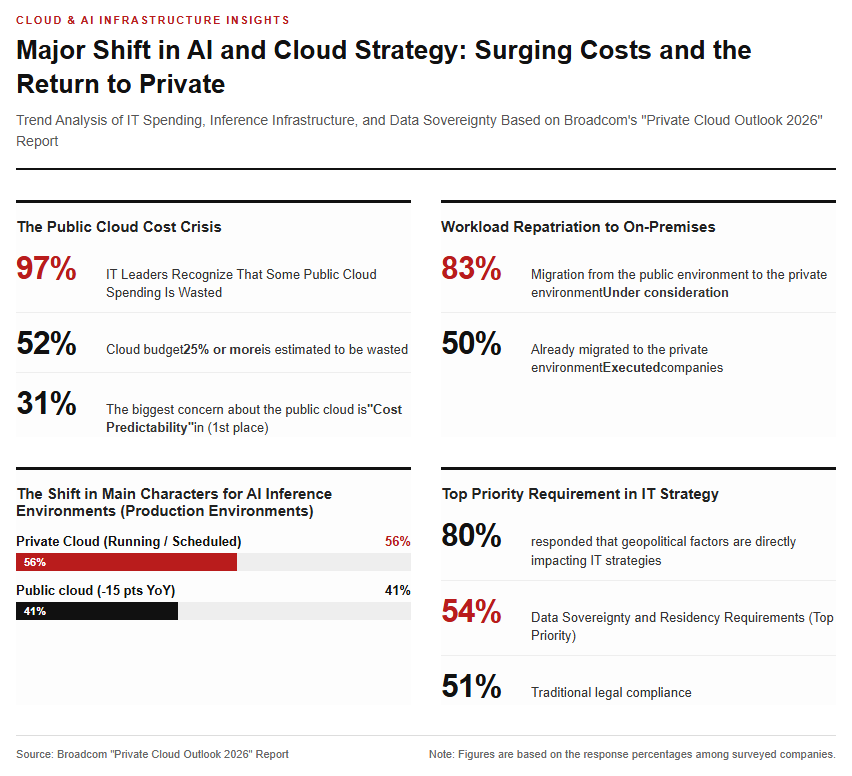
With the acceleration of enterprise AI adoption, the sharp increase in costs associated with public cloud usage has emerged as a serious management challenge. According to a report compiled by research firm Esker, 72% of financial leaders reported that AI-related expenditures exceeded initial plans over the past year. Furthermore, according to the “Private Cloud Outlook 2026” report published by Broadcom, 97% of IT leaders recognize that some portion of their public cloud spending is wasted, with 52% estimating that over 25% of their cloud budgets are being squandered. Driven by this cost inflation, “cost predictability” has overtaken traditional security to become the number one concern regarding public cloud usage, cited by 31% of respondents. As a result, the findings show that 83% of surveyed companies are considering repatriation—moving workloads from the public cloud back to private environments—with 50% having already executed the migration. This shift is happening because, as the experimental phase of AI models concludes and operations transition to production, cost management has become the top priority.
The Definitive Shift in Inference Processing and the Demand for Data Sovereignty
In the migration from public clouds to private environments, AI model inference processing is seeing a particularly notable trend. According to Broadcom’s report, 56% of companies surveyed reported that they are currently running or plan to run AI inference in production environments on private clouds. Meanwhile, the proportion of inference running on public clouds plummeted by 15 percentage points year-over-year to 41%, confirming that the primary infrastructure for inference is clearly shifting to private environments. Another major factor driving this change is the demand for data governance and data sovereignty amid rising geopolitical risks. Eighty percent of IT leaders responded that geopolitical factors directly impact their IT strategies, with data sovereignty and residency requirements (54%) surpassing traditional legal compliance (51%) to become the top priority. Centered on industries handling massive amounts of confidential and customer data—such as finance, the public sector, healthcare, and manufacturing—the value of private clouds, which allow organizations to process data with low latency while keeping it under their own control, is being reassessed.
HPE’s “Private Cloud AI” Strategy and Technical Approach
The Complete Picture of the Turnkey “HPE Private Cloud AI” Platform
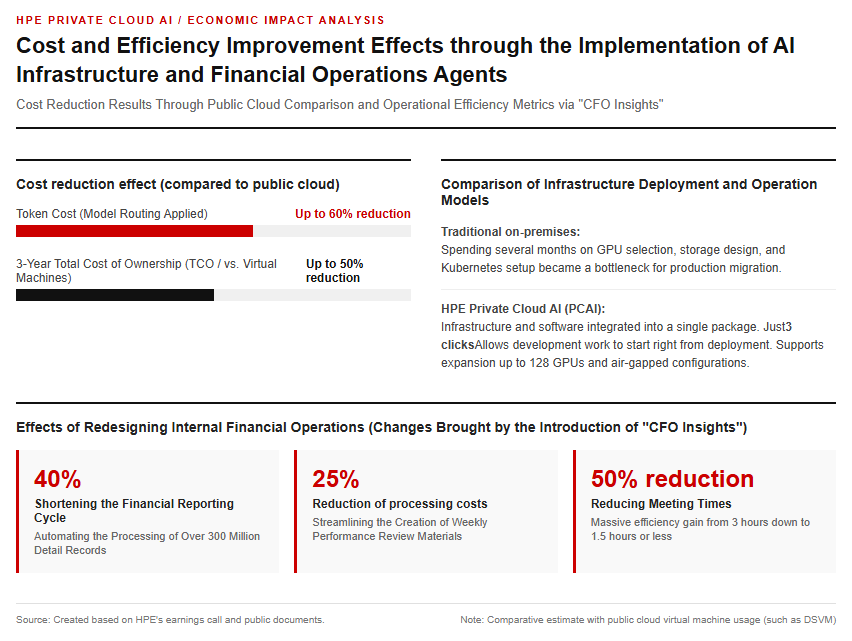
Enterprise infrastructure giant Hewlett Packard Enterprise (HPE) is capitalizing on this surge in private cloud demand by deploying “HPE Private Cloud AI (PCAI)”, a turnkey AI infrastructure jointly developed with NVIDIA. In traditional on-premises AI deployments, selecting GPU servers, designing storage, and building a Kubernetes environment took months, acting as a barrier to production migration. PCAI provides the necessary infrastructure and software as an integrated package, creating an environment where deployment and development work can begin in just three clicks. The March 2026 update added support for NVIDIA Blackwell and Vera Rubin architectures, network racks scalable up to 128 GPUs, and an air-gapped configuration that protects sensitive data in a completely isolated environment. Furthermore, for storage, “HPE Alletra Storage MP X10000″—the world’s first object storage to obtain NVIDIA-Certified Storage certification—has been adopted, supporting high-speed training and inference processing of large-scale data.
The diagram below shows the architectural concept of a turnkey AI platform.
Demonstration of Model Routing and Up to 60% Token Cost Reduction
At the core of HPE’s strategy is the thorough optimization of AI processing costs through intelligent model routing. For companies advancing AI adoption internally, the “bloat of token consumption,” which consumes expensive API usage fees, has become a serious problem. According to results revealed by HPE Chief Financial Officer (CFO) Marie Myers during an earnings call, HPE deployed open-source and open-weight models on its own private cloud to build an agentic AI platform. Daily routine tasks and internal processing are automatically distributed to cost-efficient on-premises models, limiting the invocation of large-scale “frontier models” only to tasks that require advanced judgment. Through this approach, HPE successfully reduced token costs internally by up to 60% compared to using a public cloud. Furthermore, in cost comparisons across development environments and overall operations, it is estimated that total cost of ownership (TCO) can be reduced by up to 50% over three years compared to using public cloud virtual machines (such as DSVMs).
Turning Company-Wide AI into Assets, Market Trends, and Future Outlook
Redesign of Internal Finance Operations and Evolution into the “AI Factory”
HPE is going beyond merely providing infrastructure, actively redesigning its own internal business processes to be AI-centric. In collaboration with Deloitte, the company built an on-premises financial AI agent called “CFO Insights” to automate the massive amount of document creation required for weekly performance reviews. Previously, more than 100 staff members created PowerPoint presentations from over 300 million line-item data points, but this has now been changed so that a single agent handles automated analysis and the creation of summary notes. As a result, meeting times that previously took three hours have been cut to an hour and a half or less, the financial reporting cycle has been shortened by 40%, and processing costs have been reduced by 25%. Furthermore, by integrating the observability platform “OpsRamp,” HPE has established an environment where token consumption and costs across the entire organization can be tracked on a single screen. Moving away from the traditional style where individual developers experiment in isolation, placing emphasis on operating as a shared “AI Factory” that generates company-wide productivity is considered crucial.
The following diagram illustrates the concept of an AI factory that consolidates business data for continuous operation.
Expansion of the AI Server Market Toward 2030 and Future Key Points
According to a forecast by research firm ABI Research, the global AI server market is projected to expand significantly from $245 billion in 2025 to $524 billion in 2030, representing a compound annual growth rate (CAGR) of 18%. In particular, fine-tuned models optimized for specific tasks and execution workloads for agentic AI are forecasted to record explosive annual growth of 68% through 2028. HPE captured a 15% share of the AI server market in 2024, securing the position of the world’s second-largest player, and brought the entire networking IP stack under its umbrella through the acquisition of Juniper Networks, which was completed in July 2025. Furthermore, by securing a $1.2 billion AI rack order from cloud provider Vultr and expanding its partnership with Oracle Cloud Infrastructure, the company is solidifying its foothold in the hybrid AI infrastructure market. Moving forward, as generative AI moves past the proof-of-concept (PoC) stage, whether companies can achieve secure and cost-effective AI operations in production environments utilizing their own data will become the watershed moment for corporate competitiveness.
Reference Page
- 【HPE accelerates secure, scalable production-ready AI through new innovations with NVIDIA】[suspicious link removed]
- [Broadcom Private Cloud Outlook 2026 Press Release] https://investors.broadcom.com/news-releases/news-release-details/broadcoms-private-cloud-outlook-2026-reveals-ai-tipping-point
- [HPE Private Cloud AI Official Solution Information] https://www.hpe.com/us/en/products/private-cloud/pcai.html
- 【ABI Research – AI Server Market Size, Vendor Shares, and Investment Drivers】https://www.abiresearch.com/blog/ai-server-market-size-vendor-shares-and-investment-drivers
- 【HPE Closes Acquisition of Juniper Networks】[suspicious link removed]
【#PrivateCloud #HPE #AISpending #InferenceWorkloads #DataSovereignty #OnPremisesAI #AIFactory #ITInfrastructure】


コメント