On November 24, 2026, International Procurement Information Co., Ltd. announced the launch of Google’s latest language model, “Gemini 4 Neon,” and other models on its AI gateway platform, “FastMetal.” This establishes an environment where enterprises and developers can quickly and safely utilize models equipped with state-of-the-art inference and processing capabilities through a Japanese Yen-denominated pre-charge payment system.
- Overview of Services and Supported Models Starting November 24, 2026
- Benefits for Corporate Adoption Brought by Yen-Denominated Prepaid Billing and Invoice Compliance
- Long-Context Processing of Approximately 1 Million Tokens and Multimodal Support
- Inference Performance and Cost-Performance That Overwhelm Competitor Models
- Potential for Combined Use with the Open-Weight Model Inkling 2 Small
- Multi-Agent Coordination and Operational Outlook via Orchestrator
Overview of Services and Supported Models Starting November 24, 2026
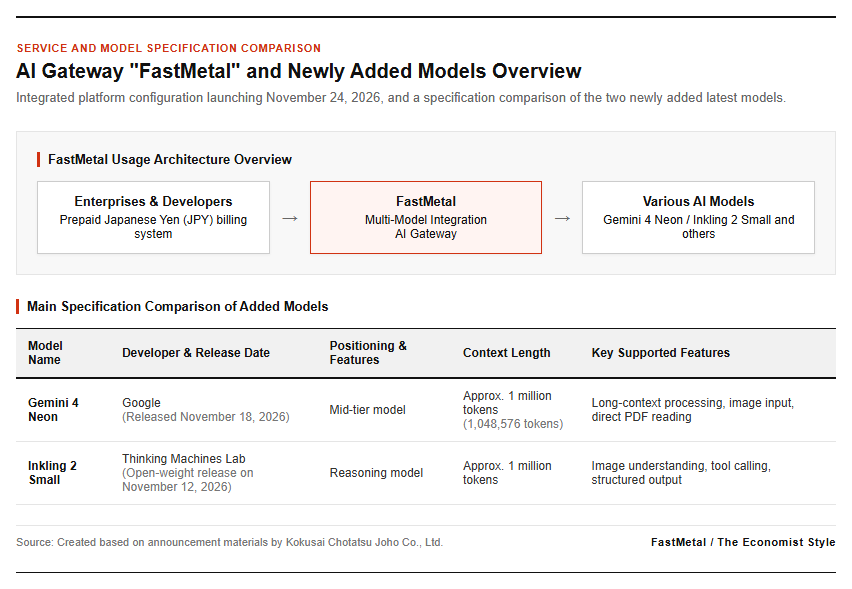
Starting November 24, 2026, International Procurement Information Co., Ltd. began offering “Gemini 4 Neon,” a large language model released by Google on November 18, 2026, on its multi-model AI gateway “FastMetal.” Additionally, “Inkling 2 Small,” an inference model announced by Thinking Machines Lab on November 5, 2026, and released as open weights on November 12 of the same year, was added at the same time. FastMetal is an integrated platform that allows users to switch between and utilize a diverse range of high-performance AI models starting from the day of registration via a web chat interface and other means.
The main specifications and features of the provided models are as follows.
- Gemini 4 Neon: A mid-tier model developed by Google that supports long-context processing of approximately 1 million tokens (1,048,576 tokens), image input, and direct PDF reading.
- Inkling 2 Small: An inference model developed by Thinking Machines Lab that supports a context length of approximately 1 million tokens, image understanding, tool calling, and structured output.
Please refer to the following overview diagram for the overall system architecture and usage image.
Benefits for Corporate Adoption Brought by Yen-Denominated Prepaid Billing and Invoice Compliance
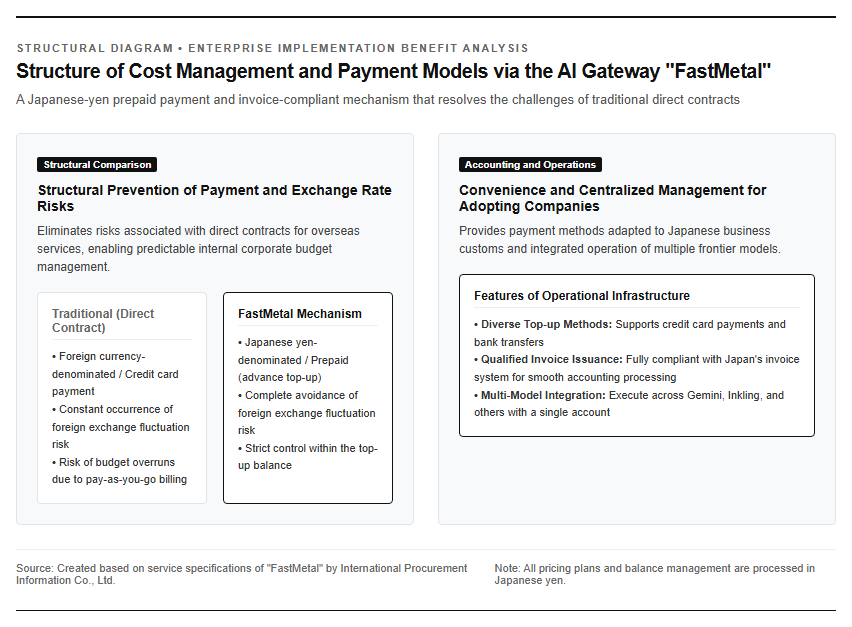
The greatest operational advantage offered by FastMetal is that all AI model usage fees are managed in Japanese Yen on a prepaid (pre-charged) basis. This structurally prevents foreign exchange fluctuation risks that occur when directly contracting with overseas AI services, as well as unexpected budget overruns caused by pay-as-you-go billing. Because consumption is limited to the charged balance, cost management within companies becomes extremely easy.
The specific adoption benefits are as follows.
- Supports balance recharging via credit card payment and bank transfer.
- Facilitates smooth accounting processing by issuing qualified invoices compliant with Japan’s invoice system.
- Allows users to cross-select and execute major domestic and international frontier models with a single account.
Models of the same generation, such as Gemini 4 Hydrogen, Argon, and Carbon, can also be selected from the same screen, realizing optimal model selection according to the intended use.
Technical Features and Overwhelming Cost-Effectiveness of Gemini 4 Neon
Long-Context Processing of Approximately 1 Million Tokens and Multimodal Support
Gemini 4 Neon is a frontier-grade mid-tier model designed to pursue an optimal balance between depth of thought and processing efficiency. Leveraging a vast context window of 1,048,576 tokens, it can batch-process massive amounts of text data and technical documents. Furthermore, it is equipped with a long-decode mechanism that performs continuous generation of up to approximately 1 million tokens, enabling the output of seamless, long-form responses.
The technical functional characteristics are as follows.
- Multimodal support: Standard support for high-resolution image input and direct analysis of PDF documents.
- Native document processing: Office format files such as Word (.docx), Excel (.xlsx), and PowerPoint (.pptx) can be directly input without text conversion and incorporated into the inference loop.
Please refer to the following conceptual diagram regarding the data flow and model configuration of the processing pipeline.
Inference Performance and Cost-Performance That Overwhelm Competitor Models
Gemini 4 Neon has demonstrated exceptionally superior capability and high reliability in third-party evaluation institutions and various benchmarks. It scored 58.6 points in the Artificial Analysis Coding Agent Index, which measures practical coding ability, capturing overall first place. Additionally, it achieved 61 points in the Intelligence Index, which measures general intelligence, ranking 3rd out of all models, and 65.2% in Terminal-Bench 4.1, a terminal task evaluation.
The main performance records in terms of cost and security are as follows.
- API unit prices: Set at $3.00 per million input tokens and $15.00 per output token, with a 95% discount on inputs to $0.15 when utilizing implicit caching.
- Cost reduction: Achieves a 32% reduction in task costs compared to the top-tier Carbon model, and a 50% to 80% reduction in costs compared to competing frontier models.
- High security: Achieved a 0.0% success rate in Gray Swan’s Indirect Prompt Injection (IPI) attack tests.
The Future of AI Development and Business Automation, and Key Areas to Watch
Potential for Combined Use with the Open-Weight Model Inkling 2 Small
Another notable model that FastMetal has begun offering is “Inkling 2 Small,” developed by Thinking Machines Lab. Released on November 12, 2026, as an open-weight reasoning model under the commercially usable Apache 2.0 license, it significantly outperforms previous generations in agentic coding—where AI autonomously builds procedures for development—and advanced intellectual tasks.
The main features and application aspects of the open-weight model are as follows:
- Supporting a context length of 1,048,576 tokens, it can comprehensively understand large codebases and visual information all at once.
- It comes with native support for features that autonomously call external tools and structured outputs that return responses in specified formats.
This enables advanced multi-model operations, allowing flexible switching between the commercial proprietary model Gemini 4 Neon and open-weight models according to a company’s security requirements and cost design.
Multi-Agent Coordination and Operational Outlook via Orchestrator
The application of generative AI has evolved from single-model conversations to multi-agent configurations where multiple models share roles and autonomously coordinate. In development environments like Google Antigravity, a two-tier operation is becoming standardized: placing Gemini 4 Neon as the “Orchestrator” (in charge of advanced planning and design) and delegating routine code rewrites and test executions to Gemini 4 Hydrogen as the “Subagent” (in charge of execution).
The future benefits brought by multi-agent operations are as follows:
- Because control is returned to the orchestrator for fixes only when the subagent hits a roadblock, quota consumption and waiting times can be drastically reduced.
- The total cost of completing 100 tasks, including labor costs and API usage fees, can be dramatically driven down.
With diverse models becoming more accessible through integrated gateways like FastMetal, business reforms based on practical costs—shifting from “which model is the smartest” to “how to combine the right models to complete tasks at the lowest cost and highest speed”—are expected to accelerate moving forward.
Reference Pages
- [FastMetal Launches “Gemini 4 Neon” (PR TIMES)] https://prtimes.jp/main/html/rd/p/000000029.000190886.html
- [Google “Introducing Gemini 4 Neon”] https://blog.google/innovation-and-ai/models-and-research/gemini-models/introducing-gemini-4-neon/
- [Thinking Machines Lab “Introducing Inkling 2 Small”] https://thinkingmachines.ai/news/inkling-2-small/
[#GenerativeAI #Gemini4Neon #FastMetal #AIGateway #DXPromotion]
コメント