It has become clear that the U.S. government is preparing new tariff hikes targeting countries such as Japan and China. The backdrop is believed to include dissatisfaction with the partner countries’ overproduction and industrial subsidies, as well as an aim to divert domestic political attention.
- Overview and Background of Multilateral Additional Tariffs
- Past Trade Agreements and Policy for Setting Country-Specific Tax Rates
- Imbalance of Tariff Costs Borne by U.S. Companies and Importers
- Ripple Effects on Individual Industries Such as Steel and Automobiles, and Supply Chain Restructuring
- Geopolitical Trends in U.S. Politics and Structural Changes in the Rust Belt
- Future Trade Negotiations and Strategic Countermeasures for Japanese Companies
Overview and Background of Multilateral Additional Tariffs
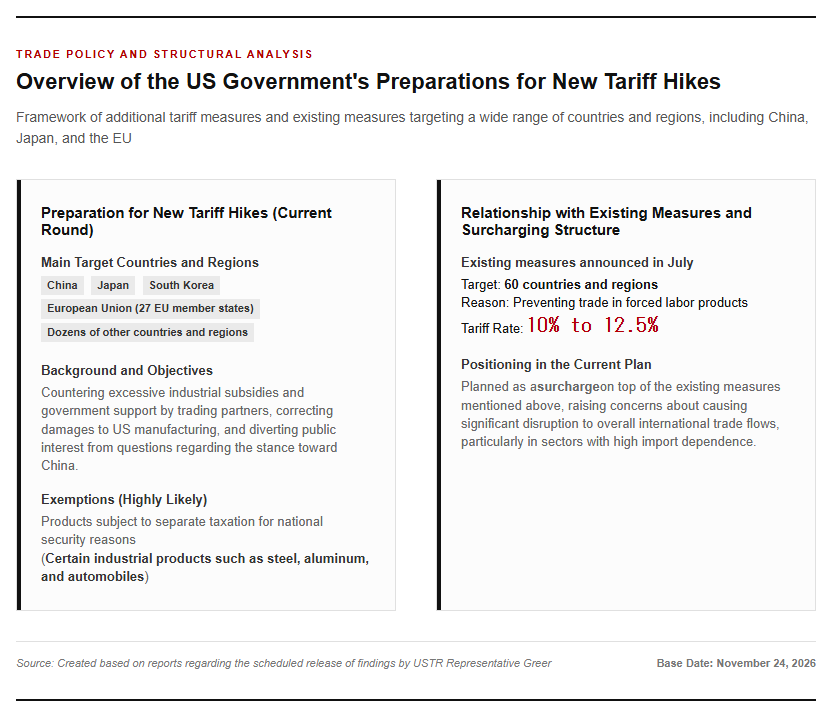
On November 24, 2026, reports brought to light that the U.S. government is preparing new tariff hikes targeting dozens of countries and regions, including China, Japan, and the European Union (EU). U.S. Trade Representative (USTR) Greer is expected to release the results of a multi-month investigation, stating that excessive industrial subsidies and government support by partner countries and regions flood the global market with cheap products and harm the U.S. manufacturing industry.
It has also been pointed out that behind this decision is the aim to divert public attention from questions regarding the stance toward China in the technology sector. The scope is expected to be extremely broad, including China, Japan, South Korea, and the 27 EU member states. However, some industrial products such as steel, aluminum, and automobiles, which are taxed separately for national security reasons, are likely to be excluded from this measure.
In addition, this measure is planned to be piled on top of the existing measure announced in July, which imposes tariffs of 10% to 12.5% on 60 countries and regions on the grounds of blocking trade in forced labor products. There are concerns that this will cause significant confusion throughout international trade flows, especially in sectors with high import dependency. Please refer to the figure below.
Past Trade Agreements and Policy for Setting Country-Specific Tax Rates
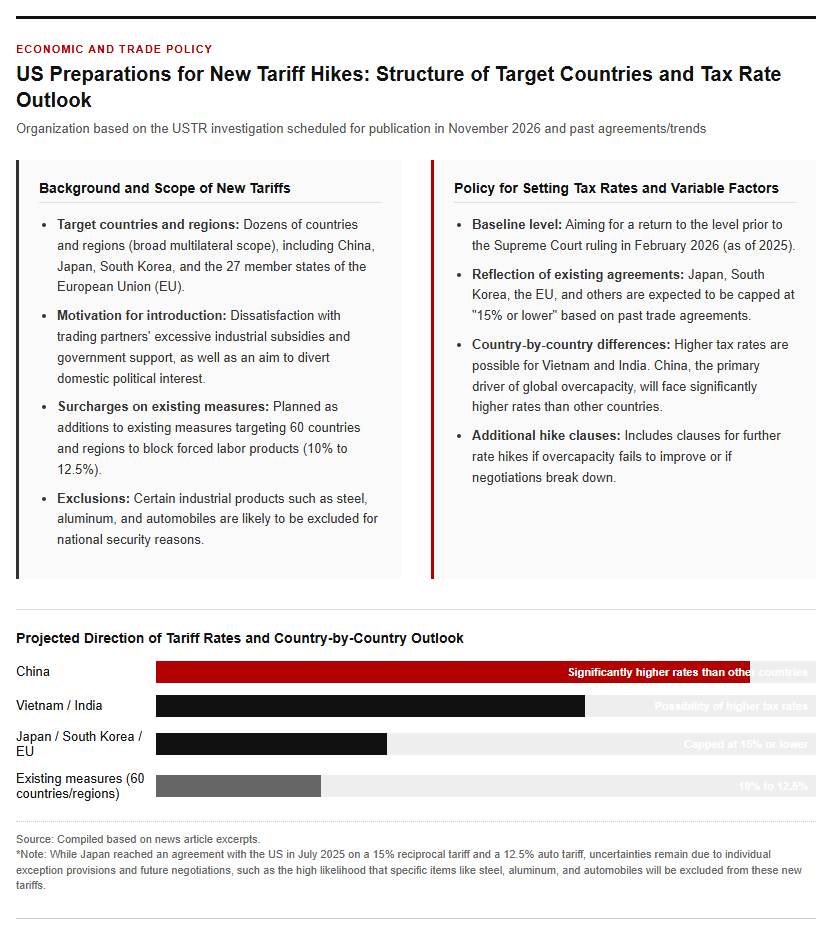
The new tariff rates are being adjusted aiming for levels comparable to those in 2025, before the U.S. Supreme Court invalidated President Trump’s original tariff measures in February 2026. For countries and regions that have previously concluded trade agreements with the United States, the contents of those agreements are expected to be reflected.
Specifically, the reciprocal tariff rates for Japan, South Korea, and the EU are expected to be kept at 15% or lower. On the other hand, based on the contents of bilateral agreements, higher tax rates may be applied to Vietnam and India. Furthermore, for China, which the U.S. government strongly criticizes as the primary cause of global overproduction, it is likely that a high tax rate significantly exceeding that of other countries will be imposed.
In addition, a provision is expected to be included that allows for further tariff hikes if the targeted countries’ overproduction does not improve or if they fail to respond to policy changes in future bilateral negotiations. Although Japan agreed with the U.S. in July 2025 to lower reciprocal tariffs to 15% and automobile tariffs to 12.5%, a highly uncertain situation continues. Please refer to the figure below.
Direct Impact on Global Markets and Corporate Management
Imbalance of Tariff Costs Borne by U.S. Companies and Importers
Along with the substantial tariff hikes, U.S. tariff revenue reached $65.7 billion in the April–June quarter of 2025, surging sharply from $24.1 billion in the pre-previous quarter. There are three parties that bear the burden of tariff costs: U.S. households, U.S. companies, and overseas companies, but the reality has become clear that the majority of the tariff burden is heavily skewed toward U.S. companies.
According to estimates, the tariff costs borne by overseas companies remain at around $4.0 billion, which corresponds to about 10% of the increase in tariff revenue. In contrast, the remaining approximately 90%, exceeding $37.0 billion, is calculated to be absorbed and borne by U.S. importing companies themselves. Since the growth of the Consumer Price Index (core goods) remains low, it indicates that passing costs on to selling prices is not progressing.
As a result, U.S. corporate profits for the April–June quarter of 2025 fell by 2.8% year-on-year, recording a decrease in earnings since the COVID-19 pandemic. As the average import tariff rate rose from 2.4% in 2024 to over 10% and further into the 20% range, the pressure on the earnings of companies finding it difficult to pass on prices has become even more severe.
Ripple Effects on Individual Industries Such as Steel and Automobiles, and Supply Chain Restructuring
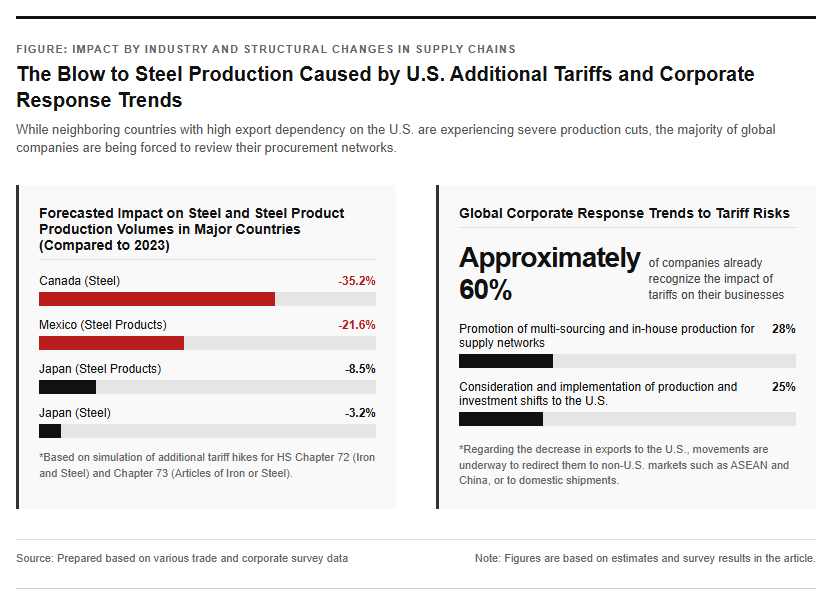
Sector-specific tariff measures are rapidly transforming global industrial allocation. For example, simulations of additional tariff hikes on steel (HS Chapter 72) and steel products (Chapter 73) that took effect in 2025 show results where production volumes drop drastically in Canada and Mexico, which have high export ratios to the U.S.
It is estimated that Canada’s steel production will experience a significant drop of 35.2% compared to 2023, and Mexico’s steel product production a 21.6% drop. Japan’s steel production will also be affected by a 3.2% drop, and steel products by an 8.5% drop. On the other hand, structural shifts are progressing, such as diverting the portion of exports reduced for the U.S. to non-U.S. markets like ASEAN and China, or allocating them to domestic shipments.
Against such tariff risks, about 60% of global companies are already aware of the impact on their business. As concrete measures, surveys reveal that 28% overall are promoting the diversification and in-sourcing of procurement networks, while 25% are considering or implementing production and investment shifts to the U.S. Please refer to the figure below.
Medium-to-Long-Term Economic Outlook and Points to Watch
Geopolitical Trends in U.S. Politics and Structural Changes in the Rust Belt
U.S. trade protectionism is closely tied to political appeals to the working class in swing states, particularly the Rust Belt (the declining manufacturing region) in domestic politics. With manufacturing workers accounting for about 8% of all workers, there is a structural tendency for protectionist trade policies aimed at winning electoral votes in states like Pennsylvania and Michigan to gain bipartisan support.
As a result, the U.S. effective tariff rate, which stood at 2.4% prior to 2024, surged to 13.8% by November 2025, and there is little prospect of it returning to past low levels anytime soon. However, this political dynamic could change toward the 2030s. This is because electoral vote allocations, which are based on the decennial census, are projected to decrease for Rust Belt states experiencing continued population outflow.
It has also been pointed out that if the political importance of the Rust Belt declines following the 2032 presidential election, the necessity for manufacturing protection will diminish, potentially opening the door for the U.S. to pivot back toward a free trade path. When formulating medium- to long-term business plans, it is crucial to monitor and assess changes in this political structure.
Future Trade Negotiations and Strategic Countermeasures for Japanese Companies
The focus going forward will shift to the announcement of survey results by the Office of the United States Trade Representative (USTR) and the direction of bilateral negotiations with each target country. Japanese companies are being urged to reframe successive tariff hikes not merely as a temporary increase in logistics costs, but as a critical company-wide management issue.
According to fact-finding surveys, an increasing number of companies are assigning the Corporate Planning Department (34%) or Business Divisions (40%) as the primary departments in charge of tariff countermeasures. As specific countermeasures, short-term options include utilizing first sale valuation, optimizing the use of FTAs and EPAs, and reducing customs-evaluated values through the review of HS codes and country-of-origin labeling.
In the medium to long term, it is essential to accelerate the relocation of production bases to the U.S. or third countries, as well as the diversification and multi-sourcing of supply chains. To cope with uncertain geopolitical risks, accurately calculating and visualizing the financial impact of tariffs on one’s own company and establishing an agile governance structure will be the keys to sustainable corporate growth.
References
- [Dai-ichi Life Research Institute Economic Analysis Report] https://www.dlri.co.jp/report/macro/495152.html
[#USCustomsTariffHike #TrumpTariffs #InternationalTradeFriction #JapaneseEconomy #SupplyChainRestructuring]


コメント