
Spice Road Co., Ltd., which operates the “Thainoon” chain of Thai restaurants, and its affiliated company have begun preparations to file for voluntary bankruptcy. The background includes soaring raw material costs, the burden of store opening expenses, and deteriorating cash flow since the COVID-19 pandemic, compounded by rising costs and labor expenses hitting the entire dining-out industry.
- Key Events and Overview of the Restaurant Business Transfer
- Earnings Trends and Structural Factors Leading to Business Deterioration
- Bankruptcy Processing and Business Rehabilitation Methods for Food and Beverage Companies
- The Current Reality of Restaurant Bankruptcies Breaking Record Highs and Rising Costs
- Limits of Price Pass-Through and the Rapidly Rising Risk of Tax Arrears Bankruptcies
- Future Outlook and Points to Watch for the Revitalization of Small and Medium-Sized Food Service Businesses
Key Events and Overview of the Restaurant Business Transfer
Spice Road Co., Ltd., operator of Thai restaurants such as Thainoon, and its affiliate Blue Celadon Co., Ltd. suspended operations on November 20, 2026, and began preparing to file for voluntary bankruptcy. Total liabilities amount to approximately 825 million yen for Spice Road (as of the end of the fiscal year ending March 2026) and about 300 million yen for Blue Celadon (as of the end of the fiscal year ending March 2025), totaling approximately 1.125 billion yen for the two companies. Spice Road was founded in August 1972 and incorporated in December 1993. In addition to Thainoon, whose signature dish is Thai ramen, the company has operated outlets such as Pancy’s Kitchen and Bangkok Yatai Khaosan, driving the ethnic food boom in Japan. Blue Celadon was established in December 2006 and operated establishments such as Siam Heritage. Notably, all stores operated by the two companies were transferred to NNP Co., Ltd. on November 1, 2026, prior to the bankruptcy preparations. As a result, store operations continue under NNP Co., Ltd. to this day, avoiding the worst-case scenario of a total wipeout of the brands and store network.
Earnings Trends and Structural Factors Leading to Business Deterioration
Riding the ethnic food boom of the 2000s, Spice Road expanded its store network, recording annual sales of approximately 1.97 billion yen for the fiscal year ending March 2009. However, weighed down by accumulating store opening costs and soaring ingredient prices, annual sales dropped to about 1.603 billion yen for the fiscal year ending March 2018, while recording a net loss of approximately 18 million yen. As the boom leveled off, competitors increased, and consumer spending stagnated, forcing store closures, the spread of COVID-19 starting in 2020 delivered the final blow. Due to a sharp decline in dining-out demand, annual sales for the fiscal year ending March 2021 halved to approximately 768 million yen. Although customer traffic showed signs of recovery in the post-COVID era, it failed to fundamentally improve the legacy of excessive debt and damaged cash flow. As shown in the figure below, the maintenance costs of the rapidly expanded store network and changes in the external environment pressured management.
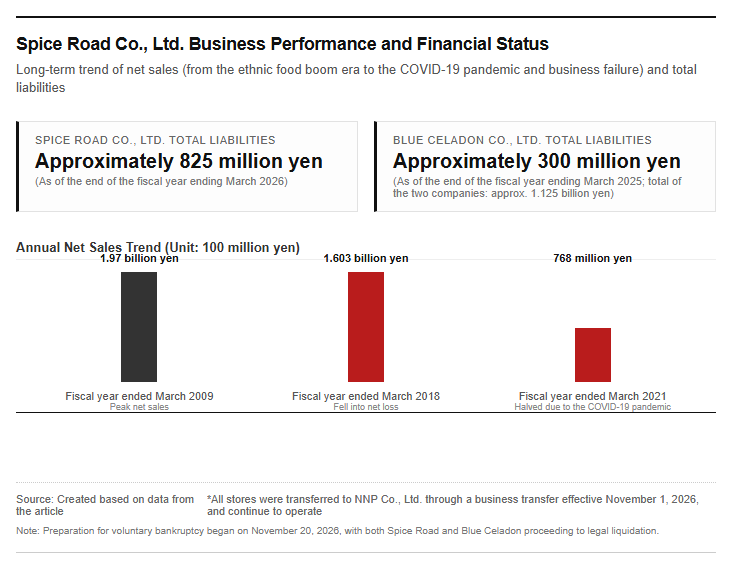
Furthermore, in recent years, intensified competition in Thai and ethnic restaurant formats, combined with soaring imported ingredient and utility costs driven by the rapid depreciation of the yen, pushed the company into a state where continuing business on its own became impossible.
Bankruptcy Processing and Business Rehabilitation Methods for Food and Beverage Companies
Methods available when companies fall into excessive debt or financial distress include legal reorganization under court jurisdiction (bankruptcy or civil rehabilitation) and private workouts based on agreements with financial institutions. Among legal proceedings, bankruptcy is a liquidation-type procedure in which a bankruptcy trustee appointed by the court monetizes assets and distributes them to creditors. Meanwhile, schemes are utilized to minimize the impairment of business value by executing a sponsor transfer (business transfer) to hand over the business and store network to another company before reaching bankruptcy. In the case of Spice Road, measures were taken to transfer all stores to NNP Co., Ltd. on November 1, 2026, just prior to filing for bankruptcy, a legal reorganization proceeding. Consequently, while the operating company itself transitioned to bankruptcy proceedings to sort out its liabilities, the store network, employment, and customer services were maintained. When small and medium-sized enterprises face financial distress, cooperating with experts early on—prior to the commencement of bankruptcy proceedings—and exploring business transfers or guideline-based private workout procedures is crucial to minimizing disadvantages for all stakeholders.
Severe Operating Environment Surrounding the Restaurant Industry and Future Outlook
The Current Reality of Restaurant Bankruptcies Breaking Record Highs and Rising Costs
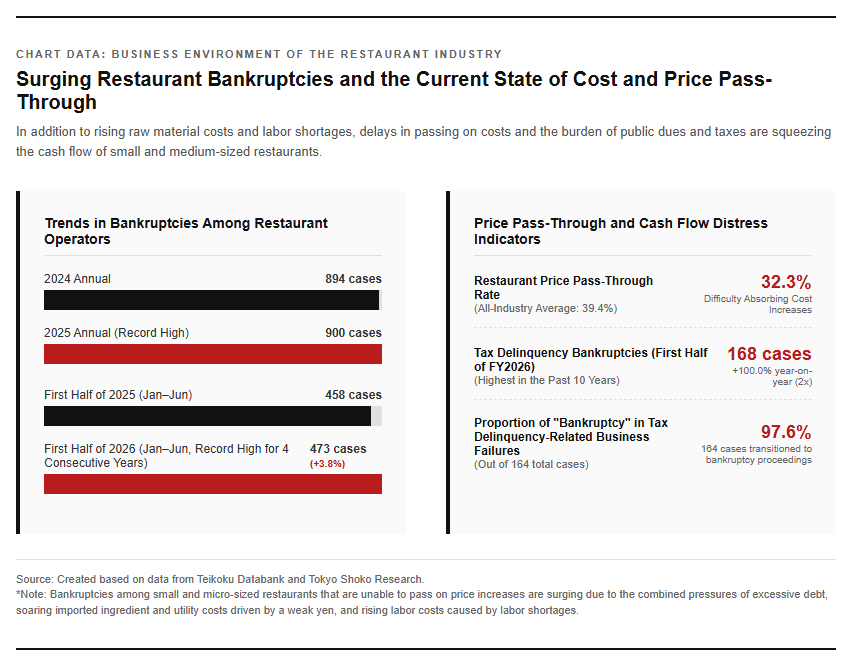
Currently, the entire dining-out industry is suffering from a historic wave of bankruptcies. According to research by Teikoku Databank, bankruptcies among restaurant operators reached 900 in 2025, surpassing the 894 cases of the previous year and setting a new record high. Furthermore, bankruptcies in the first half (January–June) of 2026 reached 473 cases, a 3.8% increase from 458 cases in the same period last year, marking a record high on a half-year basis for the fourth consecutive year. Behind the increase in bankruptcies are the rapid depreciation of the yen, rising raw material prices, and soaring energy costs such as electricity and gas bills. In addition, labor costs have surged due to severe labor shortages, along with wage-hike pressures and restrictions on accepting new foreign workers, pushing operational cost burdens to their limits. While major dining-out chains control costs and achieve higher revenues and profits by utilizing central kitchens and leveraging economies of scale, smaller small- and medium-sized enterprises and micro-restaurants cannot absorb the rapid increase in expenses, widening the gap based on scale.
Limits of Price Pass-Through and the Rapidly Rising Risk of Tax Arrears Bankruptcies
For restaurants facing soaring costs, the biggest challenge is the difficulty of passing on price increases. According to actual surveys, the price-passthrough rate for restaurants stands at just 32.3%, significantly below the all-industry average of 39.4%. Many small and medium-sized stores hesitate to raise prices out of fear of driving customers away, leading to a marked decline in profitability. This squeeze on cash flow is also casting a shadow over the payment of public taxes and dues. According to data compiled by Tokyo Shoko Research, bankruptcies due to tax delinquencies in the first half of fiscal 2026 (April–September) reached 168 cases, a sharp 100.0% year-on-year increase and double the previous figure. This is the highest number in the past 10 years, with bankruptcies accounting for 97.6% (164 cases) of the total. Cases are mounting where small-scale businesses, having lost the source of funds for tax payments due to inflation and wage hikes, face a loss of credit and the risk of asset seizure due to tax delinquency, ultimately forcing them to give up on continuing their operations. As shown in the diagram below, which illustrates the cash flow structure of the food service industry, the double burden of excessive debt and public tax obligations poses a major barrier to management.
Future Outlook and Points to Watch for the Revitalization of Small and Medium-Sized Food Service Businesses
Going forward, for restaurants to overcome severe environmental changes and establish sustainable management, breaking away from mere price competition and undertaking structural reforms are indispensable. The expansion of inbound tourism demand presents a major opportunity, and there are high expectations for providing high-value-added services that leverage the appeal of Japanese cuisine, which ranks as the number one destination draw for foreign visitors to Japan. Meanwhile, as a response to labor shortages, initiatives to systematize chefs’ techniques into manuals to simplify store operations, as well as strengthening digital-driven MEO (Map Engine Optimization) and SNS customer acquisition, are growing in importance. On the financial front, businesses are urged to utilize tools such as the “Guidelines for Business Restructuring of Small and Medium-Sized Enterprises” during normal times before management hits a dead end, and to consider early business reviews and out-of-court restructuring procedures. Major points to watch in the future will be whether neighborhood restaurants can map out sustainable growth, and whether healthy industry metabolism can proceed through business successions and sponsor support.
Reference Pages
- [Teikoku Databank Bankruptcy Flash] https://www.tdb.co.jp/
[#ThaiFood #SpiceRoad #TeeNee #RestaurantBankruptcy #BusinessTurnaround #FoodServiceIndustry #OutOfCourtRestructuring]


コメント