A coalition of over 140 major companies has announced the launch of a new stablecoin, Open USD. This project aims to transform the market structure by introducing a new mechanism that returns returns from reserve assets to participants, countering the existing dominant stablecoins.
- A massive alliance of over 140 global companies
- A revenue model breaking the traditional stablecoin market
- The Sharp Drop in Circle’s Stock Price and the Response of Established Players
- Regulatory Framework in the U.S. under the GENIUS Act
- Spillover effects and new risks on the banking system
- The Key to Growth Toward a Trillion Market by 2030
A massive alliance of over 140 global companies
Open Standard has announced a new US dollar-pegged stablecoin, Open USD (OUSD), backed by over 140 companies. This project includes traditional financial and tech giants such as BlackRock, Google, Visa, Coinbase, and Mastercard, as well as major cryptocurrency companies such as Ripple, OKX, and Bybit. Led by Bridge co-founder Zack Abrams, this initiative is the latest effort by leading financial and technology companies to build a shared stablecoin infrastructure. Open USD aims to be widely adopted as infrastructure supporting global payments, merchant payments, and corporate financial operations, and is unmatched by a stablecoin backed by such a broad corporate alliance. The chart below shows the composition of the main participating companies in Open USD.
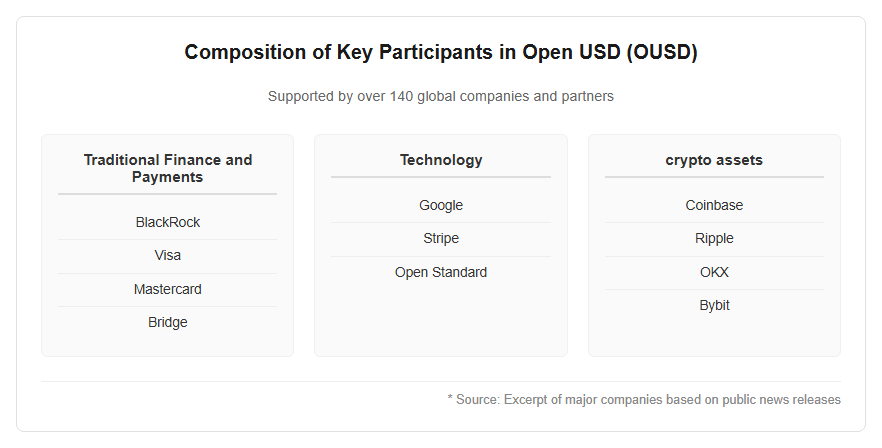
This extensive network is a key factor determining the token’s circulating supply and adoption rate.
A revenue model breaking the traditional stablecoin market
What sets Open USD apart from existing stablecoins is its economic model and governance structure. While many existing stablecoin issuers monopolize interest income from reserve assets, Open USD has announced a policy to distribute most, if only, of the revenue generated from reserve assets to token holders and companies participating in the ecosystem. Additionally, tokens can be minted and redempted (redemption) for free, and there are no artificial limits on issuance amounts, which is a major feature. Regarding governance, it envisions a form of management by an independent, partner-led organization rather than a centralized issuer. This incentive design aims to make it an attractive option over traditional stablecoins for companies requiring dollar payments, international remittances, or tokenized value transfers.
Market shocks and regulatory trends
The Sharp Drop in Circle’s Stock Price and the Response of Established Players
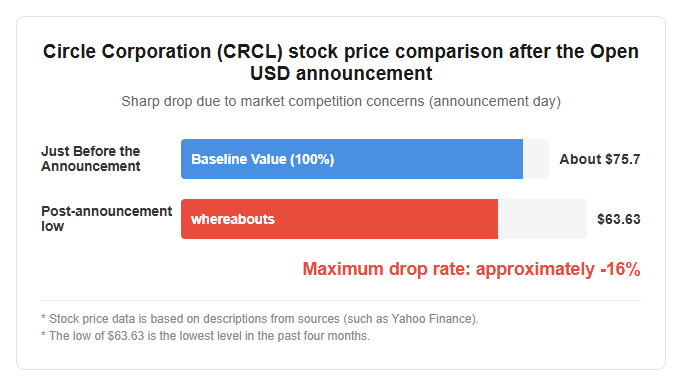
Following the announcement of Open USD, the stock price of Circle Internet Group, which issues the existing major stablecoin USDC, plunged by about 13% to 16% at one point. The stock price briefly fell to $65 or $63.63, marking the lowest level in the past four months. Investors seem to have judged that Open USD’s return-to-income model could directly threaten Circle’s main revenue stream. In response, Jeremy Allaire, CEO of Circle, stated that the stablecoin market is large enough to support ongoing innovation and welcomed the emergence of competitors. He emphasized that USDC is the world’s most trusted and widely adopted asset for institutional investors, and stated that he will continue to expand partnerships with banks and payment companies and continue investing in the ecosystem. The graph below compares the stock price movements of stablecoin issuers after the news release.
Regulatory Framework in the U.S. under the GENIUS Act
The timing of Open USD’s deployment is closely linked to developments in stablecoin regulation in the United States. In the United States, the legal framework for payment stablecoins is being established based on the “GENIUS Act” signed by President Donald Trump. Experts predict that this law will clarify the processes for stablecoin issuance, custody, and compliance, making it easier for companies to adopt digital assets for payments. On the other hand, adapting to regulations is also a key factor that determines the success or failure of a project. For example, in Europe, there have been cases where the Dutch exchange Knaken, which failed to comply with MiCA (Markets in Crypto-Assets Regulation), was forced into bankruptcy proceedings while freezing the assets of about 30,000 customers. For Open USD to become widespread in the future, it is essential to ensure these new regulatory requirements are met and to build credibility on par with traditional financial institutions.
Impact on the Financial System and Future Outlook
Spillover effects and new risks on the banking system
The expansion of stablecoin adoption is being pointed out as having complex effects on the existing banking system. If stablecoin payments replace credit card payments, banks will lose various fees earned from card issuance and merchant management. There is also a risk that small individual deposits may be replaced by issuers’ large deposits through stablecoin purchases, increasing vulnerabilities in the banking system. Stablecoin issuers’ deposits are often excluded from deposit insurance, raising concerns that if the banks where deposits are held to receive instability, large sums of money could flow out all at once. In the past, during the collapse of Silicon Valley Bank (SVB), the transfer of funds deposited by Circle was delayed, causing USDC’s price to temporarily fall below 1 dollar. To avoid these risks, issuers tend to concentrate their funds among major banks (G-SIBs), which could further widen the gap with small and medium-sized banks.
The Key to Growth Toward a Trillion Market by 2030
Currently, the stablecoin market is estimated at about $312 billion, but there are bullish forecasts that it could reach $4 trillion by 2030. For Open USD to gain share in this massive market, it needs to learn from past failures. For example, the collapse of algorithmic stablecoins like Terra was caused by vulnerabilities in the underlying assets. In contrast, future projects will require transparency such as overcollateralization, reliable backing with fiat currency, and real-time data disclosure. Moreover, not only decentralized finance (DeFi) but also integration with real-world asset (RWA) tokenization markets will also be important growth strategies. The success of Open USD depends on how quickly it realizes the network effects of its massive alliance and integrates it into a global payment network while complying with regulations.
[#ステーブルコイン #OpenUSD #フィンテック #暗号資産 #デジタル決済 #GENIUS法 #金融市場 #ブロックチェーン]

コメント