_en.png)
Hashimoto-gumi, a construction company based in Yaizu City, Shizuoka Prefecture, and AI inside Co., Ltd. signed a comprehensive partnership agreement in June 2026. Through this partnership, the construction of the regional co-creation DX model “Yaizu Model,” which leverages construction site data to help solve regional issues, has begun.
- Launch of comprehensive collaboration between Hashimoto-gumi and AI inside
- Turning on-site knowledge into regional assets through ‘outward-looking’ investment
- Japan’s largest fishing ports take on the challenge of digital fisheries
- A vision for smart cities co-created by local governments and the private sector
- Multimodal AI for structuring unstructured data
- Eliminating the ‘On-site Input Burden’—the Key to Success
- Timeline to 2031 and Restoration of Trust
- Nationwide Horizontal Deployment and Survival Strategies for Regional AI
Launch of comprehensive collaboration between Hashimoto-gumi and AI inside
On June 25, 2026, Hashimoto Holdings, centered around Hashimoto-gumi headquartered in Yaizu City, and AI inside announced a comprehensive collaboration aimed at promoting DX in the construction industry and local communities. The construction industry is facing chronic labor shortages, a shortage of skilled workers, and serious challenges such as the “2024 problem,” requiring fundamental solutions that are not mere spiritual arguments. Under this partnership, demonstration experiments of AI utilization at actual construction sites will begin in July 2026.
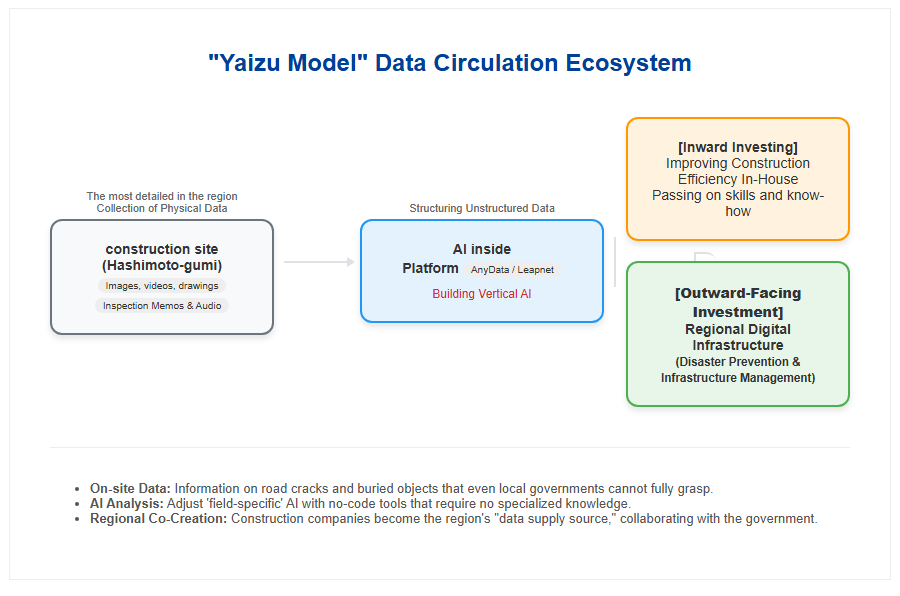
A major feature of the “Yaizu Model” promoted by this project is that it goes beyond simply improving operational efficiency for a single company. Construction companies routinely collect detailed physical data such as cracks in local roads, deterioration of bridges, and the locations of buried objects underground—so detailed that even local governments cannot fully grasp them. The true aim of this project is to analyze these on-site data with AI and create a ‘regional digital infrastructure’ that supports disaster prevention and infrastructure management. As shown in the diagram below, we aim to build an ecosystem where data is transformed into regional assets.
Turning on-site knowledge into regional assets through ‘outward-looking’ investment
Most traditional construction DX initiatives were “inward-looking investments” aimed at reducing overtime within the company, such as digitizing administrative tasks and improving photo management efficiency. However, the “Yaizu Model” aims to shift the paradigm toward “data external sales and regional collaboration,” where data obtained on-site is repurposed to maintain regional infrastructure and ensure safety.
By combining Hashimoto-gumi’s construction know-how and regional network with AI inside’s advanced AI technology, they transform construction data into regional assets. Specifically, by analyzing on-site information collected by drones and cameras on the AI inside platform and sharing it with local governments, efficient maintenance of public infrastructure and rapid disaster response become possible. In this way, the business model where construction companies act as ‘data sources’ and partners with local communities is attracting attention as a new survival strategy for the construction industry in rural areas where public works budgets are trending to be cut.
Yaizu City’s DX Strategy Expanding Beyond Industry
Japan’s largest fishing ports take on the challenge of digital fisheries
Yaizu City’s DX is not limited to the construction sector. At Yaizu Fishing Port, one of Japan’s largest deep-sea fishing bases, the “Digital Fisheries Strategic Hub Project” is being promoted to address chronic labor shortages and improve analog workflows. The Yaizu City Fisheries Promotion Association will take the lead in implementing phased digitalization from 2025 (Reiwa 7) to 2031 (Reiwa 13).
Until now, in the fisheries industry, collecting entry information and recording market transactions were done by phone, fax, blackboard, and handwritten forms, resulting in inefficiencies such as miswriting and duplicate work. The introduction of digitalization will bring the following improvements.
-
Entry of arrival information via smartphone app and web publication.
-
Input of auction results on tablets and real-time display on monitors.
-
Reducing administrative tasks through automatic aggregation of measurement data.
-
Ensuring accurate traceability by weighing per box.
In the short term, the project will start with overseas purse seine fishing and deep-sea bonito single-line fishing, aiming to expand to all species and link data with an eye toward the consumption stage.
A vision for smart cities co-created by local governments and the private sector
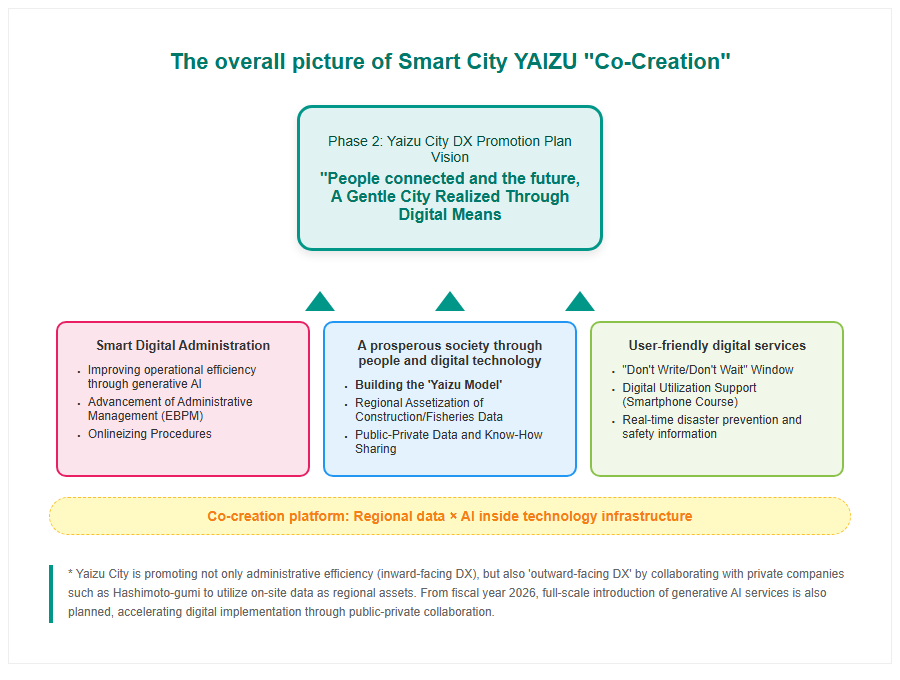
Yaizu City formulated the “Second Phase Yaizu City DX Promotion Plan” in April 2026 to accelerate the realization of the smart city YAIZU. This plan sets the vision of “Connected People and the Future, A Gentle City Realized Through Digitalization,” promoting co-creative community development involving government, industry, and citizens.
As a specific initiative, starting in fiscal year 2025 (Reiwa 7), the company plans to begin providing generative AI services with NTT West Japan Shizuoka Branch as the preferred negotiator. In addition to improving administrative efficiency, it also includes support for digital utilization by local businesses and strengthening policy planning (EBPM) through data openness. The ‘Yaizu Model’ led by Hashimoto-gumi is closely aligned with the city’s overall strategy and serves as a model case for public-private collaboration to advance regional digital implementation. The following diagram shows the overall picture of co-creation promoted by the city.
Technical Foundation and Implementation Challenges
Multimodal AI for structuring unstructured data
The technical core of the “Yaizu Model” is AI inside’s “structuring technology for unstructured data.” At construction sites and fishing ports, massive amounts of data such as images, videos, audio, and handwritten notes are generated that are difficult for computers to handle as is. The core of this technology is that AI understands these, tags them, and automatically converts them into an analyzable database.
For example, at construction sites, it becomes possible to automatically determine the depth of cracks from bridge inspection photos and predict repair timing by comparing them with past data. Traditionally, such analyses required specialized data scientists, but AI inside’s platform offers a ‘no-code, low-code’ system that allows field staff to adjust AI themselves. This enables even local companies lacking highly skilled technicians to build and operate “vertical AI” that has learned site-specific technical terms and drawing symbols.
Eliminating the ‘On-site Input Burden’—the Key to Success
Even if innovative AI technology is introduced, if on-site workers feel burdened by data input, the project will fail. It is said that 90% of failures in construction DX are not due to technical issues but to the “burden of input,” making it extremely important to build UI/UX that allows on-site supervisors to collect high-quality data without much effort.
Moreover, the data collected on-site is often “dirty data,” such as inaccurate location information, blurry photos, or scribbled notes. Rather than forcibly analyzing these with AI, the biggest technical barrier—and at the same time, the solution—is how to build a system that automatically performs cleansing and checking at the time of input. Whether on-site workers can genuinely feel that “digitalization makes their work easier” will determine the success or failure of the model.
Future Outlook and Key Points
Timeline to 2031 and Restoration of Trust
The “Yaizu Model” and related DX initiatives will proceed over a long-term timeline spanning several years. In the fisheries industry, digitization of weighing and delivery will advance from 2025 to 2026, and from 2027 onward, the publication of auction information and the provision of information via websites will become more active. Ultimately, by 2031, the goal is to achieve advanced traceability where consumers can check fish catch and freshness information.
One aspect behind this digitalization is the restoration of trust following past scandals such as the bonito theft incident. By shifting from an analog system relying on handwritten blackboards and paper forms to a digital transaction system free of fraud, it has become an urgent task to rebuild the brand as a highly transparent ‘Fisheries City Yaizu.’
Nationwide Horizontal Deployment and Survival Strategies for Regional AI
The initiatives in Yaizu City could serve as a compass for many local governments in Japan facing similar challenges (labor shortages, aging infrastructure, and analog work). The introduction of a “platform-based” approach that combines general-purpose LLMs (such as ChatGPT) and specialized AI like AI inside offers a good balance of cost and expertise, making it a realistic option for mid-sized companies.
Going forward, the focus will be on how to integrate real-time data obtained from construction sites into multiple fields such as regional disaster prevention, transportation, and environmental protection. The process of the “Yaizu Model,” which starts with DX in a single company and changes the power balance and structure of the entire region, will continue to attract nationwide attention as a new survival strategy for regional AI.
[#焼津モデル #建設DX #水産DX #地域共創 #AI活用 #スマートシティ #地方創生]

コメント