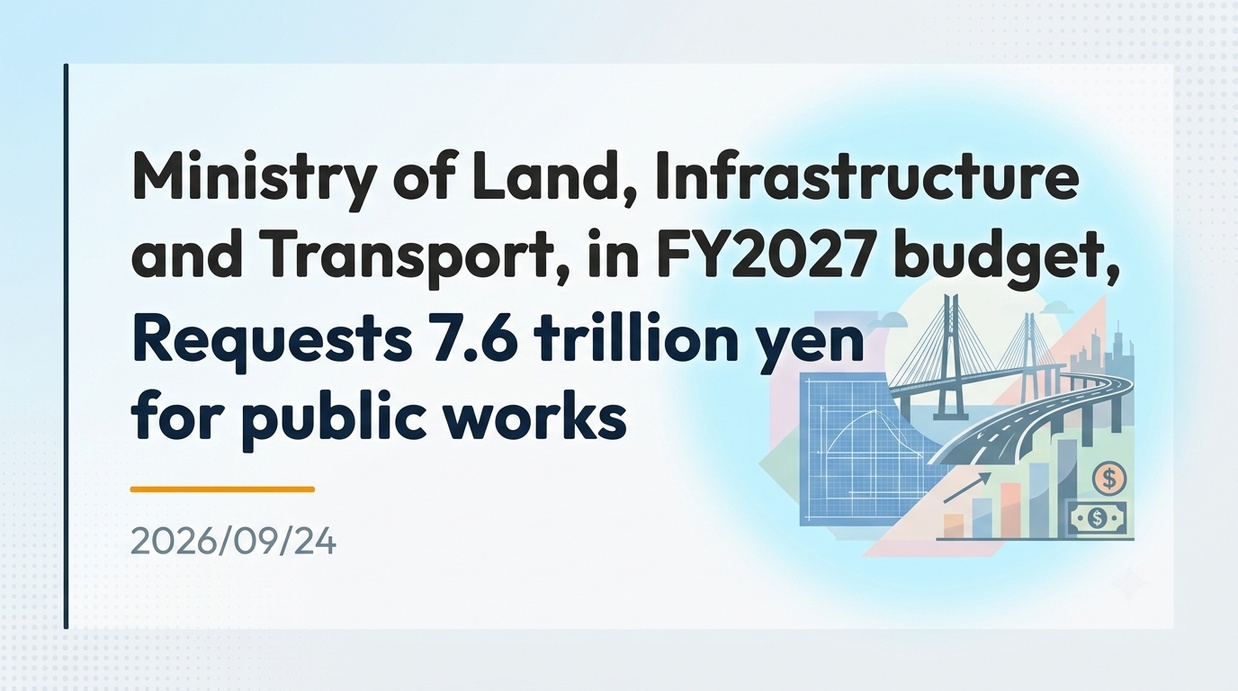
Japan’s Ministry of Land, Infrastructure, Transport and Tourism (MLIT) has requested 8.7694 trillion yen in general account funds for its FY2027 budget request, including 7.6761 trillion yen for public works. This expansion aims to counter the decline in real construction volume caused by surging material and labor costs, while strengthening disaster prevention, mitigation, and aging infrastructure management.
- Key Events and Numerical Highlights of the FY2027 Budget Request
- Historical Budget Trends and Shrinking Real Construction Volume Driven by Inflation
- The Profit-Squeezing Mechanism of “Cost Estimation vs. Bidding Timelags”
- Countermeasures for Labor Shortages and the “2024 Problem”
- National Resilience, Preventive Maintenance, and Regional Infrastructure Revitalization
- Parliamentary Deliberations and Key Watchpoints Toward Budget Passage
Key Events and Numerical Highlights of the FY2027 Budget Request
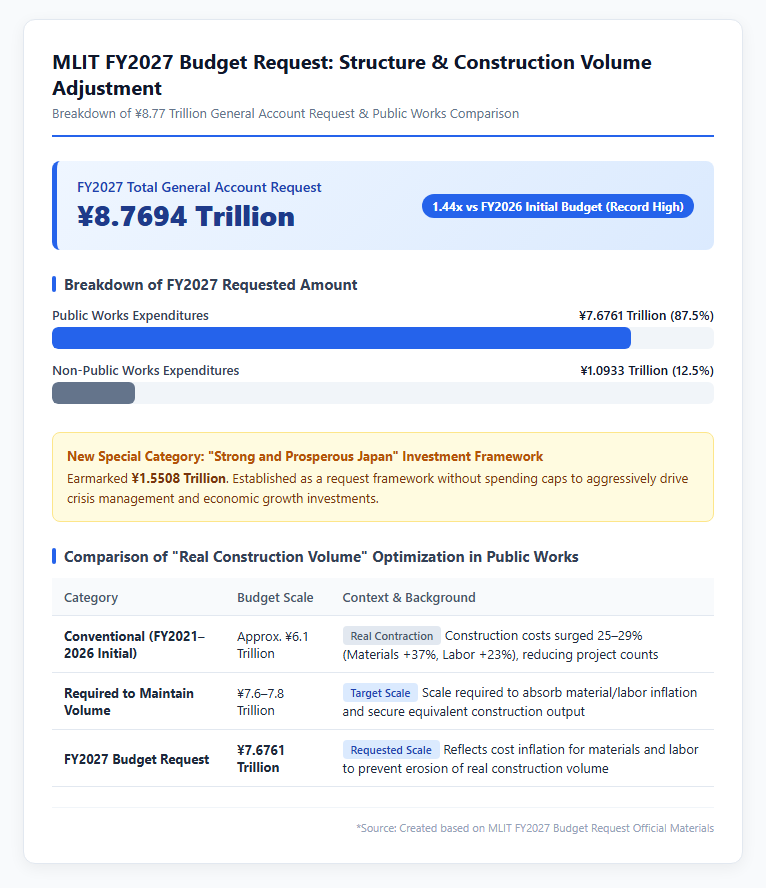
On August 28, 2026, the Ministry of Land, Infrastructure, Transport and Tourism (MLIT) released the overview of its budget request for fiscal year 2027 (FY2027). The requested general account budget reached a record 8.7694 trillion yen, representing a 1.44-fold increase compared to the initial budget for FY2026. Public works expenditures account for 7.6761 trillion yen of this total, while non-public works expenditures receive 1.0933 trillion yen. A defining feature of this request is the newly established “Strong and Prosperous Japan” Investment Framework, which accounts for 1.5508 trillion yen outside traditional budgetary caps. This framework operates without a request ceiling, serving as a dedicated mechanism to aggressively drive crisis management investments and economic growth initiatives. Furthermore, several critical programs were submitted as “item requests” without specified monetary amounts, including measures under the First Medium-Term Plan for National Resilience, responses to material price hikes and labor cost retention, and infrastructure developments supporting strategic industrial clusters. Consequently, the final budget scale may expand further during upcoming assessments by the Ministry of Finance and cabinet deliberations later this year. As illustrated in the diagram below, expanding public works serves as a crucial turning point for rebuilding national infrastructure.
Historical Budget Trends and Shrinking Real Construction Volume Driven by Inflation
Since entering an inflationary period in FY2021, the initial public works budget across the Japanese government had remained largely static at approximately 6.1 trillion yen. However, compared to January 2021, construction material prices have surged by approximately 37%, while labor costs have risen by about 23% since March 2021, driving overall construction costs up by 25% to 29%. As a result, maintaining a fixed nominal budget led to a severe reduction in “real construction volume”—reducing the actual quantity and count of executable engineering projects. Experts had pointed out that maintaining real construction volume at historical levels would require expanding the initial budget to between 7.6 trillion and 7.8 trillion yen. Therefore, requesting 7.6761 trillion yen for public works is not merely an arbitrary expansion, but an essential adjustment to accurately reflect rising material and labor costs, thereby preventing the erosion of physical project output. Because shrinking public works contracts imposes heavier fixed-cost burdens on contractors and degrades profitability, optimizing the total budget allocation became an urgent priority.
Soaring Material Costs and Structural Challenges Hitting Construction Sites
The Profit-Squeezing Mechanism of “Cost Estimation vs. Bidding Timelags”
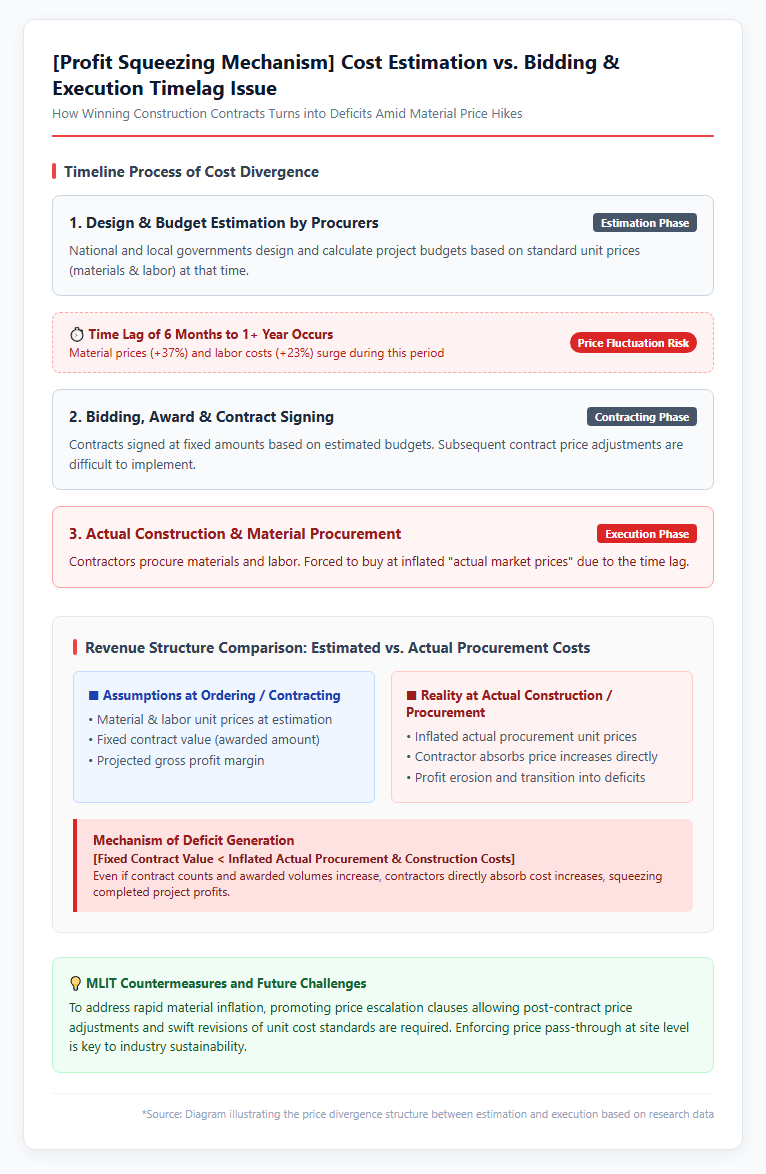
A primary cause of severe profit margin pressure across the construction industry is a structural flaw known as the “estimation and bidding/execution timelag.” In public works projects, six months to over a year frequently elapses between the time public procurers (national or local governments) design and estimate project budgets and the time winning contractors actually procure materials on-site. When a gap emerges between the material unit prices used during budget estimation and the actual market prices when contractors procure materials after winning the contract, contractors cannot pass these price increases onto the contract value and must absorb the losses directly. Because adjusting contract amounts after signing remains difficult in public works, many contractors fall into a trap where taking on more work leads to financial deficits due to bloated material expenses. To prevent such outcomes, MLIT has promoted price-escalation clauses and contract revision mechanisms, yet enforcing price pass-through on actual job sites remains challenging. As depicted in the structural chart below, early identification of time gaps between budget estimation and construction execution is essential.
Countermeasures for Labor Shortages and the “2024 Problem”
In the construction and logistics sectors, addressing the “2024 Problem”—stemming from overtime caps (a principle limit of 45 hours per month and 360 hours per year) enforced since April 2024—has become an urgent mandate. The construction industry faces severe labor shortages driven by an aging workforce and declining youth recruitment: workers aged 55 and older account for 36.7% of the workforce, whereas those under 29 make up only 11.7%. In response, MLIT earmarked 16.8 billion yen (a 2.03-fold year-on-year increase) in its FY2027 request for securing construction workers and improving productivity. Focus areas include enforcing appropriate labor cost standards in public works, promoting five-day workweeks, and improving working conditions via the Construction Career Up System (CCUS). To achieve radical labor savings, MLIT also requested 43.8 billion yen (a 4.36-fold increase) to advance digital transformation in infrastructure (i-Construction 2.0). By implementing physical AI on job sites, automating construction operations, and expanding BIM/CIM adoption, MLIT aims to reduce site labor requirements by 30% and boost productivity by 1.5 times by 2040.
Key Investment Areas and Future Points of Contention
National Resilience, Preventive Maintenance, and Regional Infrastructure Revitalization
The FY2027 budget request prioritizes heavy investment in disaster prevention and mitigation to prepare for intensifying flood risks and major earthquakes triggered by climate change. MLIT requested 747.3 billion yen to accelerate comprehensive river basin flood control, 341.6 billion yen for earthquake countermeasures targeting Tokyo metropolitan and Nankai Trough mega-quakes, and 1.1293 trillion yen for disaster prevention and safety grants. To transition from post-disaster reconstruction to proactive “preventive maintenance” that repairs aging infrastructure beforehand, 1.1591 trillion yen was allocated across infrastructure maintenance operations. Furthermore, to overcome mobility constraints caused by local bus route reductions and driver shortages in regional areas, MLIT allocated 8.35 billion yen (a 3.61-fold increase) to eliminate “transportation deserts.” Plans involve expanding demand-responsive transit, public ride-sharing, and autonomous driving deployment to establish mobility solutions across approximately 3,000 transport-deprived areas nationwide. Additionally, MLIT directed 303.0 billion yen (a 2.92-fold increase) toward housing and building decarbonization (Housing Green Transformation / GX) to foster sustainable local communities.
Parliamentary Deliberations and Key Watchpoints Toward Budget Passage
The figures released reflect MLIT’s initial request stage. They will undergo rigorous assessment and negotiation by the Ministry of Finance before being finalized in the Cabinet’s official budget proposal around December 2026. Following deliberations in the ordinary Diet session opening in January 2027, the final budget is expected to pass by late March 2027. The central point of interest moving forward is how unquantified “item requests” and the “Strong and Prosperous Japan” Investment Framework survive financial assessment. In particular, the extent to which measures under the First Medium-Term Plan for National Resilience and material price inflation responses are monetized will dictate the ultimate public works total. Furthermore, observers will closely watch whether increased public works spending effectively trickles down to secure fair profit margins for small and mid-sized contractors and boost wages for field technicians. Beyond mere physical infrastructure building, effective budget execution is required to ensure the long-term sustainability of local construction capacity and regional transit networks.
Reference Pages
- [Overview of FY2027 MLIT Budget Request] https://www.mlit.go.jp/page/kanbo05_hy_003926.html
【#MLIT #FY2027Budget #PublicWorks #NationalResilience #ConstructionCostInflation】


コメント