
The Liberal Democratic Party (LDP) has discussed proposals to strengthen economic security in preparation for the revision of the three major security-related documents, outlining the establishment of “AI sovereignty” and the reinforcement of production foundations. This move is driven by the intensifying struggle for AI technological hegemony between the U.S. and China, as well as Japan’s growing digital deficit and security risks caused by dependence on foreign cloud services and semiconductors.
- Key Points of the LDP’s “AI Sovereignty” Discussion and the Revision of the Three Security Documents
- A Paradigm Shift from “Sovereign AI” to “AI Sovereignty”
- Social Infrastructure “Resilience” and Improving the Sustained Combat Capability of the SDF
- The Expanding Digital Deficit and the Risks of Dependence on Overseas IT Infrastructure
- Establishment of a New National Security Certification System for Data Centers and Clouds
- Acceleration of Public-Private Investment and Focus Strategy on “Physical AI” and “Vertical AI”
- Trade-offs in Institutional Design and Social Consensus (Future Developments and Key Points)
Key Points of the LDP’s “AI Sovereignty” Discussion and the Revision of the Three Security Documents
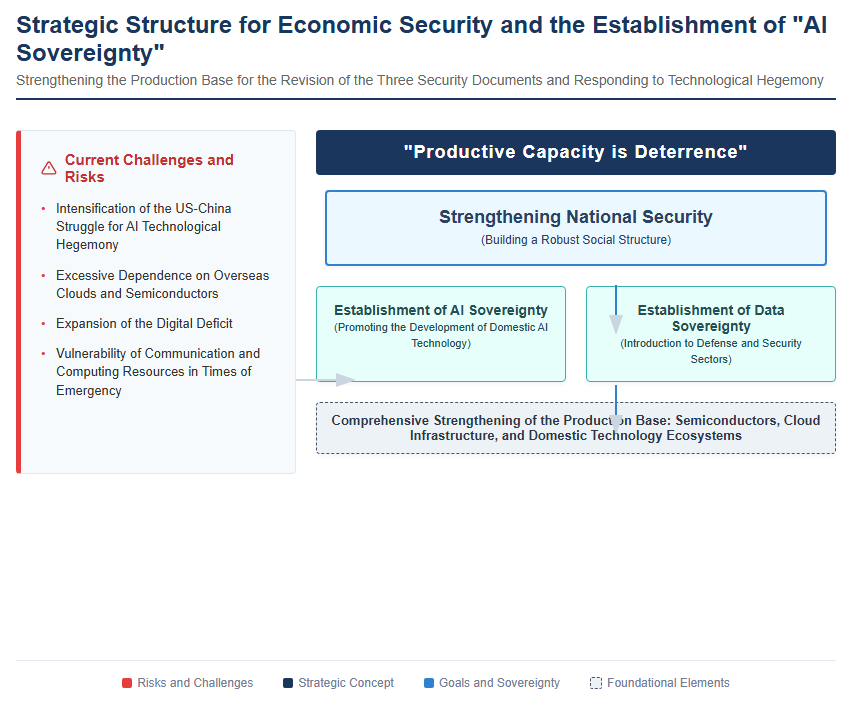
On November 25, 2026, the LDP held a joint meeting of the Defense Division and the Security Research Council to discuss proposals for strengthening economic security in preparation for the government’s planned revision of the three major security-related documents (including the National Security Strategy) in December 2026. During the meeting, economic security was positioned as the foundation supporting national security, with the view expressed that maintaining civilian life and industrial activities is essential for the Self-Defense Forces’ (SDF) ability to sustain combat operations. In particular, under the concept that “production capacity is deterrence,” a policy was proposed to comprehensively strengthen not only the defense industry but also the production foundations that support civilian life and the economy as a whole. The core of this proposal is the establishment of “AI sovereignty” and “data sovereignty.” By ensuring the thorough implementation of artificial intelligence within government defense and security departments and promoting the development of domestic AI technology, the goal is to reduce excessive dependence on other countries and build a robust social structure that remains unshaken even in times of crisis. The following figure shows the basic structure of the AI strategy.
A Paradigm Shift from “Sovereign AI” to “AI Sovereignty”
Behind this discussion lies a strategic shift detailed in the “AI White Paper 2.0” compiled by the LDP’s AI and Web3 Subcommittee. A paradigm shift was proposed, moving from the previously discussed “Sovereign AI”—which aimed merely at possessing domestic foundational models—to “AI Sovereignty,” which balances autonomy with indispensability. This approach does not fall into total self-sufficiency; rather, it involves selectively securing autonomy and resistance to disruption in strategic areas such as defense and critical infrastructure, while ensuring international division of labor and interoperability with like-minded nations. Furthermore, the goal is to monetize Japan’s strengths in semiconductor manufacturing equipment, high-precision materials and components, and “tacit knowledge” data from manufacturing sites to acquire “strategic indispensability” within the global supply chain. The aim is to lead the construction of a reliable AI economic sphere, centered on the Indo-Pacific region, and establish a position as an AI power following the U.S. and China.
Social Infrastructure “Resilience” and Improving the Sustained Combat Capability of the SDF
In the proposed revision of the three security documents, with the example of Ukraine’s ability to endure a long-term war in mind, “resilience”—the ability to recover immediately even after an attack on infrastructure—has emerged as a keyword. The proposal puts “collective resilience”—the diversification of industrial bases and supply chains to ensure rapid recovery and alternative procurement even if social infrastructure, power, or communication networks are attacked during an emergency—at the center of its diplomacy and defense policy. Additionally, the policy aims to adopt the “Whole-of-Society” approach prevalent in Europe, where the public and private sectors work together to conduct continuous, comprehensive checks to respond to risks such as cyberattacks and illegal data leaks. To maintain the SDF’s defense capabilities, it was agreed that not only the SDF’s own equipment but also the sustained combat capability of civilian infrastructure and industry is indispensable, and that cyber defense and economic security must be comprehensively strengthened as inseparable elements.
Industrial Structure Challenges and the Digital Deficit Crisis
The Expanding Digital Deficit and the Risks of Dependence on Overseas IT Infrastructure
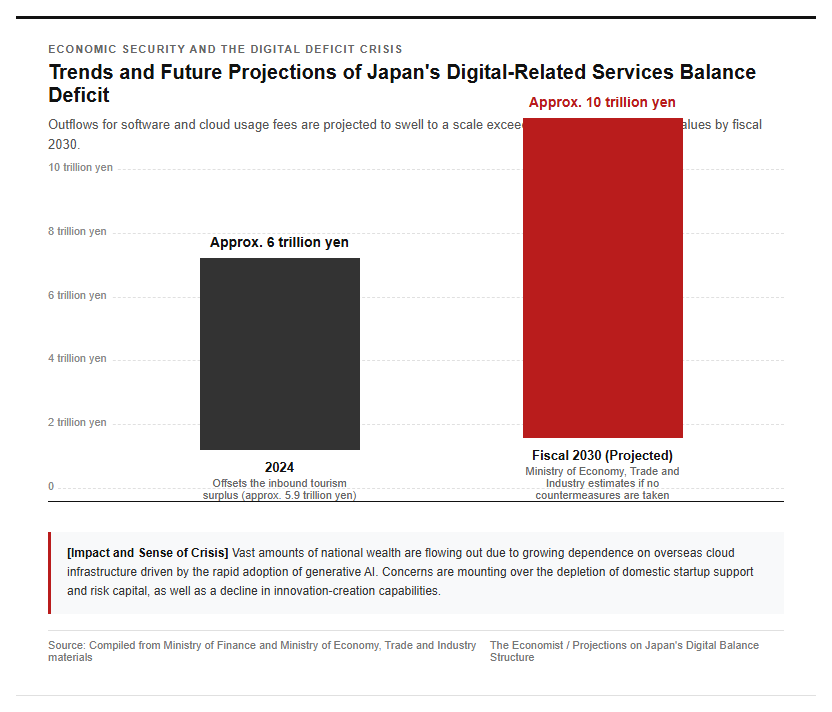
The primary driver behind the urgent need to strengthen economic security is the dramatic expansion of Japan’s “digital deficit.” In 2024, Japan’s balance of payments for digital-related services (software usage fees, cloud usage fees, copyright royalties, etc.) reached a deficit of approximately 6 trillion yen, a situation that nearly offsets the surplus in the travel balance brought by inbound tourism (approximately 5.9 trillion yen). Furthermore, as the rapid spread of generative AI requires massive computational resources, dependence on cloud infrastructure provided by giant overseas IT companies is increasing even further. According to estimates by the Ministry of Economy, Trade and Industry, if no measures are taken, the digital deficit is projected to swell to approximately 10 trillion yen by fiscal year 2030, exceeding the value of crude oil imports. There are concerns that this massive outflow of national wealth could deplete domestic startup support and risk capital, significantly diminishing Japan’s capacity for innovation. The following graph shows the trends in the digital deficit.
Establishment of a New National Security Certification System for Data Centers and Clouds
Dependence on overseas platforms also creates serious vulnerabilities in terms of security. Foreign-owned operators currently account for about 60% of Japan’s domestic cloud market, raising concerns that critical infrastructure and sensitive data are exposed to servers and jurisdictions outside the country. In particular, because legal risks exist such as China’s National Intelligence Law and National Defense Mobilization Law, which allow the requisition of private IT companies’ data and management rights in the event of an emergency, the government has embarked on strong regulations. The Ministry of Internal Affairs and Communications and the Ministry of Economy, Trade and Industry plan to introduce a national security certification system starting in fiscal 2027 or later to strictly review governance, information leakage countermeasures, and equipment procurement sources for domestic data center operators and cloud providers. The government plans to submit a bill to amend the Economic Security Promotion Act to the ordinary diet session in January 2027 to create a framework that encourages companies handling critical information, such as finance and healthcare, to use certified services, mandates prior reporting, and effectively blocks foreign operators with security concerns.
Future Developments and Outlook for an “AI-Driven Nation”
Acceleration of Public-Private Investment and Focus Strategy on “Physical AI” and “Vertical AI”
For Japan to make a comeback in the AI competition, large-scale public-private investment and concentration on a unique “winning path” are essential. In 2023, private investment in the AI field stood at approximately 10 trillion yen in the U.S. and about 1.2 trillion yen in China, whereas Japan lagged significantly behind in 12th place globally with only about 100 billion yen. To overcome this disadvantage, the government is proceeding with support for domestic large language model (LLM) development through “GENIAC” and the development of GPU computing infrastructure through subsidies to companies such as Sakura Internet and SoftBank. Furthermore, avoiding a simple scale competition with general-purpose AI (LLMs) from the U.S. and China, the government has presented a strategy to intensively invest in “vertical AI,” which is domain-specific and leverages the tacit knowledge of manufacturing sites, medical care, and automobiles where Japan holds strengths, as well as “physical AI,” which merges with robotics and autonomous driving. In addition, in the semiconductor field, under the “AI and Semiconductor Industry Infrastructure Strengthening Framework,” the government aims for 10 trillion yen in public support and over 50 trillion yen in public-private investment by 2030, accelerating the establishment of bases such as TSMC’s Kumamoto plant and Rapidus.
Trade-offs in Institutional Design and Social Consensus (Future Developments and Key Points)
The biggest point of attention moving forward is how to overcome the trade-off between “agile policy promotion” and the “formation of social consensus” being advanced by the government. While rapid responses to agentic AI and cyber defense have been highly praised in the revision of the Basic Plan for AI and the Three Security Documents, issues have also surfaced, such as concerns from creator organizations regarding the short public comment period and a lack of effectiveness in copyright protection, as well as a lack of specific details in education and employment safety nets. Toward the amendment of the Economic Security Promotion Act in fiscal 2027 and the launch of operations for the data center certification system, completing a “design of trust” based on the trinity of regulation, technology, and literacy is required. Swift actions by both the public and private sectors are being tested to see if Japan can balance technological autonomy and reliability and transform itself from an AI consumer nation into a technology exporter.
Reference Pages
- [Ministry of Internal Affairs and Communications: 2024 White Paper on Information and Communications] https://www.soumu.go.jp/johotsusintokei/whitepaper/r06.html
- [Ministry of Economy, Trade and Industry: GENIAC (Generative AI Accelerator Challenge)] https://www.meti.go.jp/policy/mono_info_service/geniac/index.html
[#AISovereignty #EconomicSecurity #ThreeSecurityDocuments #DigitalDeficit #Semiconductors #DataCenters #GenerativeAI]

コメント