London Stock Exchange Group (LSEG) and U.S.-based NVIDIA have announced a collaboration to significantly accelerate the analytical processing of ultra-large-scale historical financial data. Amid the rapid rise of 24-hour stock markets and demand for AI analysis, the move aims to fundamentally overhaul traditional financial data analysis infrastructure that has relied on overnight processing.
- The Reduction from “Hours to Seconds” Achieved by LSEG and NVIDIA
- GPU Processing Infrastructure Supporting 110 Trillion Rows of Massive Market Data
- Transition from Overnight Batch Processing to Real-Time Continuous Analysis
- The Cost and Governance Advantages Brought by “No Data Replication Needed”
- Advancement of Quantitative Operations and Risk Trading Operations
- The Evolution of Financial AI Infrastructure and Future Market Focus
The Reduction from “Hours to Seconds” Achieved by LSEG and NVIDIA
On October 14, 2026, the London Stock Exchange Group (LSEG) announced a partnership with U.S. semiconductor giant NVIDIA. The primary objective of this collaboration is to dramatically improve the analysis and processing speed of “LSEG Tick History,” the massive volume of ultra-high-frequency trading history data held by financial institutions. By leveraging NVIDIA’s GPU-accelerated data processing library cuDF and the open-source high-speed data processing framework Polars, benchmark tests have verified that multi-year market data analysis, which previously took anywhere from hours to days, can be completed in just a few seconds.
The most significant feature of this technological innovation is that it enables computational processing to be executed directly on the GPU while maintaining access controls and licensing permissions, without having to create new, complete duplicates of the original massive dataset. This makes it possible to immediately feed data into quantitative analysis and AI model training while avoiding the security risks and storage costs incurred when migrating or duplicating large-scale data to a separate environment. The following figure shows an overview of financial data processing via GPU acceleration.
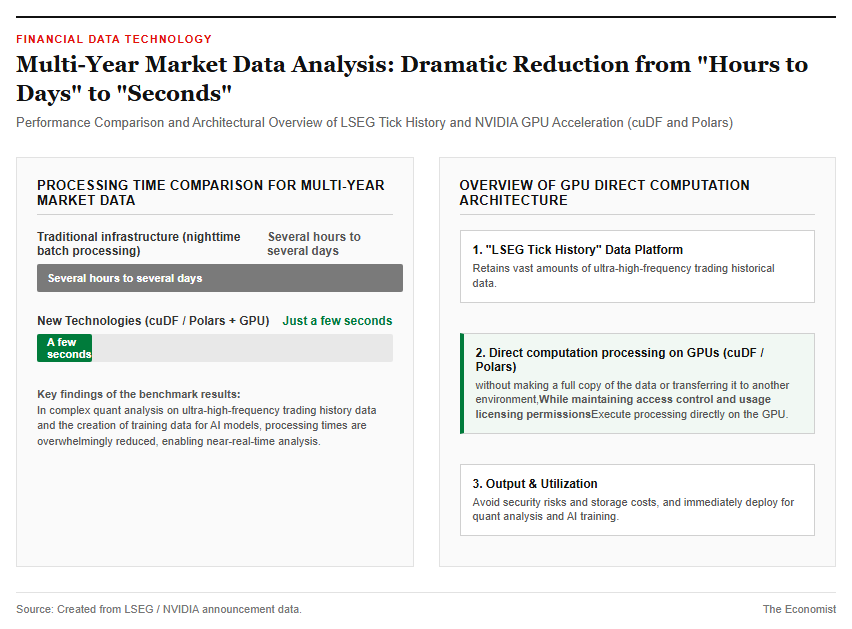
The dramatic improvement in data analysis speed in financial markets brings immediate changes to the front lines of trading strategy validation and risk management. Moving away from conventional batch-processing data infrastructure, data analysis utilizing the latest computational resources is becoming the new standard in the financial industry.
GPU Processing Infrastructure Supporting 110 Trillion Rows of Massive Market Data
“LSEG Tick History,” which has now been selected for acceleration, is a massive database covering financial markets around the globe. Specifically, it has accumulated historical data spanning over 30 years and covers data on more than 100 million instruments collected from over 580 exchanges, trading venues, and contributors. The total number of data rows reaches a staggering 110 trillion, making it known as one of the most comprehensive market data assets in the financial industry.
The utilization of such massive data had been facing limitations due to the recent surge in data volume. According to LSEG’s announcement, the company’s real-time network traffic in the first half of 2026 increased by 29% year-over-year, reaching an all-time peak of 26 million messages per second in June of the same year. Furthermore, the number of customer API requests for Tick History data has surged by 48% year-over-year.
As data demand explodes, conventional CPU-based data processing has often forced the use of “downsampling,” which reduces the resolution of analytical data. However, the introduction of cuDF, a GPU processing library, has established an environment capable of processing all data entirely at ultra-high speeds without stripping away the fine price fluctuations and quote movements at the tick level, which is the minimum unit of the market. The ability to analyze while maintaining fine details provides a decisive advantage in building high-precision AI models and market reproduction analysis.
The Background of Financial Practices and Technological Innovation in the Era of 24-Hour Trading
Transition from Overnight Batch Processing to Real-Time Continuous Analysis
Why is ultra-fast processing now in such high demand for financial data analysis? Behind this lies a changing market environment: global stock and financial product trading is rapidly shifting toward “24/7 continuous operation.” In traditional financial markets, the standard model has been overnight batch processing—loading data during the night hours after a day’s trading has ended to perform daily analyses and risk calculations before the start of the next day’s trading.
However, as major exchanges and proprietary trading systems (PTS) transition to trading frameworks approaching 24 hours a day, the very concept of “outside trading hours” is beginning to disappear. In an environment where the market is constantly operating, it becomes impossible to secure nighttime processing time, creating the need to analyze historical data in real time and continuously—even while daytime trading is taking place—and reflect it in decision-making. The following figure illustrates the changes in data analysis methods associated with the shift to 24-hour trading.
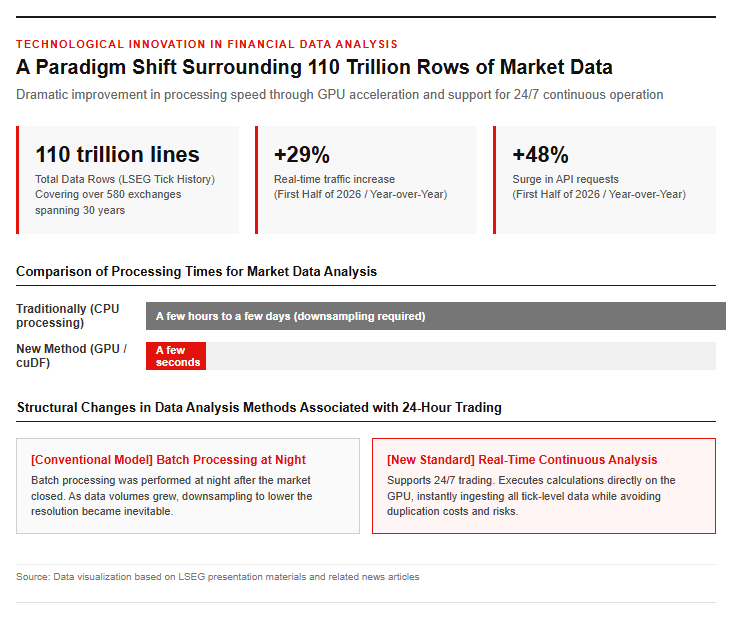
Because time lags in data analysis directly lead to missed investment opportunities and delayed risk detection, technology that compresses analysis taking several hours down to a few seconds goes beyond mere operational efficiency to become an essential prerequisite for surviving in 24-hour markets.
The Cost and Governance Advantages Brought by “No Data Replication Needed”
The technical highlight of this partnership is that it performs advanced computational processing without creating a complete replica of all data. In typical data analysis, data is frequently copied from a data source to a dedicated analytical environment or cloud storage for processing. However, when replicating 110 trillion rows of financial data on a petabyte scale, serious challenges arise, including not only massive storage usage costs, but also the security risks of copied data leaking externally and the increasing complexity of data permission management.
Under the approach taken by LSEG and NVIDIA, processing is executed by bringing the GPU computing resources to the data while keeping existing, strictly managed data governance and licensing frameworks entirely intact. This enables financial institutions to immediately benefit from advanced analytics utilizing the latest GPU infrastructure while avoiding the risks of data breaches and compliance violations.
This approach forms the core philosophy of “LSEG Everywhere AI,” a company-wide strategy promoted by LSEG. By placing data under trusted governance in close proximity to the computing infrastructure and securely fusing it with proprietary AI models and quantitative algorithms owned by client companies, it enables safe and advanced AI utilization in the financial markets.
Specific Impacts on Financial Markets and Future Prospects in the AI Era
Advancement of Quantitative Operations and Risk Trading Operations
The acceleration of analytics infrastructure through the partnership between LSEG and NVIDIA will significantly impact the specific operations of financial institutions. The foremost example is the advancement of investment strategy backtesting and algorithm development in quantitative trading. Previously, due to computing time constraints, firms had to narrow down their analysis periods, target stock counts, and trading venues. However, the ability to instantly calculate all data without losing granularity now enables the creation of robust investment models capable of adapting to a more diverse range of market conditions.
Second, it is the analysis of execution quality and the refinement of market reconstruction in practice. By reconstructing past order book states with ultra-high speed and accuracy, it becomes possible to reduce slippage (the difference between the order price and the execution price) and accurately evaluate liquidity.
Furthermore, significant advancements are expected in financial risk management and the application of AI models. The instant simulation of large-scale stress scenarios for portfolios and their utilization as a reliable data supply infrastructure for autonomous AI agents are progressing. By automating and instantly executing market analysis tasks that traditionally took experienced quantitative analysts a significant amount of time, the speed of decision-making will be dramatically enhanced.
The Evolution of Financial AI Infrastructure and Future Market Focus
In the future financial industry, the integration of GPU-powered ultra-high-speed data processing infrastructure with large language models (LLMs) and autonomous AI agents is projected to accelerate further. LSEG has demonstrated the potential use cases of finance-specific Vertical LLMs and AI agents at its proprietary events and other venues, advancing the construction of next-generation financial systems that integrate real-time market data, high-speed computing environments, and AI reasoning models.
The key points of interest in the market moving forward are the adoption speed of this solution among major institutional investors and hedge funds, as well as the accompanying evolution of trading algorithms. As trading strategies premised on GPU-accelerated ultra-high-speed analysis become widespread, close attention will be paid to how the market’s overall price discovery function and liquidity supply system will change.
Also, the expansion of data delivery networks to accommodate 24-hour stock trading and the expanded application of GPUs to other financial data assets will be important points to watch. As computing resources and market data converge at an unprecedented density, it is certain that financial institutions capable of leveraging technology to instantly extract insights from data will establish a strong competitive advantage in the markets of the future.
Reference Page
- 【LSEG Press Release】[suspicious link removed]
【#LSEG #Nvidia #FinancialAI #GPUDataProcessing #Fintech #AIInvestment】
コメント