
The government and the ruling coalition have entered final coordination to tighten requirements and continue the “wage increase promotion tax system” for small and medium-sized enterprises (SMEs) with revisions in the FY2027 tax code reform. The background includes a thorough review of special taxation measures by the “Japanese version of DOGE” and expert views questioning the policy’s effectiveness, weighed against the necessity of maintaining momentum for wage hikes among SMEs facing labor shortages and high prices.
- Government and ruling party coordination toward tightening application requirements and downsizing the system
- Discrepancies in policy effect verification between the Ministry of Finance and the Small and Medium Enterprise Agency
- Review of special taxation measures and the impact of a 543 billion yen decrease in tax revenue
- Analysis flaws pointed out at the expert meeting and the “end of the historical role”
- Impact of Stricter Application Requirements on SME Tax Burdens and Cash Flow
- “Wage-Hike Bankruptcies” Driven by Surging Labor Costs and Structural Management Risks
- Key Points to Watch in the Year-End Tax Reform Outline Toward the March 2027 Expiry
- Productivity-Linked Wage Hike Strategies Independent of Tax Incentives
Government and ruling party coordination toward tightening application requirements and downsizing the system
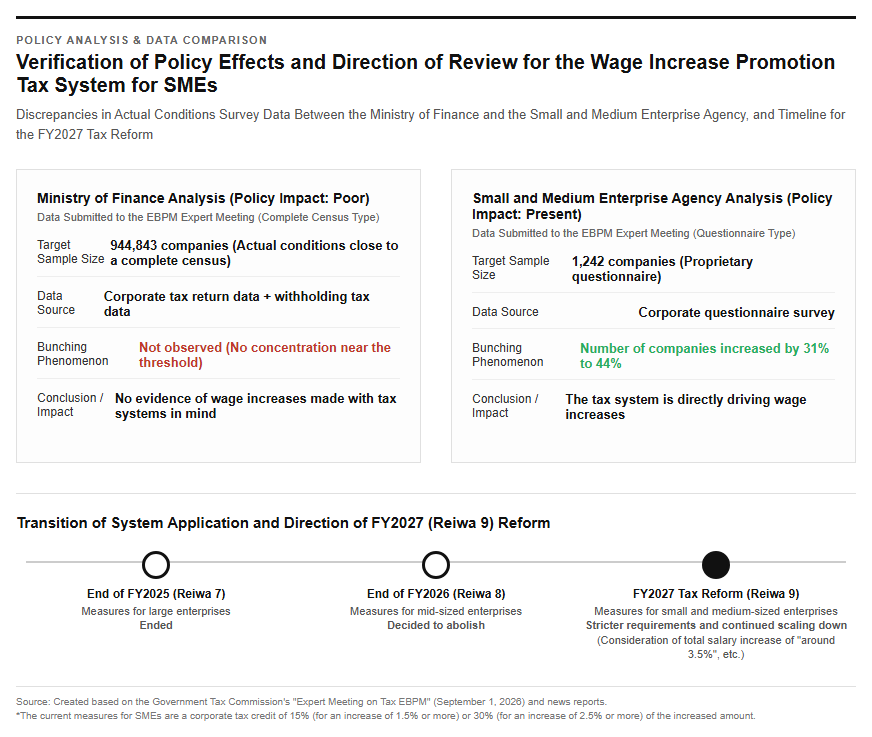
As of November 2026, the government and ruling coalition have entered final coordination to continue the “wage increase promotion tax system”—which reduces the corporate tax burden for SMEs that implement certain wage increases—by narrowing its target requirements in the FY2027 tax code reform. Under the current measures for SMEs, if the total amount of salaries paid to all employees increases by 1.5% or more compared to the previous fiscal year, 15% of the increase can be deducted from corporate tax; if it increases by 2.5% or more, 30% can be deducted (up to 35% with various certification bonuses). However, under the revision plan being considered within the government and ruling coalition, stricter measures have emerged, such as raising the hurdle for deduction eligibility and limiting the target to cases where the total salary paid per employee increases by “around 3.5%” or more compared to the previous fiscal year. While measures for large companies ended at the end of FY2025, and it has already been decided that measures for mid-sized companies will be abolished at the end of FY2026, it was determined that a review of the measures for SMEs is also unavoidable. On the other hand, since wage increases exceeding inflation have not yet fully taken root on the ground among SMEs, the situation is settling into a downsized continuation plan to avoid complete abolition of the system and maintain momentum.
Discrepancies in policy effect verification between the Ministry of Finance and the Small and Medium Enterprise Agency
Regarding this tax system, evaluations were sharply divided among the government agencies responsible for verification. This was because, at the “Expert Meeting on EBPM in Tax Systems” of the Government Tax Commission held on September 1, 2026, the Ministry of Finance and the Small and Medium Enterprise Agency presented conflicting data analysis results. Based on a near-complete census of 944,843 companies linking corporate tax return data and withholding tax data, the Ministry of Finance pointed out that no “bunching phenomenon”—where companies concentrate near the wage increase rate thresholds of 1.5% or 2.5%—was observed. This implies that there is no trace of companies raising wages with tax policies in mind, and that the policy effect is meager. In contrast, based on its own questionnaire targeting 1,242 companies, the Small and Medium Enterprise Agency countered that the number of companies increased by 31% to 44% at the 1.5% and 2.5% boundaries, asserting that the tax system directly supports wage hikes. As the comparison chart below shows, differences in data collection methods and analytical granularity between the two ministries created a divergence in conclusions, but within the government, voices calling for a strict review based on more objective empirical data became dominant.
Background of abolition discussions at the Japanese version of DOGE and EBPM meetings
Review of special taxation measures and the impact of a 543 billion yen decrease in tax revenue
The background behind the wage increase promotion tax system for SMEs emerging as a top candidate for downsizing and review lies in the thorough inspection of expenditures and revenues promoted by the government through the “Japanese version of DOGE (Government Efficiency, etc.).” According to estimates published by the Ministry of Finance, the decrease in national tax revenue resulting from the wage increase promotion tax system for SMEs amounts to approximately 543 billion yen, including projected figures for FY2024, occupying an extremely large scale among special taxation measures. To secure financial resources for consumption tax reductions, growth investments in priority fields, and reinforcement of defense capabilities, the government has set a policy of sequentially streamlining and abolishing special taxation measures whose policy effects have not been sufficiently demonstrated. Furthermore, the reality that base-up results for SMEs (fewer than 300 employees) reached 3.51% in the 2026 Shunto (spring labor offensive) tally announced by RENGO (Japanese Trade Union Confederation)—greatly exceeding the current tax system requirements of 1.5% and 2.5%—is also part of the backdrop. As practical wage increases proceed even without the tax system, doubts rapidly grew within fiscal authorities and the ruling party regarding the continued maintenance of preferential measures accompanied by a massive tax revenue reduction exceeding 500 billion yen annually.
Analysis flaws pointed out at the expert meeting and the “end of the historical role”
According to the minutes of the 9th EBPM Expert Meeting held on November 10, 2026 (published on November 16 of the same year), harsh criticisms regarding tax incentives for small and medium-sized enterprises (SMEs) were voiced consecutively. Regarding the propensity score and difference-in-differences (DID) analyses presented by the Small and Medium Enterprise Agency, attending members expressed a unanimous, skeptical consensus that they were “subject to selection bias and merely a tautology” and that “the analysis has flaws.” During the meeting, expert members pointed out that “the median deduction per company is a meager 240,000 yen or so, having no major impact on business management” and “while it had meaning as a banner under deflation, its historical role has ended under inflation,” leading to successive opinions that it should be abolished as a top priority. Furthermore, the reality was highlighted that about half of deficit-making corporations implement wage hikes due to labor shortages and rising prices, bringing to light the reality that tax reduction measures do not serve as a direct incentive for wage increases. These rigorous analysis results by experts served as a powerful rationale for scaling back the system in political decision-making.
Wage Hikes Without Profit Improvements and Challenges in SME Management
Impact of Stricter Application Requirements on SME Tax Burdens and Cash Flow
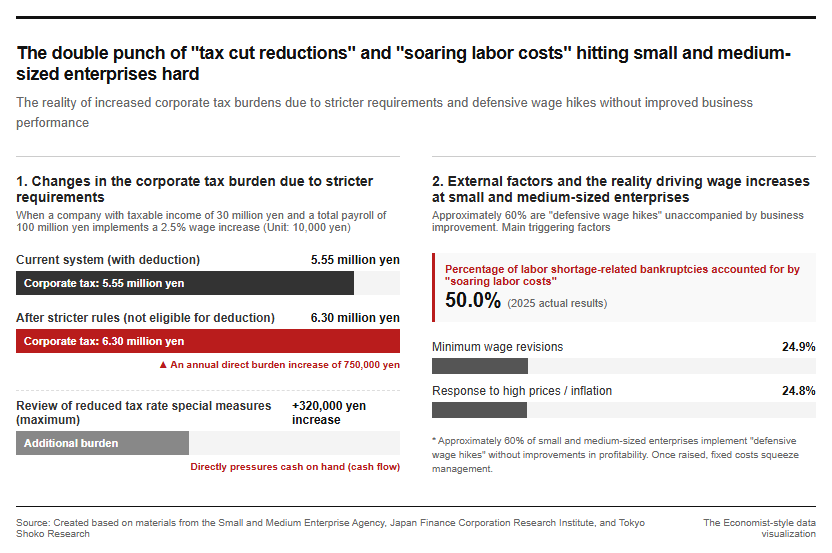
If the requirements for the tax incentives promoting wage increases are tightened to an “increase in salary of around 3.5% per capita,” many SMEs may become unable to receive tax deductions, facing a substantial tax hike. For instance, if an SME with taxable income of 30 million yen and a total annual payroll of 100 million yen implements a 2.5% (2.5 million yen) wage hike, under the current system, a corporate tax deduction of 750,000 yen is applied, making the tax payment amount approximately 5.55 million yen. However, if it falls outside the deduction targets due to stricter requirements, the corporate tax to be paid increases to 6.30 million yen, resulting in a direct burden increase of 750,000 yen per year. Furthermore, if special preferential measures for reduced tax rates—which lower the corporate tax rate for annual incomes of 8 million yen or less from 19% to 15% (expiring at the end of March 2027)—are also revised, up to 320,000 yen in annual corporate taxes will be added. Because taxes are outflows of cash rather than mere figures in profit calculations, they directly hit available funds during final tax returns after the settlement of accounts or intermediate tax payments in the following period. In particular, companies that have actively engaged in wage hikes will lose the merits of tax reductions, and caution is warranted regarding the risk of tightening cash flow and the sources of funds for loan repayments.
“Wage-Hike Bankruptcies” Driven by Surging Labor Costs and Structural Management Risks
While support through tax systems heads toward downsizing, the employment environment surrounding SMEs has reached an extremely critical phase. According to a survey by Tokyo Shoko Research, corporate bankruptcies nationwide in 2025 are on track to exceed 10,000 cases for the second consecutive year, with bankruptcies caused by “surging labor costs” accounting for 50% of all labor shortage-related bankruptcies. An analysis released in May 2025 by the Japan Finance Corporation Research Institute also points out that approximately 60% of wage hikes implemented by SMEs are “defensive wage increases” unaccompanied by profit improvements. To respond to external factors such as hiring difficulties, revisions to the minimum wage (24.9% of the total), and high prices (24.8%), a structure has taken root where companies are forced to push through wage hikes even in a state where profits are squeezed. As shown in the figure below, wage hikes without profit improvements become a factor that temporarily lowers net profit margins, weighing heavily as a fixed-cost risk because once-raised base salaries cannot be lowered later. There are concerns that the combination of shrinking tax preferences and soaring labor costs will further accelerate the exit of small-scale businesses with weak financial strength.
Future Outlook and Tax and Management Strategies Required for SMEs
Key Points to Watch in the Year-End Tax Reform Outline Toward the March 2027 Expiry
Both the tax incentives for wage increases targeting SMEs and the special preferential measures for reduced corporate tax rates are designated under current regulations to expire for “business years beginning by March 31, 2027.” The specific details and timing of how the system will be downsized or modified will be finalized through the “Ruling Parties’ Tax Reform Outline” decided in mid-December 2026, followed by Diet deliberations and legislative amendments. Points that management should note include the fact that the timing of when the system expires or changes differs depending on the fiscal year-end. For example, while for March-closing companies, the current fiscal year beginning in April 2026 may be the final application year for the current requirements, for December-closing companies, the current system may remain applicable up to business years beginning in January 2027. It is extremely important to accurately grasp how transitional measures for the introduction timing of new requirements (such as the 3.5% standard), the revision range of deduction rates, and the “5-year carryforward deduction measure” for unexhausted tax credits will be incorporated into the outline announced at the end of the year.
Productivity-Linked Wage Hike Strategies Independent of Tax Incentives
Amid growing uncertainty over tax reforms, small and medium-sized enterprises (SMEs) are being urged to move away from wage-hike plans built on the premise of “obtaining tax deductions.” Once base salaries or allowances are raised, they cannot be easily reduced, meaning that any scaling back of tax incentives would cause increased labor costs to directly pressure management. As a future management strategy, it is essential to build an “evaluation and compensation system linked to the improvement of gross profit and labor productivity” that is independent of the tax system. It is important to agree in advance on a logic whereby gross profit margins are increased through business process improvements via capital investment and appropriate price-passing (price hikes) to customers, with the resulting funds being returned to employees. Even in loan screening by financial institutions, plans that state “debt can be repaid through earnings and cash flow even without preferential measures” are evaluated much higher than plans dependent on tax incentives. Business owners should urgently build a sustainable financial foundation centered on productivity enhancement, without wavering due to institutional reviews.
Reference Page
- [Cabinet Office, Government Tax Commission: “List of Minutes and Press Conferences from the Expert Meeting on Tax EBPM (2026)”] https://www.cao.go.jp/zei-cho/gijiroku/ebpm/2026/index.html
- [Cabinet Office, Government Tax Commission: “Documents from the 9th Expert Meeting on Tax EBPM”] https://www.cao.go.jp/zei-cho/gijiroku/ebpm/2026/8ebpm9kai.html
- [Act on Special Measures Concerning Taxation, Article 42-12-5 / e-Gov Law Search] https://laws.e-gov.go.jp/law/332AC0000000026#Mp-Ch_3-Se_1_2-At_42_12_5-Pr_2
- [Ministry of Economy, Trade and Industry: “METI Requests Concerning the FY2027 Tax Reform”] https://www.meti.go.jp/main/zeisei/zeisei_fy2027/zeisei_r/index.html
[#SMEs #WageIncreasePromotionTaxSystem #TaxReform #CorporateTax #JapaneseDOGE #EBPM #CashFlow]


コメント