Prime Minister Sanae Takaichi’s suggestion to cap new government bond issuance at around 40 trillion yen for FY2027 has sparked growing concern within the ruling coalition over its potential impact on defense spending and growth investments. This anxiety stems from the rigid budget drafting process caused by imposing a de facto cap amid record-high preliminary budget requests, as well as insufficient communication with financial markets.
- Key Aspects of the Event and Background of the Statement
- Funding Concerns Surrounding Defense Expansion and Growth Investments
- Course Corrections and Damage Control by the Government and Ruling Coalition
- Divergence from FY2026 Budget and Market Analysts’ Perspectives
- Funding Consumption Tax Cuts and Impact on Long-Term Yields and Forex Markets
- Fiscal Management Challenges, Future Outlook, and Key Watchpoints
Key Aspects of the Event and Background of the Statement
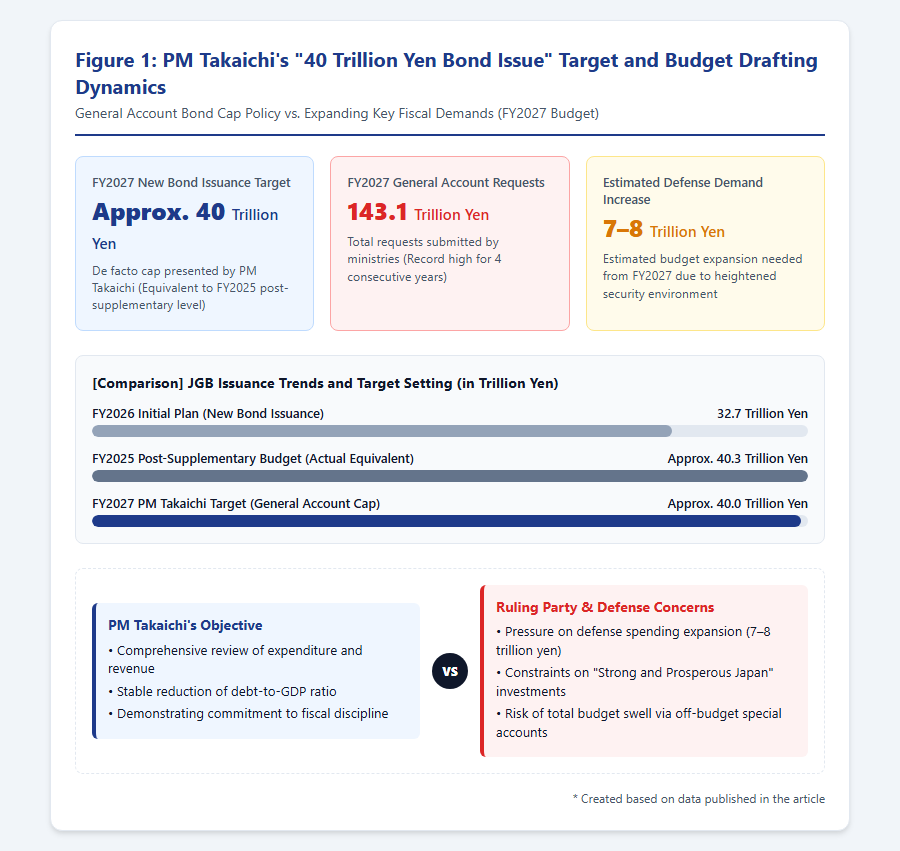
In an interview with the Yomiuri Shimbun on August 27, 2026, Prime Minister Sanae Takaichi signaled an intention to cap new Japanese Government Bond (JGB) issuance at approximately 40 trillion yen during the budget drafting for fiscal 2027. Citing the experience of fiscal 2025—when higher-than-expected tax revenues allowed the government to keep total bond issuance below the previous year’s level at roughly 40.3 trillion yen even after supplementary budgets—Prime Minister Takaichi stated that the administration would naturally adopt the same approach for the FY2027 budget. This remark effectively meant that the Prime Minister personally imposed a de facto cap on bond issuance ahead of the budget negotiations intensifying toward the end of the year. With government ministries submitting record-high budget requests totaling 143.1 trillion yen for the general account in FY2027, the statement was intended to demonstrate a firm stance against ever-expanding government spending. However, concerns are spreading among government officials that this concrete figure of “40 trillion yen” has taken on a life of its own within the ruling coalition and financial markets, significantly narrowing their flexibility during the budget compilation process.
Funding Concerns Surrounding Defense Expansion and Growth Investments
Defense policy architects within the Liberal Democratic Party (LDP) and lawmakers advocating for economic security were among the first to raise alarms over the Prime Minister’s “40 trillion yen bond cap.” Amid rising regional security tensions, the Ministry of Defense estimates that an additional 7 trillion to 8 trillion yen in defense spending will be required for the FY2027 budget. Furthermore, large-scale national investments in strategic sectors such as AI, semiconductors, and quantum technology are scheduled under the administration’s “Strong and Prosperous Japan” investment initiative. Executing these key priorities demands substantial financial resources, fueling strong fears that capping JGB issuance at 40 trillion yen could suppress essential investments. Financial experts within the government criticized the remark, calling it poorly communicated and akin to a slip of the tongue. Even if general account bond issuance is constrained to 40 trillion yen, total bond issuance could swell significantly once special accounts and separately managed funding mechanisms are included. Consequently, a growing sentiment inside the party holds that the Prime Minister has unnecessarily raised the bar for explaining fiscal policy to the public and financial markets.
Course Corrections and Damage Control by the Government and Ruling Coalition
As unrest spread over the statement, the government and the Ministry of Finance scrambled to perform damage control and clarify interpretations. In a press conference on September 4, 2026, Minister of Finance Satsuki Katayama addressed Prime Minister Takaichi’s comments, stating that while the government aims to appropriately control annual bond issuance across both initial and supplementary budgets, it will also firmly respond to necessary fiscal demands. When asked by reporters whether 40 trillion yen serves as an absolute benchmark, Katayama acknowledged the weight of the Prime Minister’s statement while emphasizing a commitment to comprehensive spending and revenue reviews. Chief Cabinet Secretary Minoru Kihara also explained in a press conference on September 14, 2026, that the Prime Minister’s comment was intended to illustrate an approach modeled on FY2025 practices. He added that funding for off-budget strategic policies, such as economic security, would be managed under special accounts, with specific details to be addressed during the budget formulation process. By maintaining the 40 trillion yen target for the general account while utilizing special account frameworks, the government and ruling coalition are attempting a course correction to secure funding for defense and growth investments.
Fiscal Discipline and Spillover Effects on Financial Markets
Divergence from FY2026 Budget and Market Analysts’ Perspectives
The “40 trillion yen” target presented by Prime Minister Takaichi has drawn mixed reactions from financial market analysts. The planned new JGB issuance for the FY2026 initial budget stands at 32.7 trillion yen; issuing around 40 trillion yen in FY2027 would represent a substantial net increase in new bond issuance. Toru Suehiro, Chief Economist at Daiwa Securities, noted in a research report that if expectations are anchored to the post-supplementary FY2025 level of roughly 40.3 trillion yen, this target could be interpreted as “slightly expansionary.” The presence of foreign investors in Japan’s bond market has grown considerably, accounting for up to 30% of purchases in benchmark 10-year JGBs. Overseas market participants closely monitor Japan’s fiscal discipline and the Bank of Japan’s monetary policy independence, creating a risk that poor fiscal messaging could trigger bond sell-offs. Beyond simply capping headline issuance figures, clear and transparent communication regarding the overall annual fiscal framework is strongly required.
Funding Consumption Tax Cuts and Impact on Long-Term Yields and Forex Markets
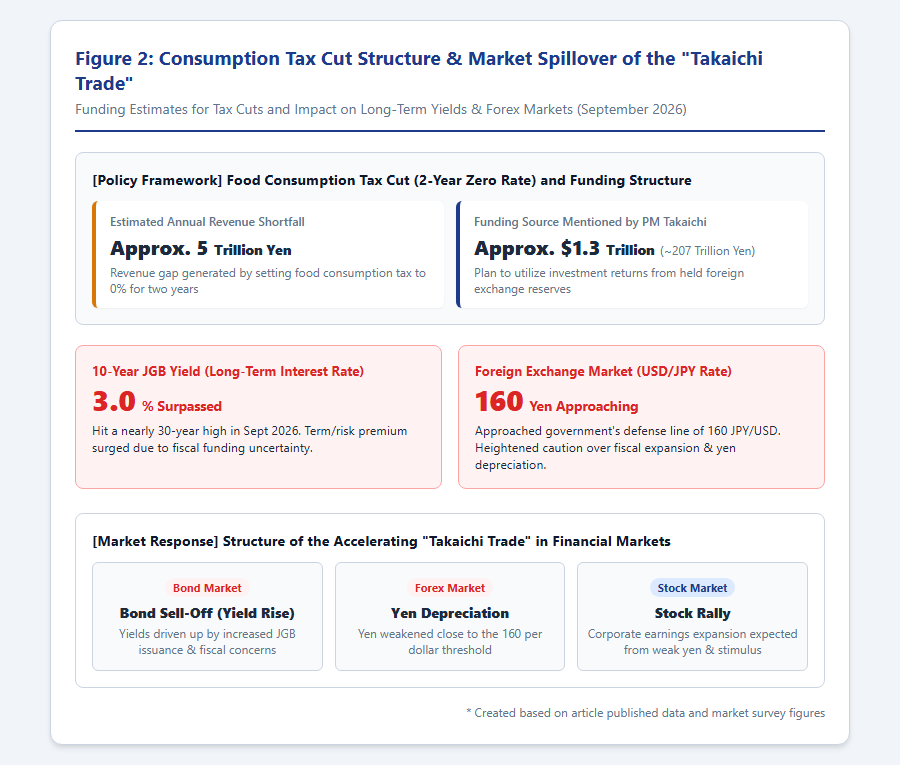
Uncertainty regarding the Takaichi administration’s fiscal direction is rebounding on financial markets through rising yields and a weaker yen. Prime Minister Takaichi mentioned utilizing foreign exchange reserves, which total approximately \$1.3 trillion (around 207 trillion yen), to fund a flagship policy: a temporary two-year zero-rate consumption tax on food. While the concept aims to offset an estimated annual revenue loss of 5 trillion yen using investment returns from foreign reserves, markets remain deeply skeptical about the sustainability of this funding source. In September 2026, Japan’s 10-year JGB yield broke through the 3% threshold for the first time in nearly 30 years, driven by a sharp rise in the risk premium (term premium). Meanwhile, in foreign exchange markets, the yen weakened close to the government’s defense line of 160 yen per dollar, accelerating the “Takaichi Trade” characterized by a weak yen, rising stock prices, and falling bond prices (higher yields). Financial market participants harbor persistent anxieties that pushing forward with aggressive fiscal spending and tax cuts without solid financial backing could erode confidence in Japan’s fiscal health, leading to further spikes in interest rates and an uncontrollable currency depreciation.
Fiscal Management Challenges, Future Outlook, and Key Watchpoints
The paramount point of interest moving forward lies in how the government will demonstrate a balance between “responsible proactive fiscal policy” and “fiscal sustainability” as budget drafting for FY2027 intensifies toward late 2026. In the budget request screening process, while full funding demands for defense and growth investments persist, achieving the 40 trillion yen bond cap necessitates rigorous reviews of existing expenditures. Furthermore, if opaque fund transfers between the general account and special accounts (off-budget management) increase, tracking total effective borrowing will become harder, potentially deepening market distrust. Beyond presenting numerical targets, the Takaichi administration must provide high-resolution explanations regarding spending priorities and how it plans to create a virtuous cycle of economic growth and tax revenue expansion. Intertwined with ruling coalition adjustments, parliamentary debates, tax revenue trends, and the Bank of Japan’s monetary policy normalization, the effectiveness of government fiscal communication will determine the future trajectory of the Japanese economy.
Reference Pages
- [Money Canvas by MUFG Bank] https://moneycanvas.bk.mufg.jp/know/column/jQ8HPQzh8bGNOx9/
[#TakaichiAdministration #JGBIssuance #FiscalPolicy #DefenseSpending #LongTermYields #ForeignExchange #JapaneseEconomy]

コメント