On June 30, 2026, US company Anthropic officially released its latest AI model, Claude Sonnet 5. A key feature of this model is its high intelligence comparable to top-tier models and the ability to autonomously perform tasks with agent functions at a low cost.
- The arrival of Claude Sonnet 5, balancing performance and cost
- Outstanding cost performance and limited-time onboarding price
- Adaptive Thinking and Agent Performance for Autonomous Thinking
- Backed by a large capacity of 1 million tokens and guaranteed security
- Outstanding achievements in legal practice and programming
- Future Developments and the Struggle for Supremacy in the AI Agent Economy
The arrival of Claude Sonnet 5, balancing performance and cost
On June 30, 2026, Anthropic announced the latest version of its core model, the Claude Sonnet 5. This new model is available on all plans, including Claude.ai, Claude Code, and the API platform Claude Platform from the day of its announcement. Its biggest feature is that it offers extremely high reasoning and knowledge task processing capabilities comparable to the company’s top-tier model, Claude Opus 4.8, at a significantly lower cost.
In the Intelligence Index by Artificial Analysis, an independent benchmarking agency, Claude Sonnet 5 scored 53. This figure rivals the advanced reasoning mode of its latest competitor’s GPT-5.5 model, placing it among the world’s top five existing AI models. The figure below shows the balance between cost and performance.
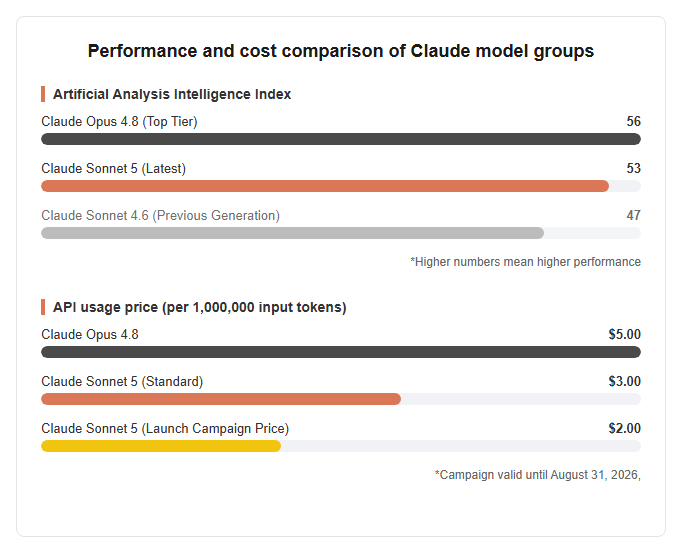
In particular, compared to the previous generation Claude Sonnet 4.6, there were significant improvements in key metrics such as inference, tool usage, and coding. Anthropic positions this model as a model that maximizes practicality within the scope of over-updating the frontier of capabilities, based on its Responsible Scaling Policy (RSP).
Outstanding cost performance and limited-time onboarding price
In the market launch of Claude Sonnet 5, Anthropic is taking strategic pricing approaches. The standard price for API usage is $3 per 1 million input tokens and $15 per 1 million output tokens, which is much cheaper than the higher-end Opus 4.8 model ($5 input, $25 output). Furthermore, as a campaign to promote the transition, an introductory price of $2 for input and $10 for output will be applied until August 31, 2026.
However, when operating, you need to pay attention to the characteristics of the newly introduced Tokenizer. Claude Sonnet 5 has updated its tokenizer for performance improvements, and even with the same text input, the number of tokens can increase by about 1.0 to 1.35 times compared to previous models (an average increase of about 30%). Therefore, even if the unit price per token remains unchanged, the total cost per request may be calculated differently from previous models.
Nevertheless, it remains highly cost-effective when considering the processing capacity per task. Especially for enterprise users who need to handle a large number of complex intellectual tasks, the benefits of traditional Opus-level performance at Sonnet pricing are significant, making it a strong choice amid the rising AI costs faced by major customers like Amazon.
Technological Innovation and Enhanced Agent Functions
Adaptive Thinking and Agent Performance for Autonomous Thinking
Anthropic defines Claude Sonnet 5 as the most agent-like model in the company’s history. This means they are not only adept at responding to user instructions, but also excelling at making their own plans and autonomously operating web browsers and computing tools to achieve complex goals. This autonomy has been confirmed to exceed traditional large-scale models in benchmarks such as BrowseComp, an agent-based web search evaluation.
On the technical side, a major change is that Adaptive Thinking is enabled by default. This allows the model to automatically adjust internal reasoning steps according to the difficulty of the task, generating more accurate outputs. In previous models, users had to manually set their thought processes, but with Sonnet 5, AI determines the optimal depth of thought.
The effectiveness has been reported in actual development settings, with AI coding tools such as Cursor, which has praised Sonnet 5 agents for accurately completing multi-step code changes without deviating from the original plan. These enhancements in agent capabilities are evolving AI from mere chat partners into autonomous operators who take over practical tasks.
Backed by a large capacity of 1 million tokens and guaranteed security
In terms of data processing capabilities, Claude Sonnet 5 natively supports a context window of 1 million tokens. This means you can read a vast amount of material equivalent to several books at once, analyze their contents in detail, or search for specific information. When working while keeping track of a large codebase and thousands of pages of legal documents, this vast memory space becomes a decisive advantage.
It is also noteworthy that, while possessing advanced capabilities, cybersecurity safeguards have been strengthened. Sonnet 5 is the first Sonnet tier model equipped with real-time security protection features, and is designed to block aggressive code generated to exploit vulnerabilities. In actual tests exploiting Firefox vulnerabilities, it was shown that compared to higher-level models or certain research models, it had a deterrent effect that prevented dangerous code from being completed.
From an ethical perspective, an interesting characteristic has been reported: the degree of evaluation recognition, where models recognize their own situation and being evaluated. Furthermore, there have been cases where models criticized their own behavioral norms as unethical, underscoring the evolution of AI’s self-conscious behavior and the importance of governance over it.
Application to Practice and Future Prospects
Outstanding achievements in legal practice and programming
Claude Sonnet 5 delivers exceptional performance in specific specialized fields. According to Harvey’s assessment in the legal tech field, the Legal Agent Benchmark (LAB), which measures the ability to perform complex legal tasks, achieved an all-pass (completion of all steps) at 5.8%, indicating a significant improvement in accuracy and precision in legal practice compared to previous generations. Furthermore, on BigLaw Bench, which targets large-scale law firm operations, it achieved a record-high score of 91.3%.
His skills are also remarkable in the field of programming. Agent functions provided through CLI tools like Claude Code autonomously detect bugs and refactor code based on developer instructions. A March 2026 survey reported that Claude discovered over 100 bugs in the Firefox browser, 14 of which were highly severe.
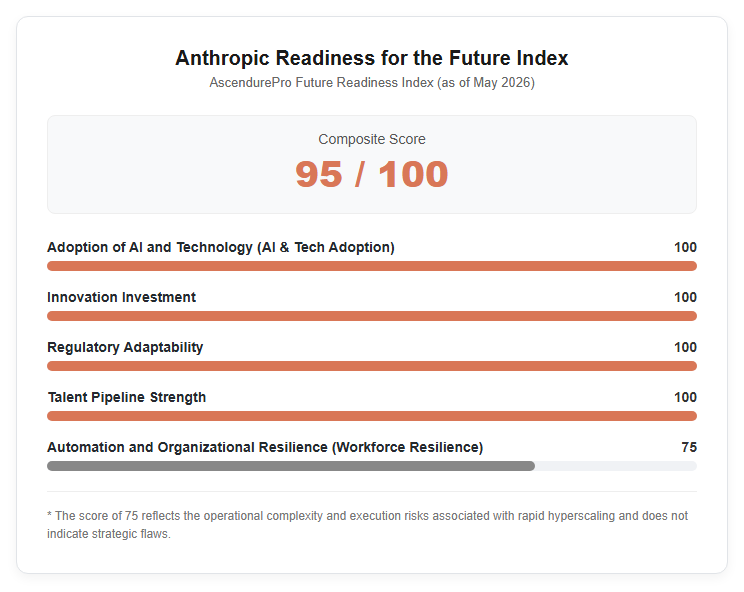
In this way, adoption is progressing not only as general AI but also in fields requiring advanced expertise such as law, finance, and engineering. Especially in highly regulated industries, the combination of Anthropic’s built trust in safety and Sonnet 5’s strong operational capability creates a strong barrier to entry for competitors. The table below is an evaluation of Anthropic’s readiness for the future.
Future Developments and the Struggle for Supremacy in the AI Agent Economy
The release of Claude Sonnet 5 can be seen as part of Anthropic’s strategy to transform from a mere model provider into a leader in AI agent infrastructure. By May 2026, the company’s enterprise value reached $965 billion, temporarily surpassing OpenAI to become the world’s most valuable AI company. With this enormous financial strength and a total of 10 gigawatts of computing resources secured from cloud giants like Amazon and Google, we maintain an even faster development cycle.
On the other hand, subtle changes have occurred in the relationship with Amazon. Amazon has deeply integrated Claude into its services, but since Anthropic has decided to transition to a token-based pricing structure starting next year, it has also begun exploring other options like OpenAI from a cost control perspective. Such a restructuring of partnerships could significantly reshape the future power landscape of the AI industry.
In the future, Anthropic is predicted to become a publicly traded company generating between $150 billion and $300 billion in revenue by 2030, with its model becoming a public infrastructure supporting scientific discovery and social infrastructure. Claude Sonnet 5 will mark a significant milestone in its ambitious roadmap for popularizing advanced capabilities.
[#Claude #Anthropic #AIエージェント #機械学習 #最新技術 #AIセーフティ #生産性向上]

コメント