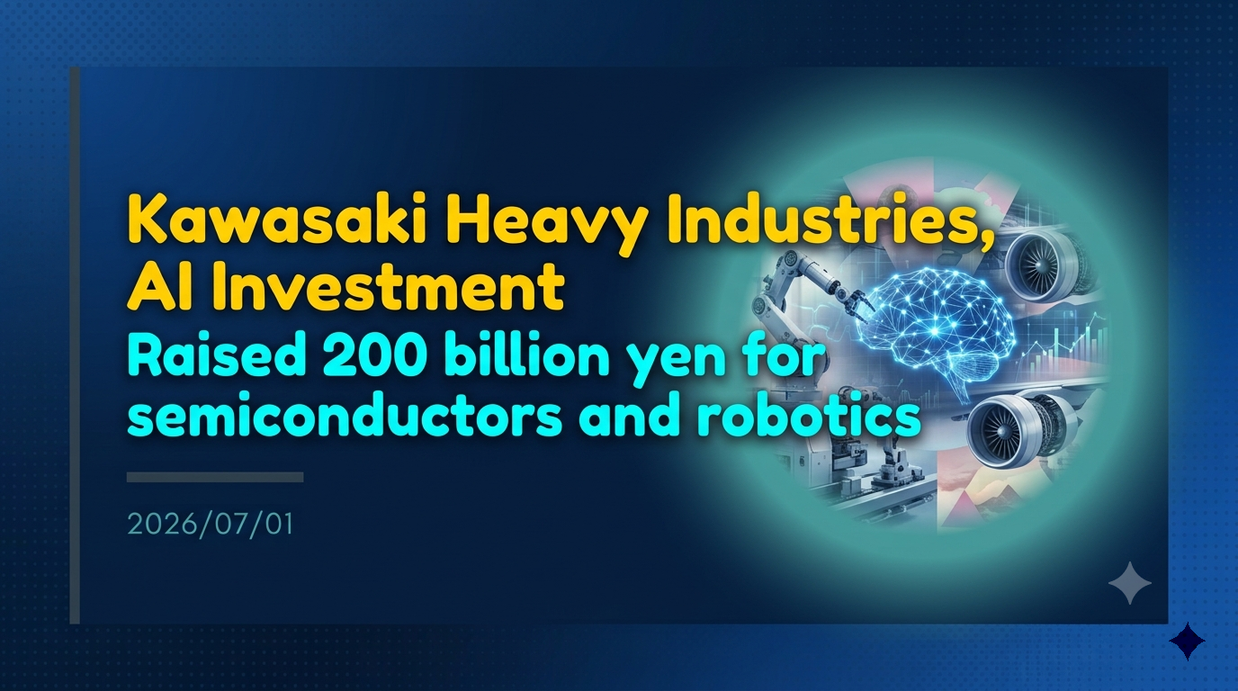
Kawasaki Heavy Industries will raise approximately 200 billion yen in capital for growth investments in AI, semiconductor robots, and aircraft. Behind this is an aggressive management approach aimed at realizing the “Group Vision 2030” and a balanced-oriented financial strategy that considers the payback period.
- Funding raised at around 200 billion yen and its breakdown
- Concentrated Investment in Growth Sectors: AI, Semiconductors, Aircraft
- Concerns over a sharp drop in stock prices and “stock dilution”
- Management Intent Behind the Use of Convertible Bonds (CB)
- Collaboration between Physical AI and NVIDIA
- Group Vision 2030 and Growth Expectations for the Defense Business
Funding raised at around 200 billion yen and its breakdown
On July 1, 2026, it was revealed that Kawasaki Heavy Industries entered final adjustments to raise approximately 200 billion yen in total funds by combining a public offering and bonds with stock acquisition rights (CB = convertible bonds). According to multiple sources, the company is targeting overseas institutional investors as a key sales target and is expected to approve issuance within this week. This funding method is characterized by the use of both immediate securing of funds through common stock and CBs that may be converted into equity in the future. In its fiscal 2025 financial results, the company achieved record highs with sales revenue of 2.3112 trillion yen and operating profit of 145.1 billion yen, and has shifted toward large-scale capital policies aimed at the next stage of growth, supported by strong core business performance. The funds raised will be used as military funding to further expand the company’s strengths in areas such as aerospace and robotics, and to accelerate the social implementation of next-generation technologies.
Concentrated Investment in Growth Sectors: AI, Semiconductors, Aircraft
The main use of the funds will be capital investment in key areas such as “physical AI,” which is expected to grow in the medium to long term, robots for semiconductor manufacturing equipment, aircraft engines, and hydrogen energy. In particular, the rapid spread of generative AI and the rush in data center construction have led to a global expansion in demand for large gas turbines that support vast power sources, and the company is aiming to strengthen its supply capacity to seize this opportunity. Additionally, with the full-scale recovery in civil aviation demand, establishing a system to increase production of parts for aircraft engines has become an urgent task. The diagram below illustrates the diverse mobility and technological expansion envisioned by the company.
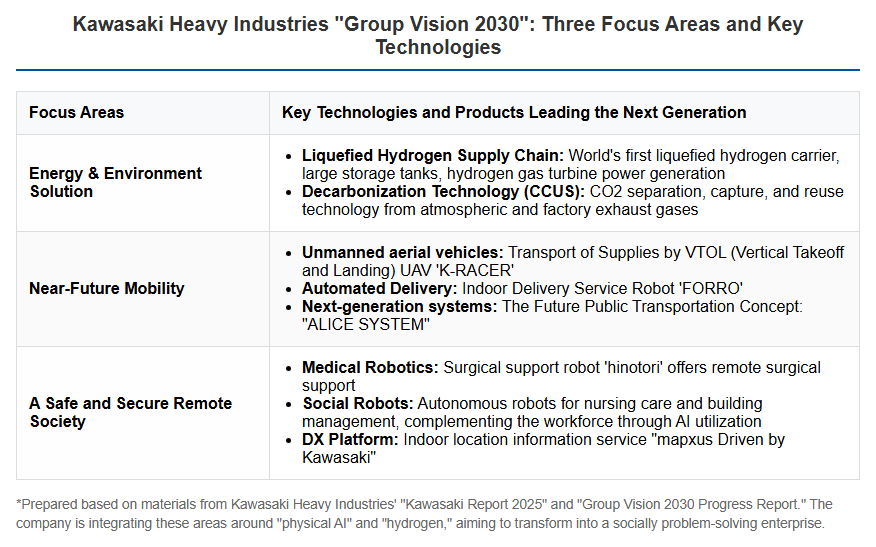
In the robotics sector, with an eye toward revitalizing the semiconductor market, we plan to expand production capacity for robots for manufacturing equipment. All of these investments are aimed at generating high future revenue contributions, embodying a “dual-approach management” that balances deepening existing businesses with exploring new ones.
Market Response and Financial Strategy Background
Concerns over a sharp drop in stock prices and “stock dilution”
Following reports of a large-scale fundraising, Kawasaki Heavy Industries’ stock price temporarily plummeted on the Tokyo stock market on July 1, 2026. The biggest factor behind the market’s negative reaction was concerns about “stock dilution,” where the value per share declines due to new share issuance. Public offerings tend to cause short-term deterioration in supply and demand, and since CBs are also seen as a future dilution factor, profit-taking sales have preceded. This move spread to other companies in the same industry, and on forums like IHI, investors expressed concerns about a downturn. For example, in IHI’s case, at the shareholders’ meeting, the responsible executive explained that “investments will be funded by operating cash flow and real estate sales,” denying the risk of capital increases, which has contributed to Kawasaki Heavy Industries’ actions fueling suspicion about capital policy across the industry. However, this decline is due to temporary supply and demand factors, serving as a litmus test for investors evaluating the company’s long-term growth strategy.
Management Intent Behind the Use of Convertible Bonds (CB)
Kawasaki Heavy Industries’ decision to combine not only common stock but also CBs is due to consideration for the business nature of the business, which requires time to recover investments. While physical AI and hydrogen energy sectors are expected to be future growth drivers, it will take a certain period before they are returned as profits. Since new shares are not issued until they are converted into shares, CBs have the advantage of securing funds while suppressing immediate dilution. The company has set a policy to manage the NET D/E ratio within the range of 70~80% as a financial health indicator, pursuing a balance between reducing interest-bearing debt and growth investments. President Yasuhiko Hashimoto stated, “Profit is the source of our challenge,” and by raising external funds through optimal methods in addition to cash generated from record-high performance, we aim to achieve rapid investment while maintaining financial discipline.
Medium- to Long-Term Outlook and Future Highlights
Collaboration between Physical AI and NVIDIA
The main focus of this investment plan is the field of “physical AI.” This is a next-generation technology where AI autonomously controls real-world robots and industrial machinery, and Kawasaki Heavy Industries is accelerating the development of next-generation robots in collaboration with the U.S. company NVIDIA. The company has accumulated robotics technology as hardware for over half a century, and by integrating AI as the “brain,” it aims to evolve into a service-oriented model that solves on-site challenges. Specifically, examples include autonomous robots in medical and nursing care settings, and optimization of logistics routes using AI. Another major strength is that simulation on digital twins utilizing NVIDIA’s virtual environment “Omniverse” dramatically accelerates development speed. The following photo shows surgical support robots active in medical settings.
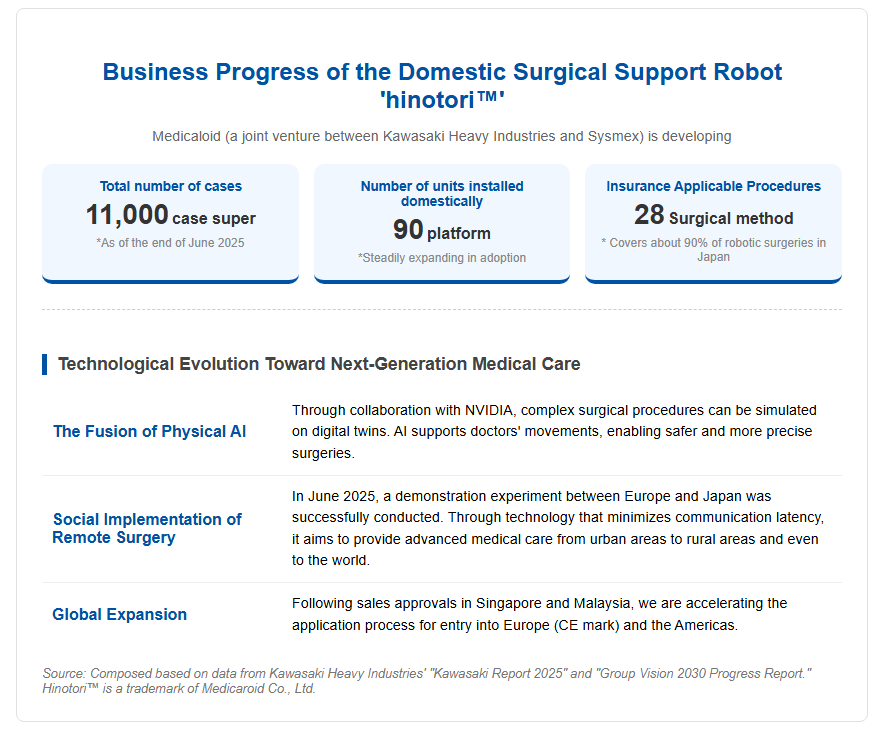
Co-creation with such high-tech companies holds the potential to transform the company from a mere heavy industry manufacturer into a solutions company equipped with advanced software technologies.
Group Vision 2030 and Growth Expectations for the Defense Business
Kawasaki Heavy Industries has set an ambitious goal in its “Group Vision 2030” to achieve a business profit margin of over 10% across all its operations. In fiscal year 2026, large-scale projects for the Ministry of Defense will be at a peak, so a temporary stagnation is expected, but from fiscal year 2027 onward, the company is anticipated to enter a growth phase again due to the expansion of the defense budget. The company possesses proprietary platforms such as the P-1 patrol aircraft and submarines, as well as its in-house developed KJ300 series engines, holding an extremely important position domestically in advancing defense equipment. We are also considering collaboration with Airbus’s defense division in the field of unmanned aerial vehicles (drones), and are considering expanding our business within an international framework. This 200 billion yen funding round is not only a strategic step to strengthen the consumer sector such as AI and robotics, but also to fundamentally enhance medium- to long-term corporate value by applying autonomous control technologies derived from these to the defense domain.
[#川崎重工業 #資金調達 #AI #半導体 #防衛産業 #経済ニュース #投資戦略 #エヌビディア]
」を開設_en.png)

コメント