During the US Thanksgiving season in November 2026, surging energy costs driven by the Iran conflict are projected to increase fuel expenses for citizens and businesses by approximately 500 billion yen. The background includes a historic surge in crude oil and diesel prices due to escalating tensions in the Strait of Hormuz, as well as severe cost-shifting onto the logistics and aviation industries.
- Why the Thanksgiving Travel Season Resulted in Approximately 500 Billion Yen in Additional Spending
- The Shock of Cumulative Fuel Costs Reaching Approximately 170,000 Yen Per Household
- Corporate and Government Burdens Caused by Historic Surges in Gasoline and Diesel
- Rising Airfares and Their Ripple Effects on Year-End Shopping and Leisure Spending
- Supply Chain Turmoil and the Persistence of Sticky Inflation Pressures
- Cost Increases Impacting Japanese Companies and Moves to Review Business Strategies
Why the Thanksgiving Travel Season Resulted in Approximately 500 Billion Yen in Additional Spending
During the Thanksgiving season in November 2026, additional fuel costs paid by US drivers and businesses to purchase gasoline and diesel are expected to reach approximately $3.14 billion (approx. 499 billion yen). The main background behind this is that following the outbreak of the Iran conflict on February 28, 2026, maritime traffic in the Strait of Hormuz—a vital Middle Eastern chokepoint—was significantly disrupted, rapidly heightening concerns over crude oil supply interruptions. According to surveys by organizations such as the American Automobile Association (AAA), the nationwide average price of gasoline soared from $2.98 per gallon before the conflict to nearly $4.50, and diesel fuel prices also broke all-time highs. Of the $3.14 billion in additional fuel costs generated during the Thanksgiving period, direct burdens borne by individual drivers account for about $1.5 billion (approx. 239 billion yen, or 47.3% of the total). The remaining $1.6 billion (approx. 254 billion yen) is a corporate burden borne by transport companies, farmers, and others, which is ultimately designed to be passed on to product prices. The traditional Thanksgiving travel rush, in which many citizens visit distant relatives every year, ended up taking the direct hit of soaring energy prices. As shown in the figure below,
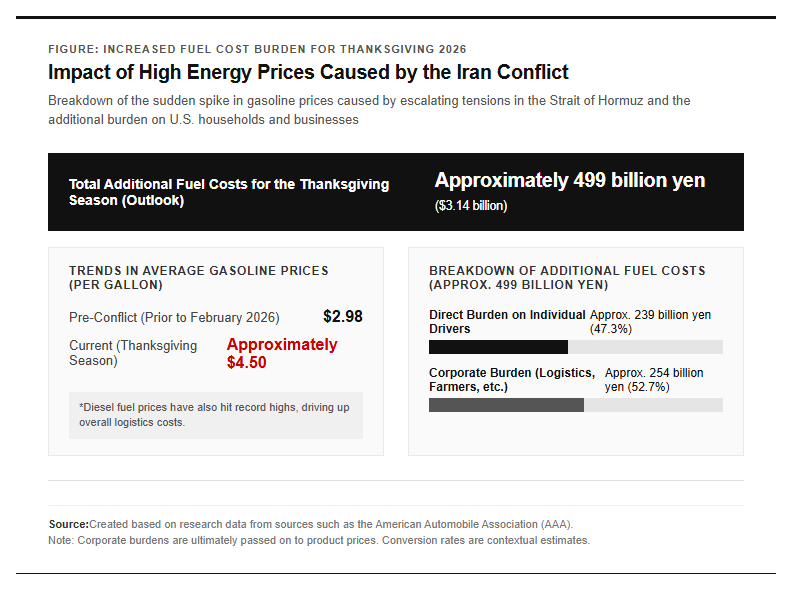
The soaring cost of fuel has become a direct burden on households.
The Shock of Cumulative Fuel Costs Reaching Approximately 170,000 Yen Per Household
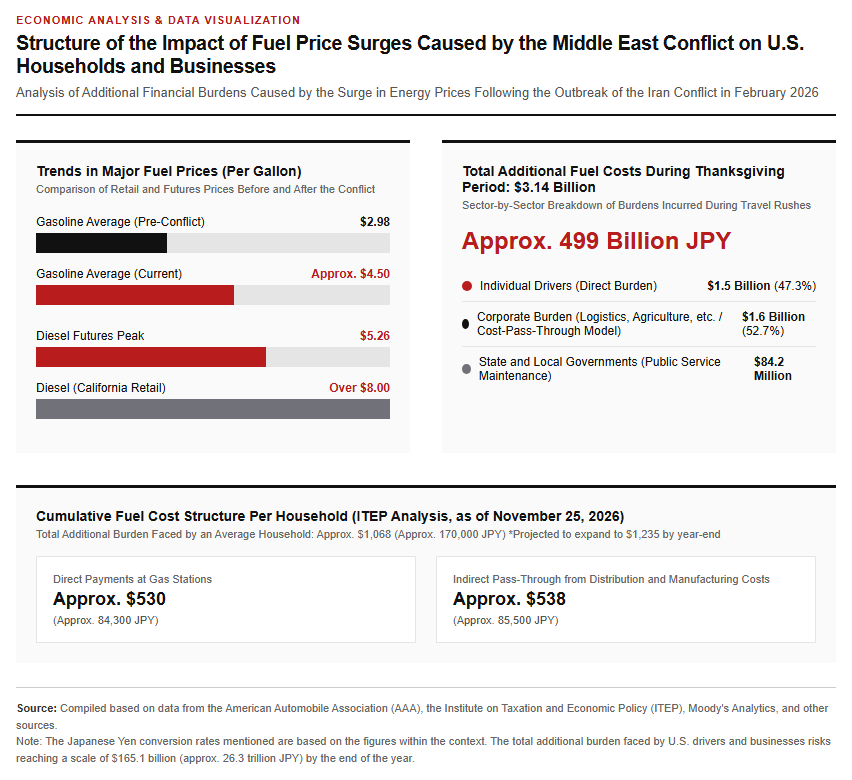
According to an analysis calculated by the Institute on Taxation and Economic Policy (ITEP) as of November 25, 2026, the total amount of additional automotive fuel costs borne by the average US household since the start of the conflict reached approximately $1,068 (approx. 170,000 yen). Breaking down the structure of this burden, the amount paid directly at gas stations was about $530 (approx. 84,300 yen), while the remaining approximately $538 (approx. 85,500 yen) corresponds to indirect expenditures passed down from the broader economy through rising distribution and manufacturing costs. For a two-person household with two drivers, they have borne about $585 (approx. 93,000 yen) at gas stations and about $420 (approx. 66,800 yen) in cost hikes in other areas up to the present, totaling over $1,000 per household. The cumulative additional fuel costs paid by the entire US public since the outbreak of the conflict have ballooned to nearly $142.8 billion (approx. 22.7 trillion yen) and risk expanding to $165.1 billion (approx. 26.3 trillion yen) by the end of 2026. If current high fuel prices persist through the end of December, the average additional burden per household is calculated to reach $1,235 (approx. 196,000 yen), severely straining household disposable capacity, particularly among low- and middle-income groups.
Ripple Effects of Soaring Energy Costs and Blows to Industry and Logistics
Corporate and Government Burdens Caused by Historic Surges in Gasoline and Diesel
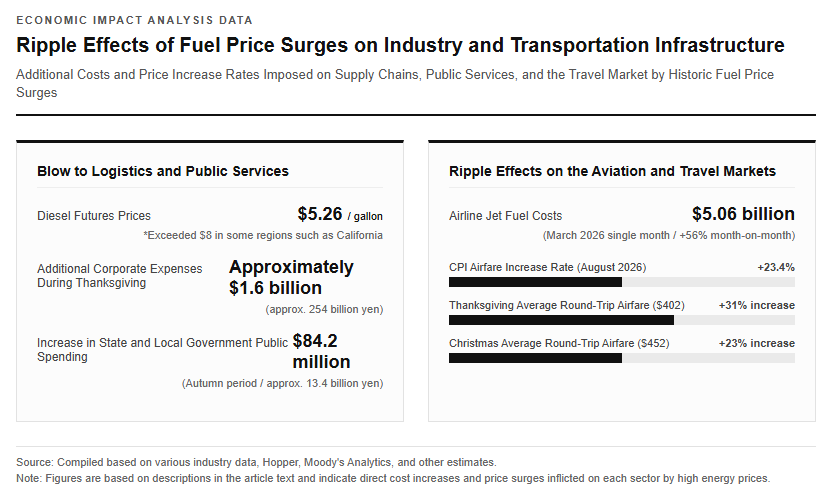
The blow of soaring fuel prices is not limited to individual consumers, but is widely spilling over into industry at large and public services. In particular, futures prices for diesel fuel—which is essential for truck transportation and the operation of agricultural machinery—recorded an all-time high of $5.26 per gallon, with retail prices surpassing $8 in some regions such as California. Because trucks across the country deliver agricultural products, daily necessities, and industrial materials, high diesel prices are driving up logistics costs across the board. During the Thanksgiving period alone, companies are being forced to pay an estimated $1.6 billion (approx. 254 billion yen) in excess additional expenses. Furthermore, state and local government agencies maintaining public services such as school buses, public transit, and emergency and fire vehicles have also experienced an increase in public spending of $84.2 million (approx. 13.4 billion yen) in the autumn alone. Moreover, according to estimates by Mark Zandi of Moody’s Analytics, the combination of inflationary pressures and rising interest rates stemming from high energy costs is accelerating the decline in real household purchasing power. As the figure below shows,
The soaring cost of diesel casts a heavy shadow over the entire supply chain.
Rising Airfares and Their Ripple Effects on Year-End Shopping and Leisure Spending
The surge in fuel prices has also had a critical impact on the aviation industry and travel market. In March 2026 alone, immediately following the outbreak of the conflict, jet fuel expenses incurred by U.S. airlines reached $5.006 billion—a 56% increase from the previous month and one of the largest cost spikes in history. To defend their profitability, airlines implemented increases in base airfares, introduced fuel surcharges, raised baggage fees, and drastically cut or suspended unprofitable routes. As a result, airfares within the U.S. Consumer Price Index (CPI) rose 23.4% year-over-year in August 2026. According to data from travel booking platform Hopper, average round-trip airfares for the 2026 Thanksgiving holiday soared to $402 (a 31% increase year-over-year), and for Christmas to $452 (a 23% increase). During the year-end and New Year holidays, when returning home and family gatherings are essential, consumers are forced to secure funds by cutting back on autumn leisure trips, dining out, and apparel purchases, raising concerns about a broader cooling of the year-end shopping season.
Medium- to Long-Term Economic and Price Outlook and Implications for Japanese Companies
Supply Chain Turmoil and the Persistence of Sticky Inflation Pressures
The prolonged Middle East situation also poses a dilemma for the U.S. Federal Reserve’s (FRB) inflation-containment measures. With crude oil prices remaining above $100 per barrel and the 10-year U.S. Treasury yield rising to the 4.9% range, the FRB raised its policy interest rate to 3.75%–4.00%, yet persistent concerns that inflation will become entrenched remain deep-seated in the bond market. The rise in crude oil prices is not limited to fuel costs for gasoline and diesel; it has spread to production and processing costs across the board for plastics derived from naphtha, synthetic resins, chemical fertilizers, and agricultural produce, keeping core inflation rates elevated. Even if crude oil futures prices temporarily decline, tanker insurance premiums for navigating the Strait of Hormuz remain high and rebuilding depleted global petroleum reserves will take a significant amount of time. Consequently, analysts point out that the decline in retail fuel prices will follow a sluggish “rockets and feathers” dynamic. Price-hiking pressures originating from the energy supply shock will remain a major risk factor for the sustainable growth of the global economy through 2027. As shown in the figure below,
Caution regarding long-term inflationary pressures is spreading.
Cost Increases Impacting Japanese Companies and Moves to Review Business Strategies
The global surge in fuel prices and supply uncertainty originating in the United States are casting a serious shadow over the business environment for Japanese companies as well. According to a survey conducted by Teikoku Databank (TDB) in April 2026, 96.6% of domestic companies responded that the surge in crude oil prices and supply instability associated with the Middle East situation have a “negative impact” on their business management. Specifically, direct cost increases topped the list, including rising fuel costs for company cars and delivery trucks (73.4%), rising prices for crude oil-derived raw materials (66.7%), and soaring logistics and transportation costs (62.0%). If the current situation continues for about six months, 43.8% of companies anticipate drastic downsizing of their core businesses, and particularly in the manufacturing sector, 22.8% responded that they would reach their breaking point in less than three months. A survey by Tokyo Shoko Research (TSR) also reported that approximately 80% of companies are experiencing negative impacts, making urgent reviews of business plans—such as introducing fuel surcharges, substituting materials, improving transportation efficiency, and passing on costs—an absolute priority.
Reference Pages
- [Brown University Watson Institute – Iran War Energy Cost Tracker] https://iranwarcost.watson.brown.edu/
[#IranWar #CrudeOilSurge #USEconomy #Thanksgiving #Inflation #FuelCosts #SupplyChain #JapaneseCompanies]


コメント