Canada’s Almonti Industries has begun full-scale tungsten mining and ore processing at the Sangdong Mine in Ningwol County, Gangwon Province, South Korea. Behind this are the price surges caused by China’s weaponization of resources and the Western countries’ efforts to build supply chains away from China.
- The Restart After 32 Years and the Importance of the Kamito Mine
- Outstanding ore grade and economic value
- China’s export controls and global supply instability
- Building supply chains for Western countries away from China
- Strategy for High Value-Added and Vertical Integration
- Impact on the Regional Economy and Sustainability Challenges
The Restart After 32 Years and the Importance of the Kamito Mine
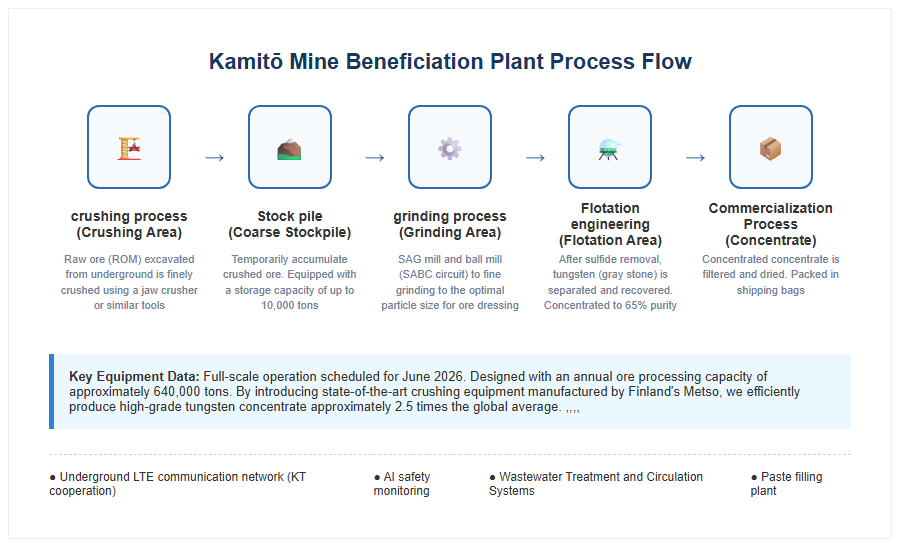
In June 2026, full-scale operation of tungsten mining and ore processing plant began for the first time in 32 years at the Sangdong Mine located in Ningwol County, Gangwon Province, South Korea. Until the 1980s, the mine was one of the world’s largest tungsten producers and a pillar of Korea’s economy, supporting about 60% of South Korea’s exports. However, in the early 1990s, it lost its price competitiveness due to the onslaught of low-priced Chinese products, and was forced to close in 1994. This restart was realized after about ten years, significant investment, and technological development since Canada’s Almonti Industries acquired the mine in 2015. By the end of the first quarter of 2026, approximately 120,000 tons of ore have been accumulated, and the company is already transitioning into the production phase of tungsten concentrate that is ready for sale. The diagram below shows the restarted ore processing facility at the Kamitō Mine.
Outstanding ore grade and economic value
The main reason Shangdong Mine is attracting renewed attention is its overwhelmingly high ore grade. The tungsten content (grade) in mined ore averages about 0.44% to 0.51%, which is more than 2.5 times the global average of about 0.18% to 0.19%. Even when processing the same amount of ore, more tungsten can be efficiently secured, making extremely high profitability expected. The economic value based on concentrate (grade 65%) is estimated to be about 27 trillion won. As an initial phase, Almonti aims to produce about 2,300 tons within the year, and plans to add about 2,100 tons annually through factory expansion. Additionally, the mine contains a large by-ore zone of molybdenum, a rare metal with excellent corrosion resistance, and is expected to serve as a diversified resource source for the semiconductor and aerospace sectors.
Geopolitical Risks and Sharp Market Prices
China’s export controls and global supply instability
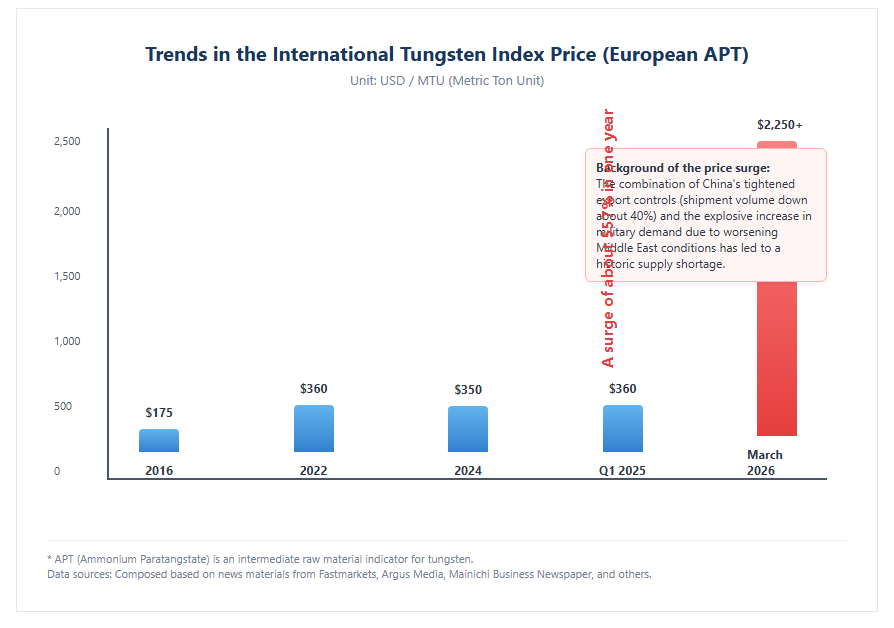
Tungsten is the densest metal and has a melting point of up to 3422 degrees, making it a “strategic material” essential for military use such as cutting tools, semiconductors, and even missiles and armored vehicles as penetrating weapons. Currently, China accounts for about 80% of global tungsten production, but Chinese authorities are reducing mining quotas under the pretext of environmental and resource protection and are gradually strengthening export control systems. In fact, from February to April 2026, a de facto embargo occurred, with Chinese tungsten-related exports to Japan dropping to zero for three consecutive months, causing a major shock in the manufacturing sector. Due to this weaponization of supply chains, the price of ammonium paratang state (APT) in the European market has surged by 557% in just one year since early 2025, continuously setting new all-time highs. The following chart summarizes the recent trends in international tungsten prices.
Building supply chains for Western countries away from China
In response to China’s monopolistic control of resources, Western countries led by the United States are rapidly reorganizing their supply chains in a ‘de-China’ manner. In particular, under the U.S. National Defense Authorization Act, defense industry companies contracting with the U.S. Department of Defense after 2027 will be prohibited from using tungsten mined and refined in countries such as China and Russia. As a result, the value of the Sangdong mine, located in allied South Korea and a source of conflict-free supply, is extremely high for security. Almonti relocated its headquarters from Canada to the United States to directly benefit from the Department of Defense’s supply chain restructuring. Much of the tungsten concentrate produced at the Shangdong mine is scheduled to be exported to the United States and other countries over the next 15 years under an already concluded contract.
Future Outlook and Key Points to Watch
Strategy for High Value-Added and Vertical Integration
Almonti aims to build an “integrated value chain” that goes beyond simple ore mining and includes downstream processes. In cooperation with Yeongwol County, the company is promoting the construction of a high-purity tungsten oxide production plant with an annual capacity of about 4,000 tons, aiming to complete everything from mining to refining and advanced material production within Korea. This will enable the supply capacity of high value-added materials to Korea’s core industries such as semiconductors, secondary batteries, and defense. Furthermore, when the company goes public on Nasdaq in July 2025, its stock price is expected to soar nearly 4000%, reflecting extremely high market expectations. Although the mine was closed in the past due to worsening profitability, the company expects a high expected profit margin of over 80%, supported by the current high price environment and the political backdrop urging de-industrialization.
Impact on the Regional Economy and Sustainability Challenges
The reopening of the Sangdong mine is expected to greatly contribute to the economic revitalization and job creation of the long-standing Neong-Ngok region. While aiming to recreate the prosperous history once given to the term “Weightstone Dollar,” there are still issues to be resolved. One is environmental consideration, which requires the purification of heavy metal pollution accumulated from past mining and the treatment of residues generated during development. Additionally, in June 2026, there were reports of temporary suspension of construction due to a strike by local workers, indicating that maintaining a “win-win” relationship with the local community will determine the project’s continuity. Furthermore, as much of the mined strategic materials are diverted to supply the United States, the institutional design of how South Korea’s domestic industry can stably secure tungsten will also become an important focus going forward.
[#タングステン #経済安全保障 #韓国経済 #レアメタル #サプライチェーン #半導体 #防衛産業 #アルモンティ]


コメント