Amazon.com in the US is expected to begin commercial service of its satellite internet service Amazon Leo within 2026. Against the backdrop of acquiring a satellite communications company that cost about 1.8 trillion yen and having deployed a total of 396 satellites, the company is set to catch up with SpaceX’s leading ‘Starlink’.
- Deployment of 396 satellites and service start within the year
- Three types of communication terminals to meet diverse needs
- Strengthening the communication network through the acquisition of Global Star
- Fierce market share competition with SpaceX’s Starlink
- Expansion in Japan and Strategic Partnership with NTT Group
- Future Outlook and Challenges for Full Construction by 2029
Deployment of 396 satellites and service start within the year
Amazon’s satellite internet business, Amazon Leo (formerly Project Kuiper), reached a significant milestone on July 2, 2026. From Cape Canaveral Space Force Base in Florida, 29 operational satellites were launched by United Launch Alliance (ULA) Atlas V rockets, bringing the total number of satellites in orbit to 396. The company stated that this base is large enough to support continuous broadband communication in the initial service areas. The diagram below shows an image of the low Earth orbit satellite network.
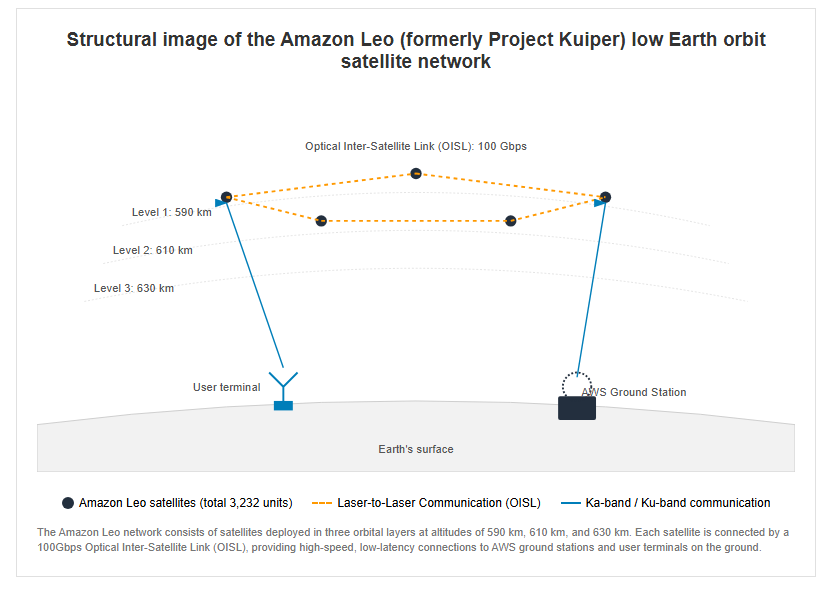
In November 2025, Amazon rebranded the project from “Project Kuiper” to “Amazon Leo” and released a public beta pre-order list. Current plans include the rollout of broader commercial services starting in late 2026. The initial service area will be limited to latitude ranges where uninterrupted communication is possible with the current constellation of satellites, but as launches accelerate, the geographic coverage will be gradually expanded.
Three types of communication terminals to meet diverse needs
Amazon Leo plans to deploy three types of customer terminals (communication antennas) tailored to user needs. The standard model, the “Leo Pro,” measures 11 inches (about 28 cm) square, is designed to achieve communication speeds of up to 400Mbps, and is intended for use at home or in small offices. Furthermore, the ultra-compact 7-inch (approx. 18 cm) square model “Leo Nano,” suitable for portability and IoT applications, offers download speeds of up to 100Mbps, while the large “Leo Ultra” model for enterprises and government agencies offers download speeds of up to 1Gbps. The following image shows the exterior of the communication terminal under development.
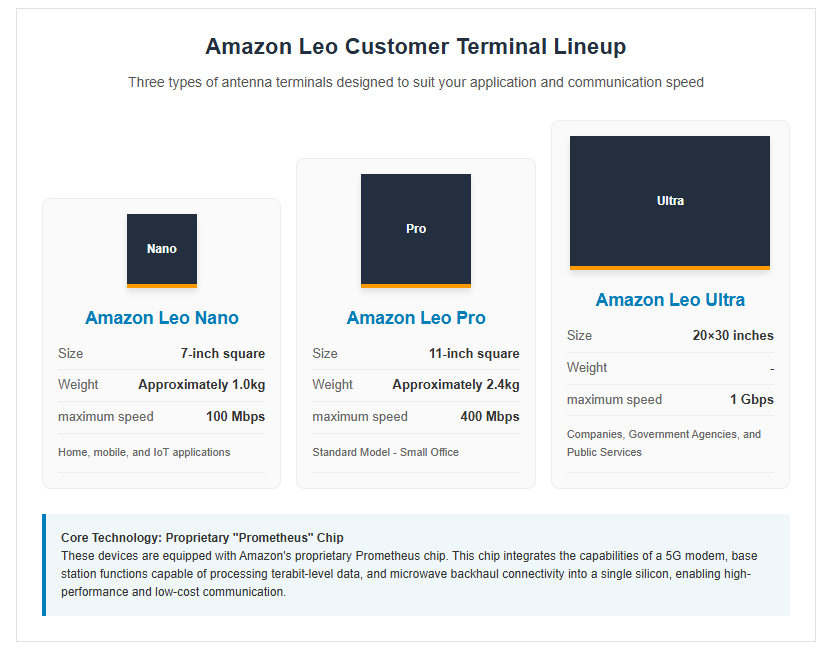
Amazon aims to secure an edge over competing services like Starlink by keeping the cost of these devices low. In particular, for the standard model, the goal is to keep the device price below $400 (about 64,000 yen). This is the result of adopting our proprietary processor, “Prometheus,” which integrates 5G modem functions, base station functions, and microwave backhaul into a single chip, achieving both high performance and low cost.
Massive acquisitions and competing with Starlink
Strengthening the communication network through the acquisition of Global Star
In April 2026, Amazon agreed to acquire the U.S. satellite communications giant Global Star for about $11.6 billion (about 1.8 trillion yen). This acquisition aims to complement Amazon Leo’s satellite network and significantly strengthen its communication network. GlobalStar has strengths in technology that directly connects communication satellites with devices such as terrestrial smartphones, and has already provided services such as emergency SOS for Apple’s iPhone. The diagram below shows the strategic network structure after the acquisition.
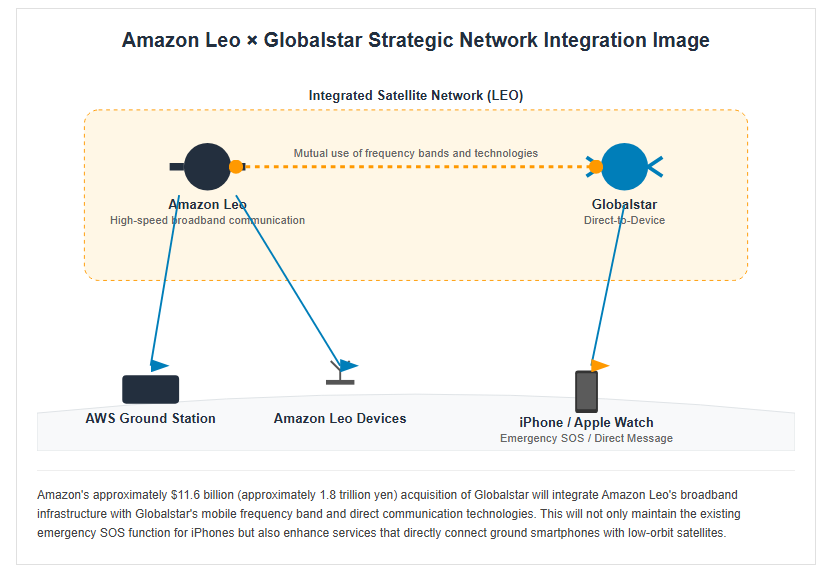
Through this acquisition, Amazon will obtain the spectrum license for GlobalStar’s mobile satellite services and operational authorization worldwide. Additionally, the partnership with Apple will be carried over, with the satellite connectivity of iPhone and Apple Watch supported by Amazon Leo’s network. Even in places where existing terrestrial communication infrastructure cannot reach, Amazon is rushing to enhance services that allow smartphones to connect directly through its low-Earth orbit satellite network, aiming for a rapid expansion of its customer base.
Fierce market share competition with SpaceX’s Starlink
In the satellite internet market, SpaceX’s Starlink currently boasts overwhelming first-mover advantage under Elon Musk’s leadership. By mid-2025, Starlink will have over 5 million active users across more than 125 countries and operate more than 7,000 satellites in orbit. In contrast, Amazon’s Amazon Leo operates 396 satellites, which is still less than 4 percent of its scale. However, Amazon is trying to counter its strengths—the world’s largest e-commerce infrastructure—and its integration with Amazon Web Services (AWS). While SpaceX is pursuing vertical integration with its own Falcon 9 rocket, Amazon adopts a multi-vendor strategy that leverages ULA’s Atlas V and Volcan, Blue Origin’s NewGlen, and even competing SpaceX rockets. By contracting to introduce communication services on more than 500 Delta Air Lines’ aircraft, Starlink is targeting corporate and government demand and aiming to break into the dominant market.
Expansion in Japan and Regulatory Response
Expansion in Japan and Strategic Partnership with NTT Group
Concrete developments are also underway regarding expansion within Japan. In November 2023, Amazon agreed to a strategic partnership with NTT, NTT Docomo, NTT Communications, and Sky Perfect JSAT. This is the first large-scale partnership in the Asia-Pacific region. Through this collaboration, the NTT Group plans to provide Amazon Leo services to companies, government agencies, and local governments within Japan. The image for its expansion in Japan is as follows.
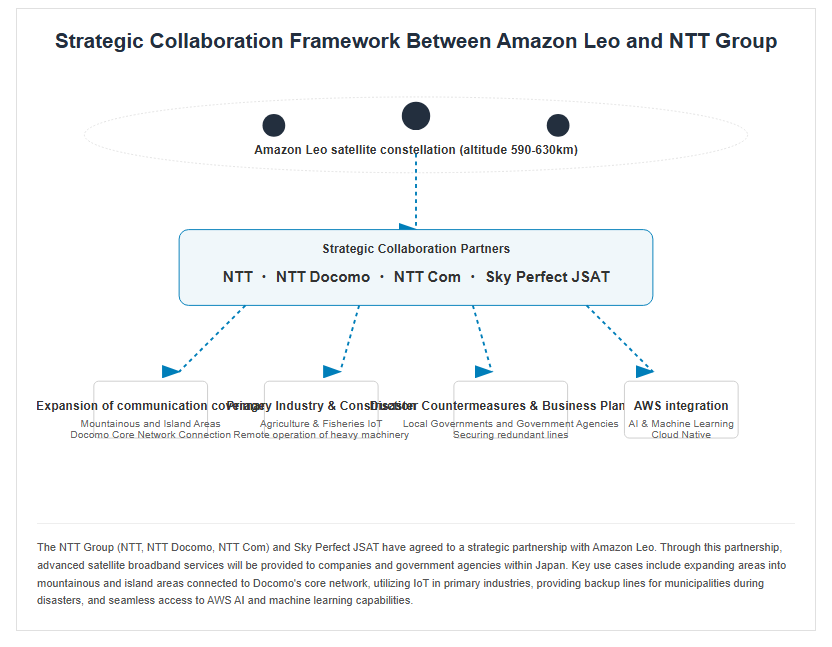
The main goal of the partnership is to strengthen the resilience and redundancy of Japan’s telecommunications networks. For example, NTT Docomo aims to expand its communication coverage by utilizing Amazon Leo as a means of connecting to the core network in areas where it is difficult to install ground base stations, such as mountainous or island regions. Furthermore, advanced solutions are expected to be introduced, such as local governments using them as backup lines during disasters, utilizing IoT in primary industries, and remotely operating heavy machinery at construction sites. NTT Group companies have been participating since the beta testing phase, scheduled for 2024 and beyond, advancing service development tailored to Japan’s unique needs.
Future Outlook and Challenges for Full Construction by 2029
The biggest challenge ahead is to meet the satellite deployment deadlines set by the U.S. Federal Communications Commission (FCC) and complete the network. Initially, under the license, Amazon was obligated to operate approximately 1,616 units, which is half of the total planned 3,232 (revised bases) by July 30, 2026. However, due to delays in rocket development and other factors making it difficult to achieve this goal, an application was made to the FCC for an extension or exemption from the deadline. In June 2026, the FCC decided to partially exempt the obligation to meet the intermediary deadline, but at the same time imposed strict conditions. For satellites launched after the deadline, a “penalty” is imposed that temporarily downgrades the priority of frequency usage until deployment progresses at a steady pace. The ultimate goal is to deploy all satellites and complete the network by July 30, 2029. Amazon’s factory in Kirkland, Washington, is set up to produce five satellites per day, and going forward, it will be necessary to dramatically accelerate deployment speed alongside full-scale operation of new rockets such as Newguren and Volcan.
[#アマゾン #AmazonLeo #衛星インターネット #スターリンク #宇宙ビジネス #NTT #通信サービス #グローバルスター]

コメント