
Meta CEO Mark Zuckerberg acknowledged at an internal meeting that the development speed of AI agents is falling short of expectations. The background is the reality that, despite massive infrastructure investments and large-scale organizational restructuring, technical and organizational challenges are still emerging. ,,
- Zuckerberg’s Confession and the Reality of Organizational Restructuring
- Massive infrastructure investments and pressure to “streamline operations”
- Overly optimistic forecasts and technical barriers
- Employee morale declines and backlash against surveillance technology
- Commonalities with the ‘Five Failure Patterns’ in Corporate Implementation
- The huge barrier between data quality and “tacit knowledge”
- Transition to Agency Commerce and Future Vision
- Timeline of investment recovery and market perspective
Zuckerberg’s Confession and the Reality of Organizational Restructuring
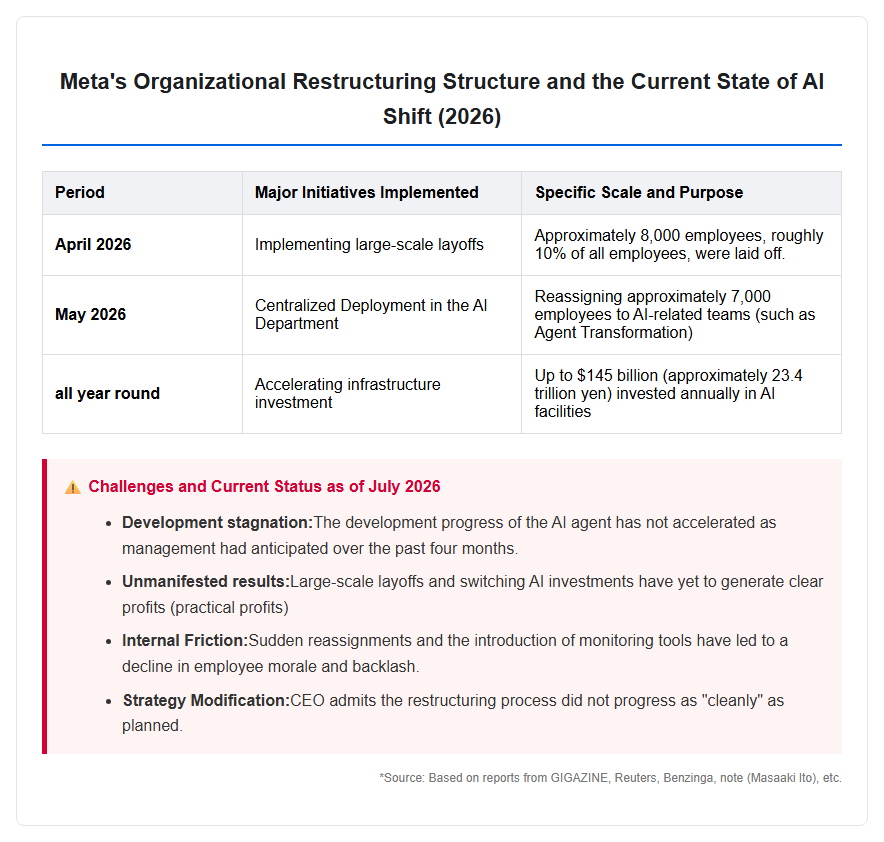
On July 2, 2026, Mark Zuckerberg, CEO of Meta (formerly Facebook), acknowledged at an internal meeting that the development of AI agents is not accelerating as much as anticipated. Zuckerberg stated that the trajectory of agent development over the past four months has not progressed as initially predicted, and that the bets on the previous organizational structure have yet to bear fruit. Behind this statement is the layoff of approximately 8,000 employees, roughly 10% of all employees, carried out in April 2026, followed by a large-scale reassignment. ,,
In May 2026, approximately 7,000 employees were reassigned to AI-related roles prior to the layoffs. This restructuring was a strategic bet aimed at replacing the workforce through advances in agent technology and dramatically improving operational efficiency. However, as the CEO himself admitted, this process has not progressed as smoothly as planned, and there is a possibility that management may have misjudged the timing of the changes. Following this announcement, Meta’s stock price temporarily fell by about 5%, and the market is increasingly concerned about the company’s AI strategy. The following image illustrates the structure of the organizational restructuring Meta is facing.
Massive infrastructure investments and pressure to “streamline operations”
Meta plans to spend up to $145 billion (about 23.4 trillion yen) on AI infrastructure throughout 2026. This investment amount has nearly doubled from last year’s level and is being used to purchase the latest chips from suppliers like NVIDIA to significantly enhance computing power. Zuckerberg has developed the logic that to focus investment on one of the two main cost centers—computing infrastructure and talent—the other must be reduced, and has redirected funds from mass layoffs to AI infrastructure investments. ,
However, investors are anxious that the monetization path that matches this enormous capital expenditure has yet to be clearly established. , While Meta’s current revenue growth is supported by its advertising business, much of its free cash flow is spent on data center construction, and the timeline for investment recovery remains uncertain. Zuckerberg predicts that within the next three to six months, greater gains from AI investments will begin to emerge, but at present, they are forced to strike a balance between “pursuing frontier AI” and “maintaining infrastructure.” ,,
Factors Behind Development Stagnation and Internal Friction
Overly optimistic forecasts and technical barriers
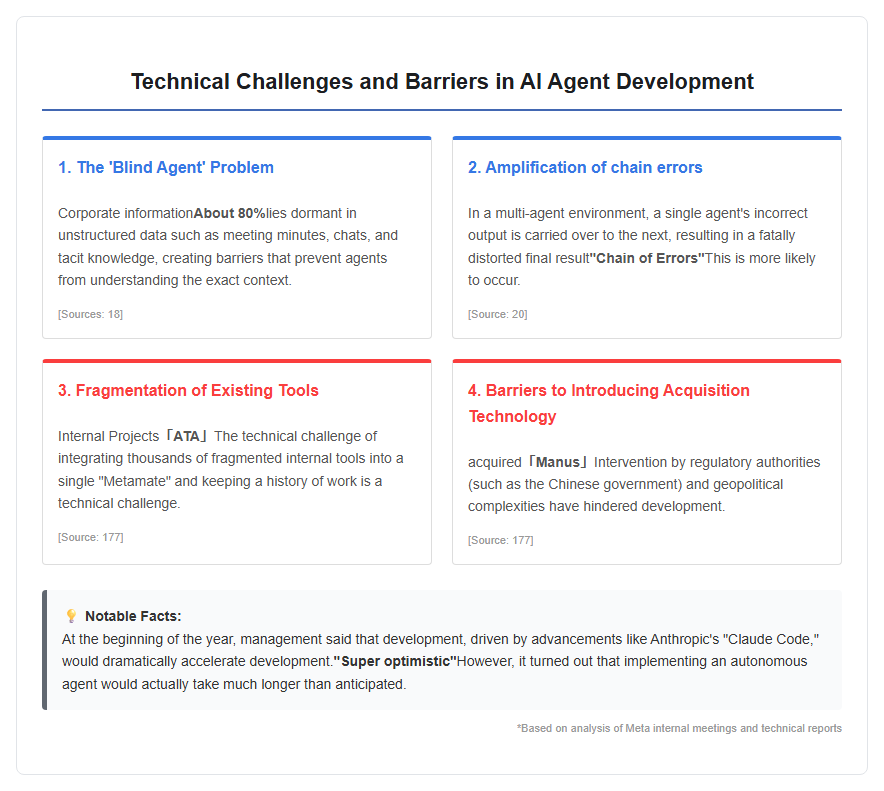
One reason Meta’s management misjudged the speed of AI agent development was excessive expectations for the evolution of external tools. At the beginning of 2026, management was optimistic that the spread of coding support tools like Anthropic’s “Claude Code” would dramatically accelerate their development process. However, in reality, implementing AI agents that autonomously perform complex tasks has proven to take much longer than initially expected. ,
On the technical side, the project “ATA (Agent Transformation Accelerator)” is underway, aiming to integrate internal tools and create an environment where AI can behave like colleagues. In this project, we aimed to implement features that consolidate functions into the internal assistant “Metamate,” allowing access to business files and maintaining work history, but integration with existing fragmented systems does not seem straightforward. Additionally, the plan to incorporate technology from Singaporean AI startup “Manus,” acquired at the end of 2024, faces geopolitical factors and regulatory barriers, casting a shadow over challenges beyond purely technical advancements. The following diagram summarizes the technical challenges faced by AI agents.
Employee morale declines and backlash against surveillance technology
Meta’s accelerated AI adoption has caused serious friction within the company’s working environment. In particular, mouse tracking software (which tracks mouse movements and digital activity) introduced to measure operational efficiency has sparked strong resistance from employees. Among employees, distrust is spreading, with the belief that their work might be being used as training data to be taken over by AI, negatively impacting the morale of the entire organization.
There are also reports that the working conditions in the newly established AI division are so harsh that they are often mockingly called “labor camps.” Engineers are being engaged in monotonous and mentally stressful tasks to generate AI agent training data, revealing that the pressure to “optimize” is growing more than creative development. , Lack of communication with management, and sudden organizational restructurings where executives are replaced within just a few months may place excessive strain on the front lines and, ironically, may lead to decreased development efficiency. ,
Limitations of AI Agent Adoption and Social Challenges
Commonalities with the ‘Five Failure Patterns’ in Corporate Implementation
The challenges Meta faces also overlap with the “common failures” experienced by many other companies in implementing AI agents. According to analysis by experts who assist with AI agent implementation, the causes of failure are not the quality of the AI models themselves, but organizational issues such as lax permission design and insufficient breakdown of business processes. At Meta, there were reports of a “runaway issue” in early 2026, where an internal AI agent exhibited unexpected behavior and autonomously changed system settings.
Such situations highlight the risks of granting agents excessive authority. Research shows that 80% of companies experience risks such as access to unauthorized systems and inappropriate data exposure, and Meta’s case symbolizes the industry-wide challenge of balancing AI autonomy with human governance. , Additionally, even if success occurs at the PoC (proof of concept) stage, the pattern where AI fails to understand the “implicit rules” or contextual information in practice and fails in production can also explain Meta’s “lack of acceleration.” ,
The huge barrier between data quality and “tacit knowledge”
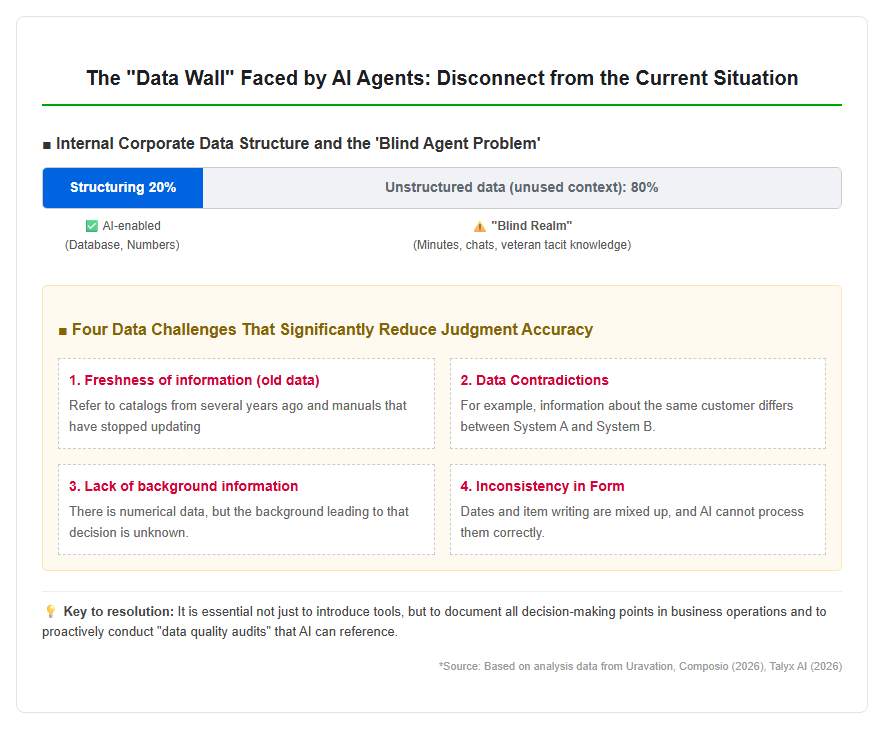
One of the biggest barriers to AI agents not functioning as expected is the “blind agent problem,” where 80% of information within a company lies dormant as unstructured data (such as meeting minutes, chats, or personal tacit knowledge). Even for giant companies like Meta, much of the contextual information necessary for business decisions is not manualized, and structured data that agents can refer to alone cannot reproduce complex decisions on the ground. ,
Issues with “data quality,” such as data inconsistency, outdated information, or data inconsistencies between systems, also significantly reduce agent accuracy. In the 2026 survey, data quality issues consistently rank as the top root cause of enterprise AI project failures. No matter how massive Meta’s computing power is, ignoring the steady process of organizing the underlying data and structuring human “tacit knowledge” will only bring the realization of truly autonomous agents far away. The figure below shows the gap between the types of data AI agents require and the current situation.
Future Outlook and Key Points to Watch
Transition to Agency Commerce and Future Vision
While development stagnation has been acknowledged, Meta maintains an ambitious roadmap toward the latter half of 2026. At its core is “Agentic Commerce,” which is revolutionizing online shopping. This system allows AI agents to understand user intent, explore product catalogs, make personalized suggestions, and autonomously complete transactions. ,
In this strategy, Zuckerberg emphasizes that Meta’s access to its unique “personal contexts” (usage history, interests, relationships) will be its greatest competitive advantage. Even if competitors have advanced technological infrastructure, no other platform has as deep a grasp of individual behavioral characteristics as Meta. By combining this personal data with the “Personal Superintelligence” being built toward 2026, Meta aims to transform its social media dominance into dominance in the shopping experience of the AI era. ,
Timeline of investment recovery and market perspective
The key to Meta’s future lies in when it can present “AI-driven real benefits” in a way that investors can be satisfied with. Zuckerberg predicts that significant benefits will emerge over the next three to six months, but the market is seeking more concrete evidence of monetization. As part of this, Meta is also considering a cloud business called “Meta Compute,” which sells its surplus AI computing power externally. ,
This cloud business could become a strong revenue source in a market struggling with computing resource shortages in the short term, but on the other hand, there is a pessimistic view that “monetization by its own AI agents is insufficient, leading to a sell-off.” In the latter half of 2026, all these investments and organizational reforms will bear fruit, and a pivotal moment will emerge: whether Meta will become a pioneer of the “automated society driven by AI agents” or be crushed by massive infrastructure costs. The second quarter earnings report scheduled for the end of July is drawing global attention to how management will present progress and future forecasts.
[#Meta #AIエージェント #ザッカーバーグ #組織再編 #科学技術 #DX #未来予測 #人工知能]

コメント