In the June 2026 U.S. employment statistics, nonfarm payrolls increased by only 57,000, significantly below market expectations. This is due to a historic decline in the workforce and a sharp slowdown in hiring enthusiasm, especially in leisure and hospitality sectors.
- A shocking slowdown in nonfarm payrolls
- The Shrinking Labor Market Behind the Improvement in Unemployment
- The World Cup boom disappointed and the slump in the leisure industry
- Unbalanced job creation and structural labor supply constraints
- The Fed and the Future of Monetary Policy under the Washe Regime
- Investors face the dual challenges of inflation and slowdown.
A shocking slowdown in nonfarm payrolls
The June employment report released by the U.S. Department of Labor on July 2, 2026, sent a major shock through the market. The key indicator, the Nonfarm Payrolls (NFP), rose by 57,000 month-over-month, about half of the level economists had predicted from 100,000 to 115,000 increases. This is the lowest growth in the past four months and marks a significant slowdown from the revised increase of 129,000 in May.
Furthermore, historical data has been revised downward, with a total reduction of 74,000 people in April and May combined. Until now, the labor market had been seen as resilient, but these figures have highlighted that momentum is rapidly fading. The chart below shows how employment growth is slowing.
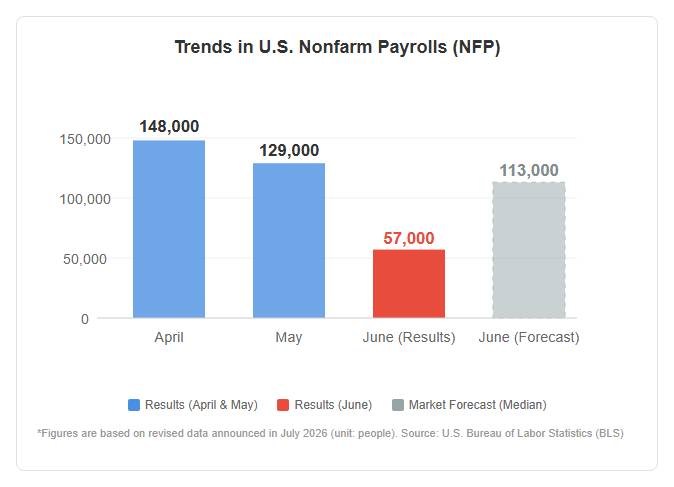
According to a report by the U.S. Bureau of Labor Statistics (BLS), one reason for this sharp slowdown is stagnation in manufacturing and retail, especially in leisure and hospitality sectors. Considering that last year’s average monthly job increase was about 36,000, the current figure of 57,000 may not be catastrophic, but it suggests that the early spring surge may have been temporary.
The Shrinking Labor Market Behind the Improvement in Unemployment
The unemployment rate fell from 4.3% the previous month to 4.2%, which at first glance appears to indicate an improvement in the labor market. However, economists point out that this change is an improvement for “bad reasons.” The main reason for the drop in unemployment was not the increase in employment, but the fact that about 720,000 people exited the labor market.
The labor force participation rate, which indicates the proportion of people employed or job seeking, decreased by 0.3 points to 61.5%. This is the lowest level in about five years since March 2021. In particular, the participation rate among the 25 to 54 prime age group fell by 0.6 points, marking the largest monthly decline in the past decade excluding the pandemic period.
If people stop looking for jobs, they are no longer counted as unemployed statistically, so the unemployment rate drops in calculations. However, the employment-to-population ratio has also dropped to 59.0%, and the proportion of people actually working is decreasing. The current situation where the labor market is “shrinking” and lowering the unemployment rate is evidence that the underlying momentum of the economy is weakening, raising concerns about the negative impact on future personal consumption.
[Economic Structure and Impact on Industry]
The World Cup boom disappointed and the slump in the leisure industry
The most notable breakdown by industry was the decrease in the number of employees in leisure and hospitality by 61,000. This marked the largest drop since December 2020. During this survey period, FIFA World Cup matches were being held in multiple cities in the United States, coinciding with the Independence Day holiday, so a significant increase in employment in tourism and food sectors was expected.
Analysts such as Goldman Sachs predicted that the World Cup effect would boost tens of thousands of jobs, but the results were the exact opposite of those expectations. The U.S. Bureau of Labor Statistics describes this phenomenon as “weaker seasonal employment than usual,” but considering the global event taking place, it shows just how much consumer willingness to hire has cooled.
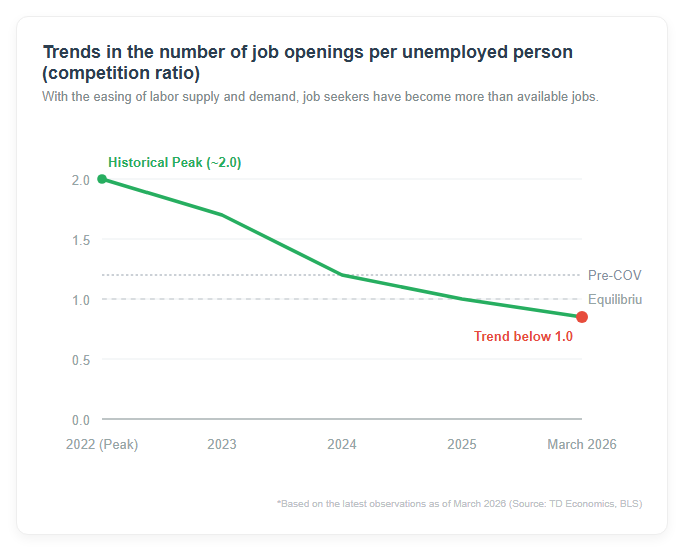
This is driven by a pessimistic outlook among consumers due to prolonged high inflation and high interest rates. The Consumer Price Index (CPI) for May rose 4.2% year-on-year, outpacing the growth in average hourly earnings (up 3.5% year-on-year). With real wages continuing to decline, spending on service consumption is being suppressed, and companies are reluctant to hire new staff, revealing a clear “low hiring” situation. The chart below shows the trend in job openings.
Unbalanced job creation and structural labor supply constraints
June job creation was concentrated in only a few sectors, and the lack of a broad base across the entire economy is also a concern. Professional and business services contributed by 36,000 and social assistance by 25,000, but the healthcare sector, which had previously been a strong pillar of the labor market, only increased by 22,000, falling short of the previous year’s average of 38,000.
Additionally, the U.S. labor market faces structural issues such as demographic changes. In addition to the aging population, strict immigration policies are restricting labor supply, and since January 2025, the total labor force has decreased by about 1.3 million. According to TD Economics, the monthly job creation (breakeven pace) needed to maintain the unemployment rate has dropped from around 150,000 to around 30,000 to 40,000 now.
This balance of “low hiring and low layoffs” means a stable environment with low risk of layoffs for existing employees, but it presents an extremely challenging situation for new job seekers entering the market from outside. The proportion of unemployed with long-term unemployed for more than 27 weeks exceeds 25%, reaching the highest level in the past decade except during the pandemic period. It has also been pointed out that constraints on labor supply may be suppressing the economy’s potential growth potential.
[Future Developments and Key Points]
The Fed and the Future of Monetary Policy under the Washe Regime
This weak employment report will force Kevin Warsh, Chairman of the U.S. Federal Reserve (FRB), who will take office in May 2026, to make extremely difficult policy decisions. Since taking office, Chairman Warsh has shown a hawkish stance, keeping interest rates at 3.50%~3.75% at the June FOMC meeting, while his dot plot (rate outlook) suggested a rate hike within the year.
However, due to a significant decline in employment numbers, expectations for a rate hike at the next July meeting quickly faded in the market. The probability of a rate hike on July 29, priced in by financial markets, has dropped from about 30% before the statistics to less than 20%. In the market, the formula is that “with weak employment, additional rate hikes are harder to justify.”
Still, it is considered unlikely that Chairman Washch will immediately change his policy. The chairman has shown a cautious stance, refusing to make judgments based solely on preliminary employment data and is closely monitoring the potential for productivity improvements through AI. Between the Fed’s two major missions—”maximum employment” and “price stability”—a softening labor market is easing pressure to raise rates, while persistently high inflation is hindering a shift toward easing.
Investors face the dual challenges of inflation and slowdown.
Immediately after the employment report was released, the stock market saw the S&P 500 and Nasdaq rise amid easing of interest rate hike concerns, while bond yields fell. However, it remains uncertain whether this relief-driven buying will last. Investors’ real concern lies in the arrival of a “nightmare scenario,” where inflation remains above 4% despite the economic slowdown.
The biggest focus going forward is the June Consumer Price Index (CPI), to be released on July 14. If inflation does not slow down, the Fed will have no choice but to keep interest rates high even with weak employment, forcing the economy into a difficult phase known as stagflation. Conversely, if inflation subsides, expectations for rate cuts will be fully rekindled, creating new upside potential in the market.
In the foreign exchange market, following these statistics, the dollar weakened while the yen strengthened, and at one point, the yen was bought back to the 160-yen range per dollar. With strong expectations of foreign exchange intervention by Japan’s Ministry of Finance, a narrowing interest rate gap between Japan and the U.S. is anticipated. For investors, this is a time when it is necessary to calmly assess the medium- to long-term impact of the strength of a company’s business model and the impact of declining real wages on consumption, without being misled by temporary stock price surges.
[#米雇用統計 #FRB #インフレ #為替市場 #米国経済 #株式投資 #ウォーシュ議長]


コメント