Prime Minister Takaichi and her cabinet ministers have adjusted their conventional “reflationist” stance, beginning to steer toward a “post-reflation” approach in response to market and U.S. pressures regarding interest rates, inflation, and the weak yen. Behind this shift is a transition toward a new, pragmatic policy aimed at balancing fiscal discipline and market confidence amidst rising long-term interest rates, high crude oil prices, and U.S. exchange rate and rate-hike pressures.
- Successive Cabinet Ministers’ Remarks on “Exiting Reflation” and the Rapid Expansion of Market Pressure
- US Requests to Correct the Weak Yen and the Bank of Japan’s Monetary Policy Change
- Strict upper limit management to keep new government bond issuance within 40 trillion yen
- Utilization of bridge bonds and special accounts that clearly specify redemption sources and deadlines.
- The Limits of a Dual Stance: Catering to the Base Versus the Market and Overseas
- End-of-Year Budget Formulation and Future Outlook Toward 2027
Successive Cabinet Ministers’ Remarks on “Exiting Reflation” and the Rapid Expansion of Market Pressure
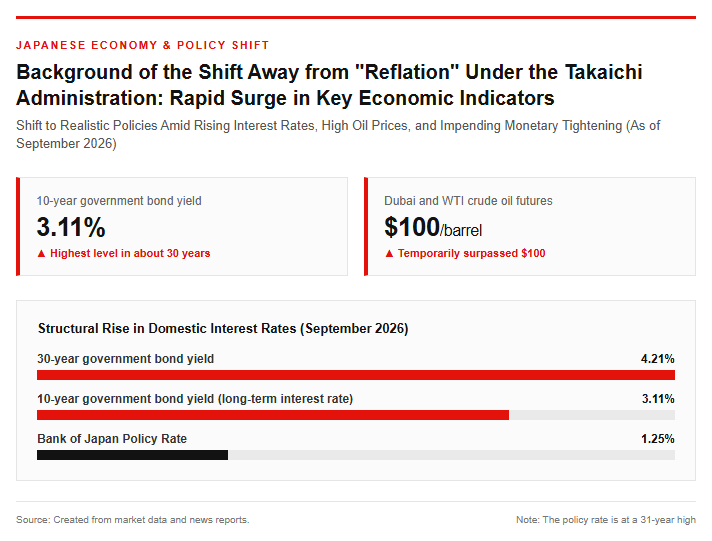
In September 2026, Finance Minister Satsuki Katayama and Minister in charge of Economic Revitalization Minoru Kiuchi made successive remarks such as “Prime Minister Takaichi is not a reflationist” and “The phase of Abenomics-style reflationary policy has come to an end.” At the beginning of the administration, the market strongly anticipated large-scale fiscal expansion and the continuation of monetary easing, but the actual situation has changed dramatically. Behind this are dramatic changes in market conditions and strong external pressure. Domestically, long-term interest rates—specifically the 10-year Japanese Government Bond yield—surged to 3.11%, a high not seen in about 30 years, while the 30-year bond yield also reached 4.21%. Furthermore, Dubai and WTI crude oil futures temporarily broke through $100 per barrel, and the surge in the cost of living driven by high import prices is putting a squeeze on people’s livelihoods. The Bank of Japan raised its policy interest rate to 1.25% in September 2026, recording its highest interest rate level in 31 years. Facing this triple hardship of high interest rates, high prices, and a weak yen, the administration has been forced into a substantial departure from its conventional flagship reflationary course. Please refer to the figure below.
US Requests to Correct the Weak Yen and the Bank of Japan’s Monetary Policy Change
What further accelerated the policy shift was a stern request from the United States. In September 2026, U.S. Treasury Secretary Bessent demanded resolute monetary policy measures from Bank of Japan Governor Kazuo Ueda to correct the weak yen, and U.S. President Trump also expressed concerns over the extreme depreciation of the yen during the Japan-U.S. summit meeting. On the U.S. side, there is a strong intention to avoid a scenario where rising long-term interest rates in Japan prompt a return to Japanese government bonds, resulting in the sell-off of U.S. Treasuries and a skyrocketing of U.S. long-term interest rates and interest payment costs. In response to this, the Bank of Japan’s Monetary Policy Meeting decided on an additional rate hike to 1.25% by a 7–2 majority vote among policy board members. Although two board members appointed by Prime Minister Takaichi (Toichiro Asada and Ayano Sato) cast dissenting votes, the BOJ executive leadership is intensifying its hawkish stance to suppress upside inflation risks. In the market, views are becoming entrenched that additional rate hikes in December 2026 or March 2027 will push the ultimate terminal rate to around 1.75%, marking a major turning point in the relationship between the government and the central bank.
Two specific measures being promoted within the government
Strict upper limit management to keep new government bond issuance within 40 trillion yen
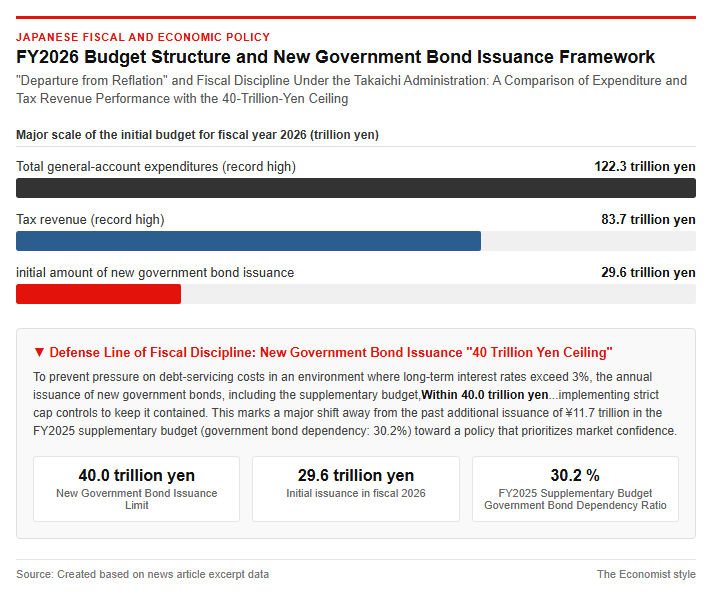
The first pillar of the government’s concrete measures for its “exit from reflation” is a strict “40 trillion yen ceiling” on the issuance of new government bonds. In an environment where long-term interest rates exceed 3%, the explosive increase in debt-servicing costs resulting from additional bond issuance would immediately strain the national finances. For this reason, Prime Minister Takaichi explicitly stated her policy to curb the annual issuance of new government bonds—including supplementary budgets—to around 40 trillion yen as a strong signal to investors and the financial markets. In the initial budget for fiscal 2026, bolstered by record-high tax revenues of approximately 83.7 trillion yen, the initial issuance of new government bonds was kept to about 29.6 trillion yen, remaining under 30 trillion yen, even as total general-account expenditures reached a record-high of approximately 122.3 trillion yen. Although the supplementary budget for fiscal 2025 saw the ratio of reliance on government bonds rebound to 30.2% due to an additional issuance of 11.7 trillion yen, the framework is designed to put in place a robust safeguard ensuring that the annual total will not exceed 40 trillion yen even when supplementary budgets are compiled. Please refer to the figure below.
- Tax Revenue Outlook: Leveraging record-high tax revenue of approximately 83.7 trillion yen to curb reliance on deficit-covering government bonds
- Issuance Ceiling: Fixed at an absolute upper limit of 40 trillion yen in total annual issuance, even after the incorporation of supplementary budgets.
- Interest Payment Countermeasures: Preventing fiscal pressure from rising interest rates and averting credit rating downgrades and government bond crashes
Utilization of bridge bonds and special accounts that clearly specify redemption sources and deadlines.
The second concrete measure is a mechanism that utilizes “bridge government bonds with specified redemption sources and deadlines” instead of relying on deficit-covering bonds in the general account when implementing large-scale growth investments and tax cuts. The government has announced that the cumulative scale of public-private investment in 17 strategic fields—such as AI, semiconductors, quantum technology, and defense—will exceed 370 trillion yen by fiscal 2040. Regarding the amount of public funds to be injected out of this total, the policy is to decide it in tandem with securing financial resources during budget compilation. As for the specific institutional design, the following framework has been introduced.
- Establishment of a special account: Separated from the general account, with a planning period of approximately 5 years set to specifically manage funds.
- Legislation of redemption funding sources: Clarifying repayment resources through the future introduction of earmarked tax revenues, refundable tax credits, etc.
- Temporary Measure to Reduce Food Consumption Tax to 1%: Implemented for a Limited Two-Year Period Starting April 2027, Preparing an Exit Strategy for the ¥5 Trillion Annual Tax Cut Funding
This mechanism follows the design philosophy of past GX Economy Transition Bonds (on a 20-trillion-yen scale) and special public bonds for child and childcare support. Because future repayment obligations and timeframes are legally guaranteed, it can prove to the market that this is not an endless issuance of government bonds, serving as a groundbreaking technical measure that enables both proactive investment and fiscal discipline.
Securing Market Confidence and Future Points of Focus
The Limits of a Dual Stance: Catering to the Base Versus the Market and Overseas
Until now, the Takaichi administration has projected a strong image as an “expansionary fiscal faction fighting the Ministry of Finance” to its core support base of followers of the late former Prime Minister Shinzo Abe, while quietly deepening cooperation with bureaucrats from the Ministry of Finance and the Ministry of Economy, Trade and Industry (such as Vice Minister of Finance Hiroki Unami and Prime Minister’s Secretary Yuji Iida) in actual institutional design and budget compilation. However, this political approach of juggling “two faces” is reaching its limits. If the government continues to send anti-Ministry of Finance and anti-rate-hike messages as domestic political theater, overseas institutional investors and foreign exchange markets will grow increasingly distrustful, concluding that “the Japanese government will eventually return to reckless monetary easing and fiscal expansion,” which will rebound as tangible costs in the form of further yen selling and rising government bond yields (higher interest rates). Much like the turmoil caused by the Truss administration’s fiscal recklessness in the UK in 2022, the risk of policies hitting a dead end in an instant upon losing market confidence is escalating. As the cost of maintaining this rhetorical performance skyrockets, the administration’s ability to articulate a policy shift in clear terms that reflect reality is being put to the test.
End-of-Year Budget Formulation and Future Outlook Toward 2027
The biggest focus moving forward will be the compilation of the FY2027 budget and the formulation of the tax reform outline expected at the end of the year. What specific figures the government can present here will serve as a decisive test for market confidence. Specifically, the following three points will be extremely important. Please refer to the figure below.
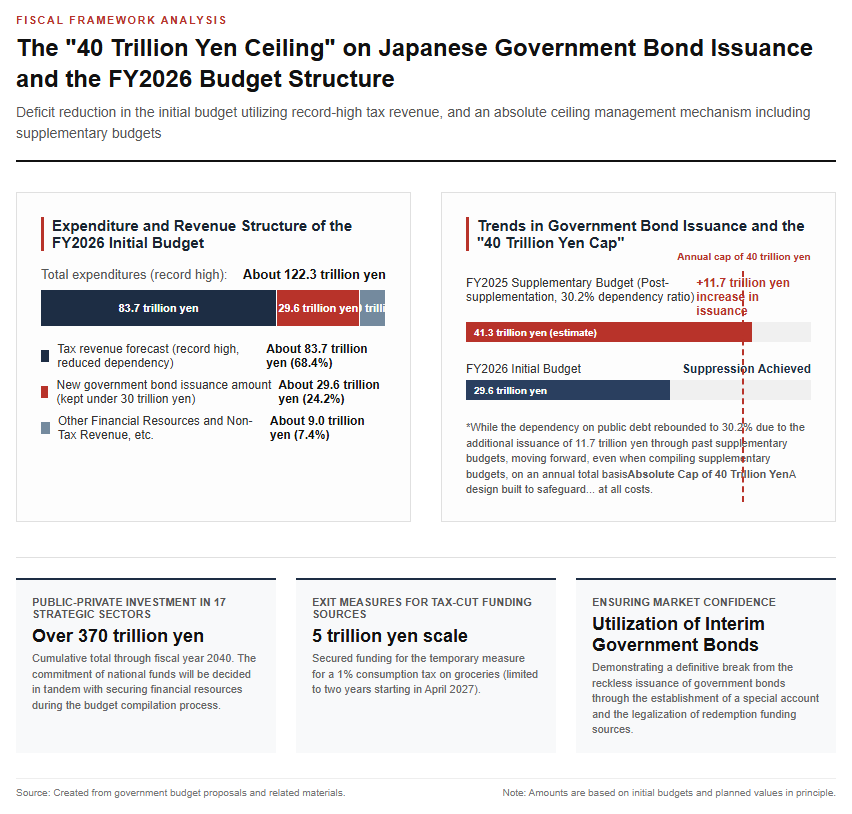
- Funding Backing for the Consumption Tax Cut: Can alternative revenue sources of ¥5 trillion annually, totaling ¥10 trillion over two years, associated with a 1% tax rate on food (effectively zero) be clearly demonstrated?
- Scale of Public Funds for 370 Trillion Yen in Public-Private Investment: Backed by the Issuance Amount of Bridging Government Bonds and Specific Redemption Revenue Sources (Non-Tax Revenues and Special Account Reviews)
- Upholding the 40 Trillion Yen Cap on New Government Bonds: Can the issuance limit be strictly defended in the year-end supplementary budget and the new fiscal year’s budget draft?
Starting in April 2027, the reduction of the reduced tax rate on food to 1% will begin, and plans are underway to transition to its successor system, a refundable tax credit, in fiscal 2029. Whether the government can prove an “exit from reflation” and “responsible fiscal discipline” to the world through numbers and systems rather than performance will determine the stability of interest rates and exchange rates in the Japanese economy and the sustainability of the administration.
Reference Page
- [Cabinet Secretariat] Regarding Japan’s Growth Strategy https://www.cas.go.jp/jp/seisaku/nipponseichosenryaku/pdf/jgs2026.pdf
- [Ministry of Finance] Senior Personnel Transfer Announcement Document https://www.mof.go.jp/about_mof/introduction/personnel/transfers/2026.08.07_45.pdf
[#SanaeTakaichiAdministration #ExitReflation #EconomicPolicy #BankOfJapan #FiscalReconstruction #ConsumptionTaxCut #GovernmentBondIssuance #MonetaryPolicy]


コメント