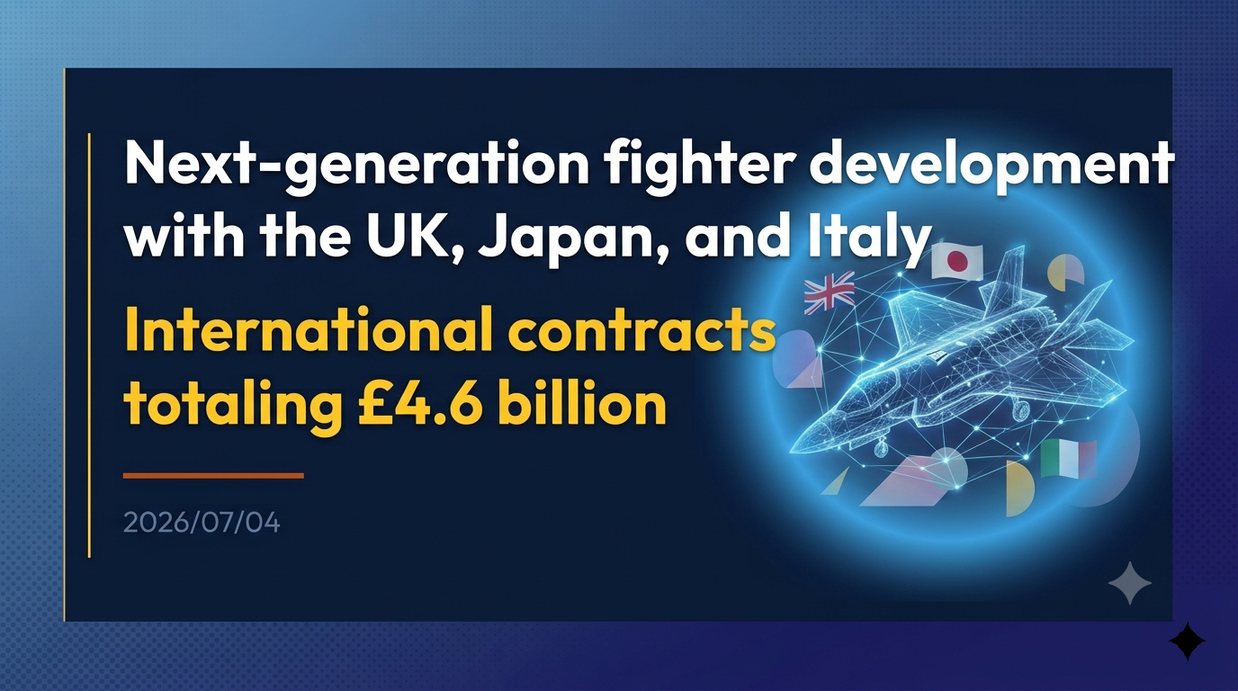
On July 3, 2026, the UK, Japan, and Italy signed an international contract totaling £4.6 billion to accelerate the development of the Next Generation Fighter Program (GCAP). This agreement marks a significant turning point in securing long-term funding backed by the UK’s Defence Investment Programme (DIP) and fully launching the design and verification phase toward operational deployment in 2035.
- Strategic Investment and the UK Government’s Long-Term Commitment
- Full-scale design phase and introduction of the latest technologies
- Structure of the Industrial Consortium ‘Edgewing’
- Stock Market and Investor Reactions
- Japan’s Thirst for ‘Source Code’ and Independence
- Contrast with the breakdown of the European FCAS program
- Technical and political barriers to deployment by 2035
Strategic Investment and the UK Government’s Long-Term Commitment
On July 3, 2026, the UK Ministry of Defence announced that it had signed an international contract worth £4.6 billion with Japan and Italy to advance the design of the Next Generation Fighter Aircraft (GCAP) to the next stage. This contract was commissioned to Edgewing, an industrial joint venture, through the intergovernmental organization GCAP (GIGO), a joint venture among the three countries. The UK’s Defense Investment Plan (DIP), released alongside this announcement, reaffirmed that a total of £8.6 billion (about 1.8 trillion yen) will be invested in GCAP over the next four years.
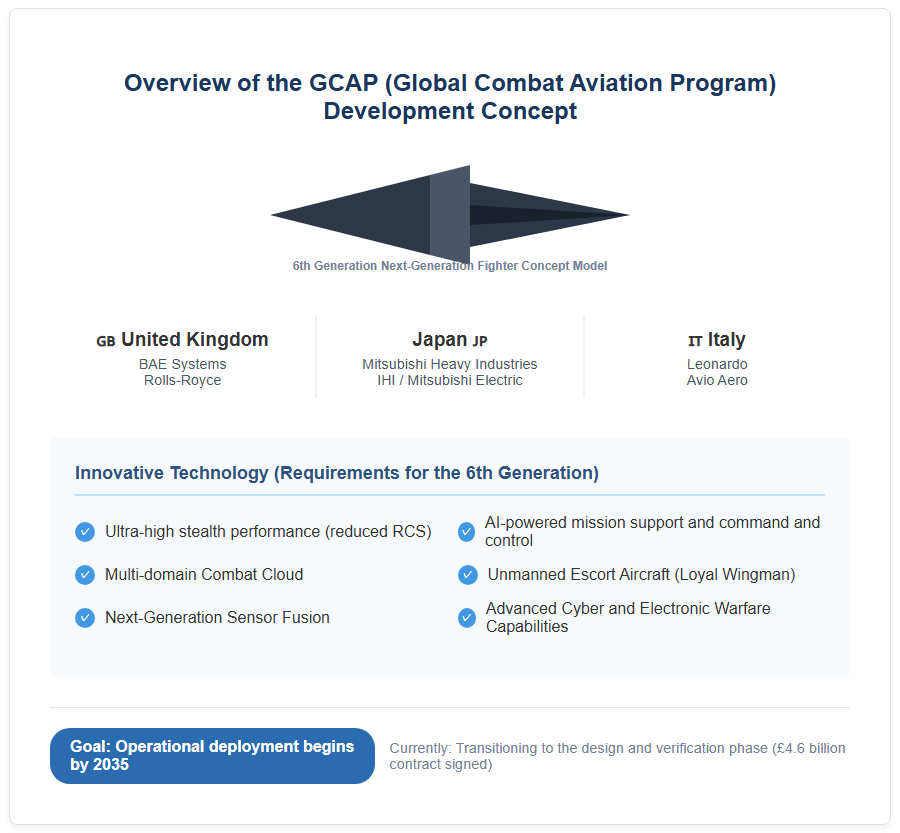
Until now, amid financial difficulties in the UK, the Treasury has shown caution about large-scale spending on GCAP, leading to tensions over fund sharing with Japan and Italy. The signing of this massive contract signifies that the UK government has formally committed to long-term funding toward its deployment target by 2035, marking a crucial milestone in dispelling uncertainty in the plan. The diagram below shows the concept model of the next-generation aircraft that the three countries are aiming for.
Full-scale design phase and introduction of the latest technologies
With this £4.6 billion contract, GCAP will transition its phase from conceptual design to specific requirements definition and rigorous testing. At this stage, the focus will be on advanced stealth capabilities required for sixth-generation fighters, mission systems utilizing AI (artificial intelligence), and the integration of unmanned fighters (loyal wingmen) in coordination with manned aircraft. According to the UK Ministry of Defence, concrete progress has already been made in digital engineering and advanced manufacturing technologies, with plans to dramatically accelerate design and production processes by leveraging AI, robotics, and augmented reality (AR).
Additionally, this project supports approximately 4,500 jobs in the UK alone, with around 600 organizations integrated into the supply chain. Progress in the contract will directly support the retention of teams of engineers and researchers with these advanced skills, strengthening the foundation of the next-generation defense industry. Major companies like BAE Systems have been forced to develop using bridge budgets until now, but with this comprehensive agreement, it can finally be said that R&D investment from a medium- to long-term perspective is now possible.
Industry Structure and Market Impact
Structure of the Industrial Consortium ‘Edgewing’
The practical leadership of GCAP’s development is being led by the joint venture “Edgewing,” formed by major companies from Japan, the UK, and Italy. This consortium is led by BAE Systems from the UK, Leonardo from Italy, and Mitsubishi Heavy Industries from Japan, each holding an equal 33.3% stake. Not only in airframe design, but also in the engine field, companies like Rolls-Royce and IHI in Japan, and Avio Aero in Italy, have established a strong international cooperation system with collaboration. In the electronics sector, companies like Mitsubishi Electric and Leonardo UK have established strong international cooperation systems.
This “one country, one prime (prime contractor)” structure is a strategic choice that avoids decision-making complexity and allows each country to clarify responsibilities while leveraging the strengths of its own defense industry. In particular, it is agreed to maintain design authority throughout the entire product lifecycle beyond 2070, meaning participating countries can freely manage aircraft modifications and upgrades domestically in the future. This system draws on lessons from past international joint development struggles for leadership.
Stock Market and Investor Reactions
This massive contract signing has had a significant impact on the stock prices and market valuations of defense-related companies. The stock price of BAE Systems, a major player in the UK, has so far shown volatile movements due to concerns over government funding. In June 2026, as the European market’s defense index declined, the company’s shares also fell by 1.73%, raising concerns among investors about the “program delay risk” caused by the unfinalized GCAP budget. However, the recent £4.6 billion contract signing and the announcement of an £8.6 billion investment plan are strong positive factors that increase certainty about the order backlog.
According to market analysts, BAE Systems’ strength lies in its massive order backlog, which could reach £83.6 billion (as of the end of 2025), and the steady progress of long-term projects like GCAP will improve transparency in medium- to long-term earnings. Investors are now focusing on how to efficiently convert order backlogs into cash flow and profit margins. On the other hand, with the price-to-earnings ratio (P/E ratio) at around 28 times, there is still a risk that even slight delays in plans or cost overruns could weigh on the stock price, and future progress in the development of the demonstration device will be closely watched.
Strategic Background and Geopolitical Value
Japan’s Thirst for ‘Source Code’ and Independence
For Japan, participating in GCAP means a long-cherished wish to “break free from dependence on the United States.” In past F-2 fighter development, Japan had the bitter experience of being restricted by the United States from accessing its core source code, preventing free modifications domestically. However, the UK promised Japan full source code sharing at GCAP, which became the decisive factor that drew Japan to this program. Japan, led by Mitsubishi Heavy Industries, is aiming to secure its position as an equal partner by introducing its expertise in stealth technology and advanced sensors.
Furthermore, as threats from neighboring countries rapidly increase, such as China unveiling the test J-36, which is considered a sixth-generation aircraft, deploying next-generation aircraft by the mid-2030s is a matter of life and death for Japan’s security. The Japanese government has revised the Three Principles on Transfer of Defense Equipment to enable the export of finished products with lethal capabilities, thereby diversifying GCAP production and maintenance costs and establishing a pathway to maintain and strengthen the defense production base. This is the first time in history that Japan has undertaken such large-scale joint development with a country other than the United States, and it truly symbolizes a shift in national strategy.
Contrast with the breakdown of the European FCAS program
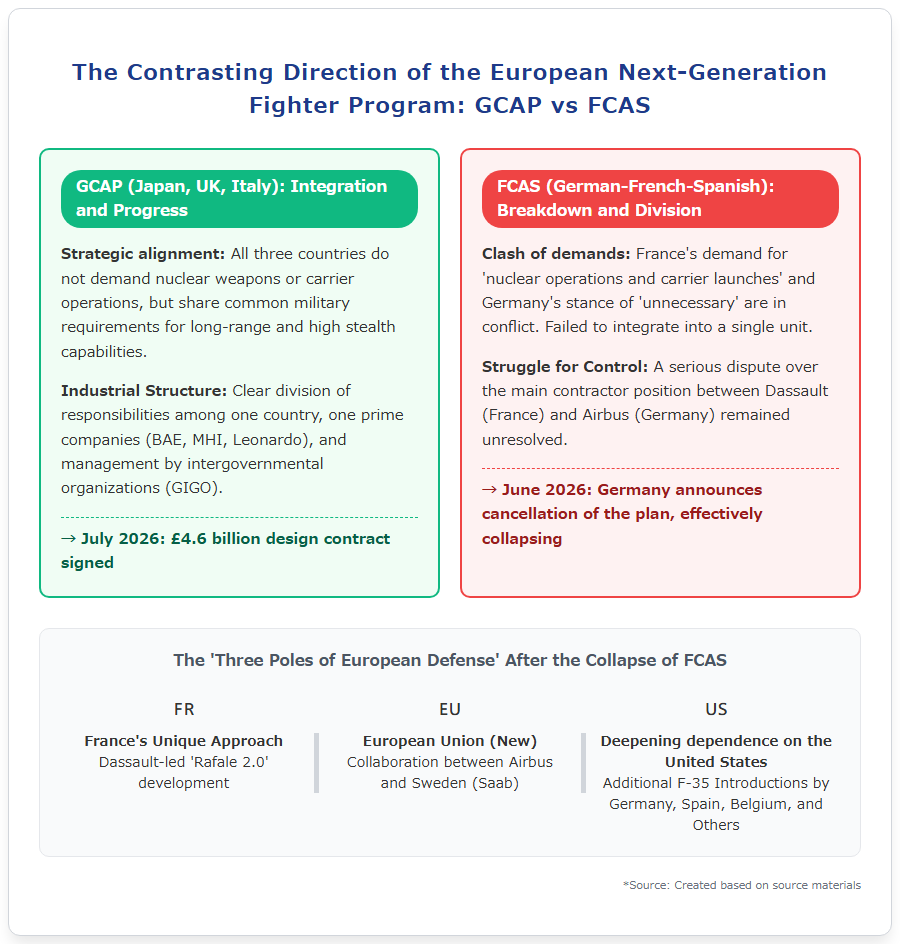
The steady progress of GCAP stands in stark contrast to the breakdown of the next-generation aircraft program “FCAS (Future Combat Air System)” by its rivals France, Germany, and Spain. In June 2026, after nine years of debate, the FCAS effectively collapsed after German Chancellor Merz notified French President Macron of the cancellation. The main reason for the breakdown was France’s inability to integrate specifications that Germany did not need, such as nuclear weapons capability and carrier operations (such as catapult launches), into a single aircraft.
In contrast, the three GCAP countries (Japan, the UK, and Italy) have not requested aircraft carrier operations or nuclear weapons, and their military demands for long-range, high stealth, and air superiority have been aligned from the outset at a high level. Also, unlike FCAS, where France’s Dassault and Germany’s Airbus fiercely competed for leadership, GCAP’s industrial division and responsibility are clearly divided. With the collapse of FCAS, European skies are likely to become increasingly dependent on American-made F-35s, while GCAP has the opportunity to enhance its competitive advantage in the international market as a partnership that shares a ‘de-American’ motivation. The diagram below conceptualizes how European defense cooperation is fragmented.
Future Outlook and Key Points
Technical and political barriers to deployment by 2035
The next major milestone for GCAP is the maiden flight of the demonstrator aircraft, with a target year of 2027. If this aircraft can safely take flight, the technical reliability of the project will improve dramatically. Mass production is expected to begin in the 2030s, with plans to begin operational deployment in 2035 as successors to the Air Self-Defense Force’s F-2 and the UK-Italy’s Eurofighter Typhoon. However, the schedule until the development deadline is extremely tight, and even slight design delays risk creating gaps in the F-2’s retirement schedule and creating gaps in Japan’s air defense system.
Moreover, the technical hurdles are not low. The success or failure of building the core “combat cloud” of 6th generation aircraft—that is, a system that connects drones, satellites, and warships on a single software platform—determines true combat power. Furthermore, behind the scenes, there is an ongoing struggle for leadership in stealth technology and electronic warfare systems between BAE Systems and Leonardo, and how to maintain harmonious coordination among these will be a key focus going forward. Although this contract paved the way for funding, the coordination of strategic interests between nations will continue until operational deployment.
[#GCAP #次世代戦闘機 #日英伊同盟 #防衛産業 #BAEシステムズ #三菱重工業 #地政学 #経済安全保障]


コメント