
In June 2026, crude oil exports from the Persian Gulf countries rebounded sharply, recording an increase of over 3.5 million barrels per day compared to the previous month. The normalization of navigation through the Strait of Hormuz, following easing tensions between the US and Iran, has significantly shifted global oil supply and demand from shortage to excess.
- Export volume surpasses 10 million barrels per day, marking the UAE’s rapid progress
- Restoration of navigation through the Strait of Hormuz and resolution of backlogged crude oil
- WTI falls below and bearish outlook on Wall Street
- Reduction of Strategic Petroleum Stockpiles and the Direction of Inventory
- Continued phased production increase agreement among the seven core countries
- The UAE’s Unique Approach and the Pressure of Oil-Producing Countries to “Protect Revenue with Volume”
- Unstable peace process and concerns over re-blockade
- Corporate Energy Security in the Era of Oversupply
Export volume surpasses 10 million barrels per day, marking the UAE’s rapid progress
According to data from June 2026, the total crude oil and condensate exports of the five major Gulf countries—Saudi Arabia, the United Arab Emirates (UAE), Kuwait, Iraq, and Iran—increased by more than 3.5 million barrels per day from May, reaching between 10.07 million and 10.2 million barrels per day. This rapid recovery was driven by the UAE, which withdrew from the Organization of the Petroleum Exporting Countries (OPEC) in May 2026. The UAE’s export volume in June reached a record high of 3.7 to 3.8 million barrels per day, surpassing May’s daily level by more than 1 million barrels. Saudi Arabia has also significantly expanded exports, with crude oil exports in June rising by 768,000 barrels per day to 4.52 million barrels per day. Loading at Rastanula Port has become particularly active, with exports in the last week of June reaching about 6.3 million barrels per day, approaching pre-conflict levels seen in January 2026. The graph below shows the export recovery status of major oil-producing countries.
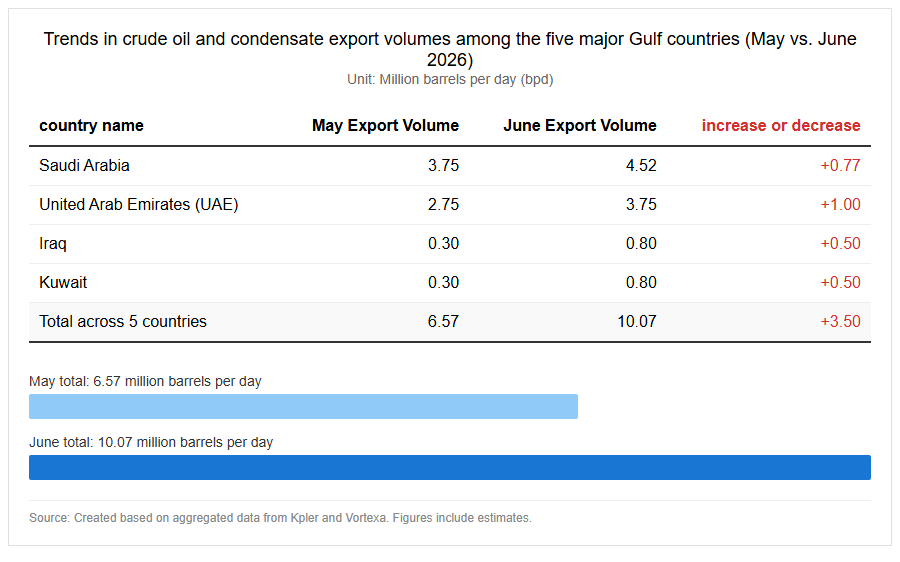
This increase in supply means that millions of barrels of crude oil, which had been stalled in the Persian Gulf region for several months, have suddenly flowed into the international market, serving as a major factor driving oil prices down to pre-conflict levels.
Restoration of navigation through the Strait of Hormuz and resolution of backlogged crude oil
The direct background to the surge in crude oil exports is the normalization of navigation through the Strait of Hormuz, the world’s largest oil choke point, thanks to U.S. military support and diplomatic progress between the U.S. and Iran. Since the provisional agreement on June 17, 2026, the resolution of oil stranded in the Persian Gulf has accelerated, reducing the amount of crude oil waiting to pass through the straits to about 23 million barrels. According to Kepler’s tally, crude oil shipments through the Strait of Hormuz have recovered to about 4.8 million barrels per day, the highest since the start of hostilities on February 28, 2026. The fact that in just ten days in late June, a group of tankers loaded with about 14 million barrels of Iraqi crude oil stranded in the bay successfully escaped and set sail for buyers in Asia, Europe, and the United States symbolizes a dramatic improvement in logistics. The daily number of tanker ships passing through has reached 30 to 40, which is within the normal pre-war levels. However, it should be noted that pre-conflict strait transport volume was about 15 to 20 million barrels per day, and the current recovery status is still only about one-third to half of pre-war levels.
[Market Impact] Sharp Drop in Crude Oil Prices and Shift to Oversupply
WTI falls below and bearish outlook on Wall Street
The crude oil market is rapidly shifting from concerns over supply shortages to caution over oversupply. On June 26, 2026, West Texas Intermediate (WTI) crude oil futures in the New York market closed at $69.23 per barrel, down 3.74% from the previous day, falling below the $70 mark for the first time since February 27, just before the start of the battle. North Sea Brent crude also plunged from a high of over $126 on April 30, recording a decline of about 30% for the second quarter. In the physical market, supply has significantly exceeded demand, marking the first time since January that futures prices are higher than expected. In response to this shift in market structure, major Wall Street investment banks have successively revised their price forecasts downward. Citigroup predicted that with the normalization of the Strait of Hormuz, Brent crude oil prices would drop slightly to a range of $60 to $65 by the end of 2026. Morgan Stanley is even more pessimistic, warning that against the backdrop of increased U.S. production and weak demand in China, the global market will face an astonishing oversupply of 4.8 million barrels per day by 2027.
Reduction of Strategic Petroleum Stockpiles and the Direction of Inventory
The recovery of supplies from the Middle East has also brought changes to emergency measures implemented by countries as part of their crisis responses. Due to the largest coordinated stockpile release in history led by the International Energy Agency (IEA), global strategic petroleum reserves (SPR) have been supplied to the market at a rate of 2.5 million barrels per day from April to June 2026, but from July to August, this release is expected to be significantly narrowed to 700,000 barrels per day. This is because Middle Eastern crude oil has begun to return to the market, reducing the need to rely on reserves as a buffer. Meanwhile, the U.S. SPR had decreased from 415 million barrels at the end of February to 331 million barrels on June 19, marking the lowest level since 1983. Going forward, the market will focus on purchasing demand to replenish released reserves, but analysts from Citigroup and Goldman Sachs say that demand for restocking alone is insufficient to overturn the overall oversupply picture. China also weathered the crisis by depleting about 1.2 billion barrels of commercial inventories, but efforts by countries highly dependent on imports to restructure their inventories may provide some support for falling crude oil prices.
[Industry Structure and Strategy] OPEC+’s Production Increase Policy and Revenue Pressure from Oil-Producing Countries
Continued phased production increase agreement among the seven core countries
Even amid growing concerns of oversupply, core oil-producing countries within OPEC+ have not slowed down their pace of production. Seven countries, including Saudi Arabia, Russia, Iraq, and Kuwait, have begun measures to gradually scale back part of their voluntary additional production cuts of 188,000 barrels per day starting June 2026, increasing supply to the market. This production increase is part of the process to abolish the voluntary production cut quota agreed upon in April 2023, and at the meeting on July 5, 2026, the same scale of increase for August is expected to be maintained. Currently, about 567,000 barrels of production cuts remain, and if production increases continue at the current pace, the cuts will be completely eliminated by the end of September 2026. The group also states that it retains the ability to revive production cuts according to market conditions, but its current focus has shifted to assessing member countries’ maximum sustainable production capacity, which is being conducted in collaboration with independent international consultants. The results of this assessment will determine the production baseline (baseline) from 2027 onward and is a key issue that will influence future market share.
The UAE’s Unique Approach and the Pressure of Oil-Producing Countries to “Protect Revenue with Volume”
The UAE’s exit from OPEC has created a major rift in the cooperative framework among oil-producing countries. The UAE has set an ambitious plan to increase its current daily production of about 3.4 million barrels to 5 million barrels by 2027, and is beginning to pursue its own path no longer bound by the group’s production restrictions. In response, Iraq is also strongly demanding a reassessment of production quotas that match its reserves and recovery needs. Since oil-producing countries’ revenues are determined by “price × quantity,” when prices fall, there is structural pressure to sell more volumes to sustain fiscal spending. In particular, Iraq, which relies on crude oil for 90% of its revenue and has a high fiscal equilibrium oil price of $84 per barrel, the current price level around $70 is a serious blow. Meanwhile, Saudi Arabia’s fiscal equilibrium oil price is said to be around $80 to $85, but due to production constraints caused by conflicts, the actual required price was raised to over $100. If these countries rush to increase production to prioritize restoring market share and securing revenue, supply will rise further, prices will fall further, and as a result, everyone’s revenue will be squeezed—the risk of the ‘synthetic fallacy.’
[Future Outlook] Remaining Geopolitical Risks and Challenges to Stability
Unstable peace process and concerns over re-blockade
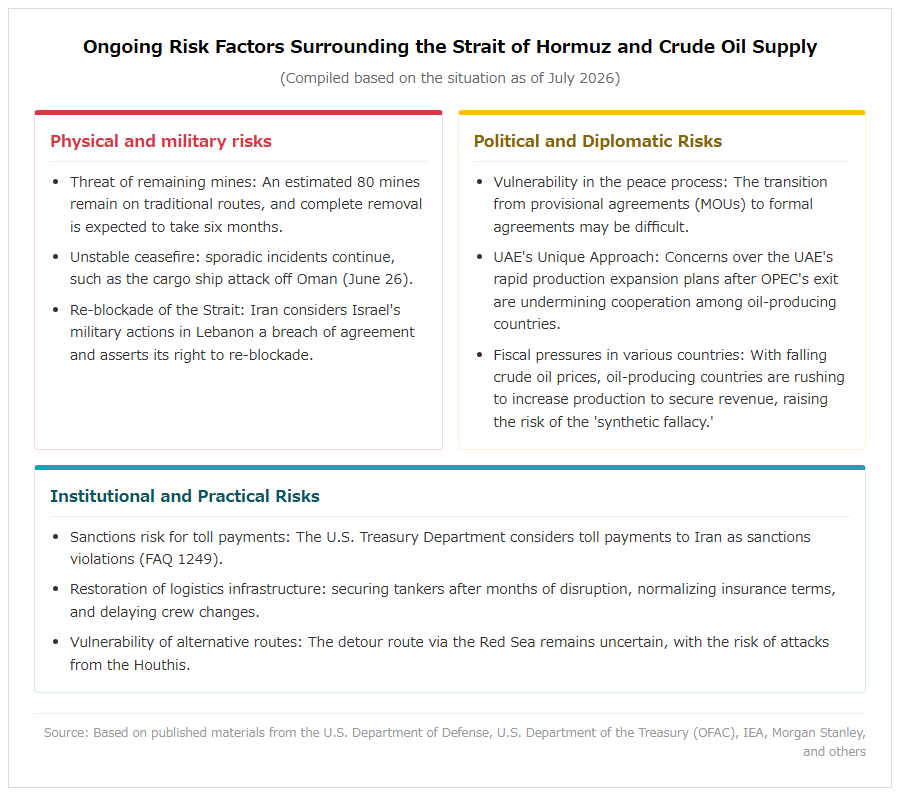
While crude oil supply is rapidly recovering, the situation in the Middle East has not fully returned to peacetime. The Strait of Hormuz remains under an “unstable ceasefire,” and on June 26, 2026, a cargo ship was attacked off the coast of Oman. Iran continues to assert its right to re-blockade the strait, considering Israel’s military actions in Lebanon a breach of agreement. Additionally, as a physical obstacle, an estimated 80 mines remain on the traditional channel of the strait, and the U.S. Department of Defense expects it will take six months to completely remove them. Furthermore, the concept of toll fees that Iran and Oman are considering as new conditions is also a major concern. The U.S. Department of the Treasury (OFAC) has warned that paying tolls to the Iranian government and the Revolutionary Guard Corps (IRGC) could violate sanctions, and if practical transit inspections and permits are introduced, even if the system is nominally open, it could cause delays and increased costs in logistics. Market analysts warn that if the peace agreement is not implemented, even low crude oil prices could fluctuate again due to renewed geopolitical risks. The following chart summarizes the main risk factors going forward.
Corporate Energy Security in the Era of Oversupply
Now that the lead in oil price formation has returned from geopolitical risk to supply-demand fundamentals, Japanese companies are now at a new stage of risk management. The “fear of shortages” that had been a few months ago has turned into “excessive fear,” but unless the operations of shipping, insurance, and sanctions authorities return to normal, practical logistics and procurement will not normalize. Japan’s crude oil dependence on the Middle East still exceeds 90%, and its vulnerability to dependence on specific supply sources or shipping routes has not been resolved. The government has indicated a policy to increase the procurement ratio of alternative crude oil to about 80% by June 2026, but diversification of supply chains at the private company level is still in progress. Going forward, the focus shifts from a “Just in time” approach focused solely on low prices to a “Just in case” inventory strategy to prepare for emergencies, along with permanent diversification to reduce dependence on the Middle East. Specifically, visibility of dependence on the Middle East, China, and the US at the Bill of Materials (BOM) level, re-examination of force majeure clauses, and steady implementation of the Energy Master Plan balancing decarbonization and security will be conditions for companies capable of withstanding prolonged and resurgent crises.
[#原油輸出 #ホルムズ海峡 #湾岸諸国 #エネルギー安全保障 #OPECプラス #原油価格 #経済ニュース]


コメント