
The Japan Semiconductor Equipment Association (SEAJ) has significantly revised its sales forecast for Japanese-made semiconductor manufacturing equipment in fiscal 2026 to 6.5502 trillion yen. This is driven by the rapid global expansion of investments in advanced logic semiconductors and high-bandwidth memory (HBM), accelerating the implementation of generative AI.
- Japan’s semiconductor manufacturing equipment market is making a leap toward the 6.5 trillion yen scale
- The chain of investment triggered by AI server demand
- Trends of major companies such as Tokyo Electron and SCREEN
- Challenges of saturation and structural reallocation of manufacturing capacity
- In fiscal year 2028, the domestic market in Japan aims to exceed 2 trillion yen for the first time
- New Demand Created by Physical AI and Agency AI
- Talent Competition and the Wall of Power Constraints
- Preparing for the medium- to long-term silicon cycle and uncertainty
Japan’s semiconductor manufacturing equipment market is making a leap toward the 6.5 trillion yen scale
On July 2, 2026, the Japan Semiconductor Equipment Association (SEAJ) announced its demand forecast for semiconductor and FPD manufacturing equipment from fiscal year 2026 to fiscal year 2028. The most notable aspect of this announcement was the forecast that sales of Japanese-made semiconductor manufacturing equipment in fiscal 2026 will reach 6.5502 trillion yen, a 26% increase from the previous year. This is an unusual upward revision, rising by about 1.05 trillion yen in just half a year from the forecast as of January 2026 (5.5004 trillion yen). Considering that the forecast as of July 2025, a year ago, was 5.3498 trillion yen, it is clear how rapidly demand outlooks, especially for AI-related investments, have surged in a short period.
Please refer to the diagram below. The trends in sales forecasts for Japanese-made semiconductor manufacturing equipment are shown.
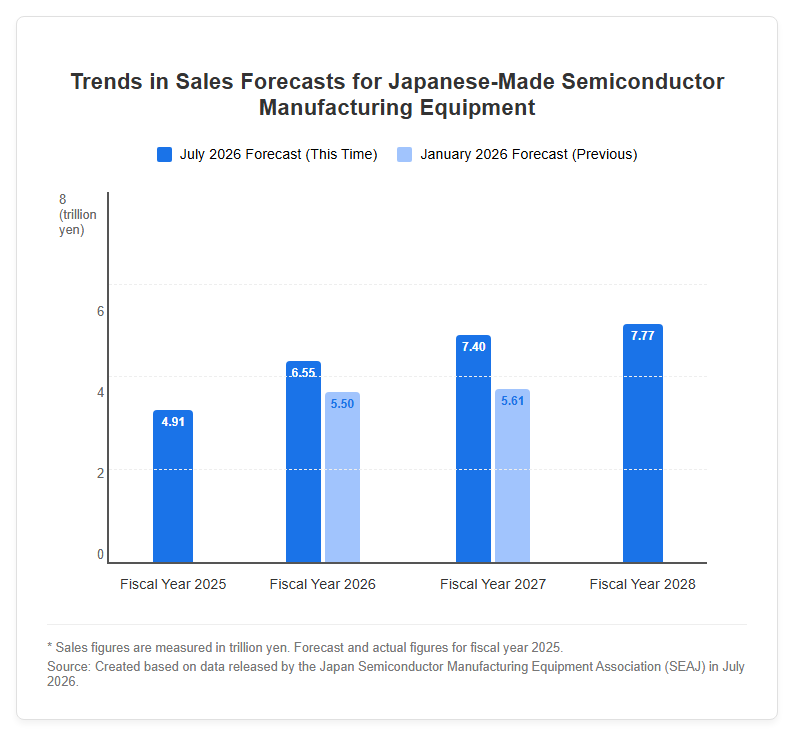
This robust growth will not stop at fiscal year 2026. For fiscal year 2027, demand for semiconductors for AI servers will remain strong, and new fab buildings being constructed worldwide will be completed one after another, leading to full-scale equipment delivery. The forecast is forecasted to reach 7.4017 trillion yen, a 13% increase from the previous year. Furthermore, it is expected to reach 7.7718 trillion yen by fiscal year 2028, suggesting that Japan’s manufacturing equipment market has moved to a higher stage.
The chain of investment triggered by AI server demand
The main driver behind this major upward revision is the acceleration of AI implementation across society. In particular, investments in advanced logic semiconductors for AI servers and DRAM investments centered on high-bandwidth memory (HBM) that supports high-performance computing have surged explosively. Based on the June 2026 release of the World Semiconductor Market Statistics (WSTS), global semiconductor sales that year are expected to reach $1.5112 trillion, an 89.9% increase year-on-year, and the market is expanding at an astonishing pace, pushing ahead of the previously anticipated “$1 trillion market” by four years.
Among these, the strain in the memory sector is particularly severe. HBM has a unique structure that stacks multiple DRAM dies vertically, and it is said that a single AI server consumes as much memory as thousands of smartphones. The manufacturing load of HBM is about four times that of standard DRAM, and as generations advance, the number of layers is increasing from 12 to 16, and eventually to 20, leading to continued price increases due to supply constraints. This “AI swallowing memory” situation is spreading not only to GPUs and HBMs but also to SSDs and advanced packaging, driving investment in manufacturing equipment across all directions.
[Impact on Market and Companies] Performance expectations of equipment manufacturers and supply chains
Trends of major companies such as Tokyo Electron and SCREEN
The structural expansion in manufacturing equipment demand is directly linked to the performance of Japan’s major equipment manufacturers. Tokyo Electron, Japan’s top market shareholder, achieved record sales of 2.4315 trillion yen (up 32.8% year-on-year) and operating profit of 697.3 billion yen (up 52.8%) in the fiscal year ending March 2025. The company has set medium-term financial targets of over 3 trillion yen in sales and an operating profit margin of over 35% by the fiscal year ending March 2027, and is confident in further growth driven by accelerated investments in advanced semiconductor fabs for AI servers. Additionally, SCREEN Holdings, which holds a high market share in cleaning equipment, is expected to set a new record for consolidated operating profit for the fiscal year ending March 2027, with the full-scale acceleration of AI-related investments providing a tailwind.
On the other hand, Advantest, which handles semiconductor testers, achieved its record high performance in the fiscal year ending March 2026, but it has been pointed out that the relative benefits of back-end equipment may temporarily diminish when the investment focus is prioritized on front-end equipment such as lithography and etching. As equipment demand expands to the limits of supply capacity, equipment manufacturers have an excellent opportunity to increase their bargaining power over prices. At the same time, suppliers of components and components are also facing labor shortages and production capacity barriers, making it urgent to raise capacity across the industry.
Challenges of saturation and structural reallocation of manufacturing capacity
There is a view that the essence of the current memory shortage is not just a temporary supply-demand gap, but rather a ‘strategic reallocation’ of manufacturing capacity. The three major companies—Samsung, SK Hynix, and Micron—are concentrating their manufacturing lines on HBM, which has extremely high profit margins, and SK Hynix’s HBM operating profit margin is reported to have reached 70%. As a result, a ‘zero-sum game’ has emerged, with a shortage of wafers for general-purpose DRAM for smartphones and PCs, suggesting rising component costs and price increases for consumer products.
This structural supply constraint poses risks for semiconductor chip manufacturers like Renesas Electronics and Intel, including rising equipment procurement costs and uncertainty in delivery schedules. There are concerns that the backlog of orders for equipment manufacturers and longer lead times could delay chip manufacturers’ production plans. Furthermore, the power consumption of cutting-edge fabs is said to reach 3 to 5 times higher than conventional levels, making infrastructure challenges such as thermal management and power supply important variables that will influence future capital investment cycles.
[Japanese Market and Technology Trends] Japan’s First Surpassing 2 Trillion Yen and the Rise of Next-Generation AI
In fiscal year 2028, the domestic market in Japan aims to exceed 2 trillion yen for the first time
SEAJ forecasts that sales of semiconductor manufacturing equipment in the Japanese domestic market are also expected to grow exceptionally strongly. Sales in the Japanese market for fiscal year 2026 are forecasted to increase by 10% year-on-year to 1.5835 trillion yen, driven by preparations for mass production of logic using the 2nm process and increased investment in advanced DRAM. Notably, the forecast for fiscal 2028 is projected to reach 2.2763 trillion yen, a 25% increase from the previous year, with second-phase investments by major foundries, establishment of mass production systems for 2nm logic, and expanded memory investments.
The chart below shows the trend of semiconductor manufacturing equipment sales forecasts in the Japanese market.
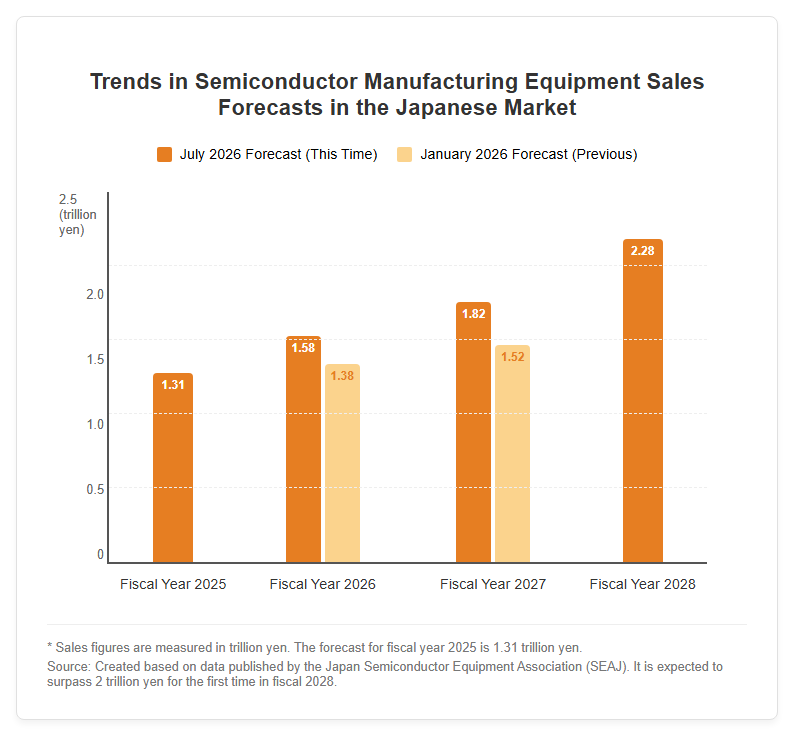
This is the first time in history that the Japanese market has surpassed the 2 trillion yen mark, and this is a significant increase compared to the forecast as of January 2026. Until now, there were periods when investments in automotive and power semiconductors were temporarily sluggish, but it has become clear that cutting-edge investment in AI is accelerating in Japan to more than compensate for these issues. This seismic shift has also served as an opportunity to reaffirm Japan’s uniquely robust supply chain, namely the advantages that material and chemical manufacturers have concentrated domestically.
New Demand Created by Physical AI and Agency AI
The emergence of new forms of AI is expected to further boost future demand. In addition to the current mainstream training and inference of large language models (LLMs), future efforts will require “agentic AI,” which plans and makes decisions on behalf of humans. Agentic AI is expected to further expand demand for CPUs responsible for control, general-purpose DRAM (DDR) supporting them, and SSDs for long-term storage applications to link multiple processes.
Additionally, advances in “physical AI,” which recognize the real world and perform complex actions, and robotics are expected to serve as trump cards for manufacturing and solving labor shortages. These advancements demand further higher performance, lower power consumption, and larger capacity semiconductors, strongly supporting investments in advanced technologies such as advances in GAA (Gate-All-Around) structures, backside power supply (BSPDN) technology, and hybrid bonding. As we approach a technological turning point (the Inflation Point), manufacturers are now required more than ever to possess ‘one-of-a-kind’ technical capabilities and advanced process integration that integrates both front-end and back-end processes.
[Future Outlook and Challenges] Structural Issues Facing Sustainability of Growth
Talent Competition and the Wall of Power Constraints
With the rapid expansion of the market, the industry faces a serious challenge of talent shortages. SEAJ Chairman Kawai (President of Tokyo Electron) points out that the competition for talent is so intense that he calls the current situation a “Talent War.” Toward 2030, securing and nurturing outstanding talent throughout the entire supply chain—not only equipment manufacturers but also suppliers of components and parts—will be the most crucial factor determining the sustainability of growth. At the same time, productivity improvement through manufacturing DX utilizing robots and AI has become an essential initiative.
Another major limiting factor is the enormous power consumption from data centers and state-of-the-art fabs. Electricity will become a bottleneck, and even with investment plans, it is expected that facilities cannot be expanded. Therefore, alongside contributing to low power consumption in semiconductors, balancing environmental impact reduction and high productivity toward carbon neutrality and net-zero goals is positioned as a critical material for equipment manufacturers. We have entered a phase where the entire industry is required to collaborate toward realizing “digital × green.”
Preparing for the medium- to long-term silicon cycle and uncertainty
The semiconductor industry structurally experiences cycles of cycles of ups and downs over several years. This upward revision suggests the arrival of a “supercycle” driven by AI’s powerful driver, but historically, there is also a lesson that overinvestment during boom periods has led to subsequent price collapses. When the massive fab planned for 2027 begins operation, it is important to closely monitor how the supply-demand balance will change.
Furthermore, uncertainties remain, including geopolitical risks such as US-China export controls and tariff policies, supply constraints on critical minerals, and delays in monetizing AI investments driven by hyperscalers. However, few doubt the medium- to long-term growth potential itself, and semiconductors have solidified their position as an indispensable foundation supporting society, known as the “oil of the 21st century” and the “digital diamond.” Japan’s manufacturing equipment industry will continue to invest in the “future” with a vision toward reaching the trillion-dollar market through a solid management foundation and proactive R&D investment.
[#半導体 #SEAJ #AI #製造装置 #投資 #DX #経済 #テクノロジー]

コメント