
The cryptocurrency Tron (TRX) has launched a trial run of quantum-resistant computer signatures on its testnet. It is drawing attention as a strategic move aimed at completing countermeasures about three years ahead of industry forecasts to prepare for future quantum computer threats (Q-Day).
- Full Overview of the Trial Launch on the Testnet “Nile”
- Two Signature Methods Adopted and Their Technical Features
- Challenges in maintaining compatibility and increasing transactions
- TRX Price Trends and Dominance in the Stablecoin Market
- Governance for Mainnet Migration and Other Project Trends
- The importance of risk management ahead of the 2029 “Q-Day”
Full Overview of the Trial Launch on the Testnet “Nile”
On July 3, 2026, TRON Core Devs, the development team behind TRON (TRX), announced the launch of a pilot of a post-quantum (PQ) signature feature with quantum resistance on the testnet Nile. With this update, developers and general users can experimentally create quantum-resistant wallets in testnet environments and send transactions signed with quantum-resistant algorithms.
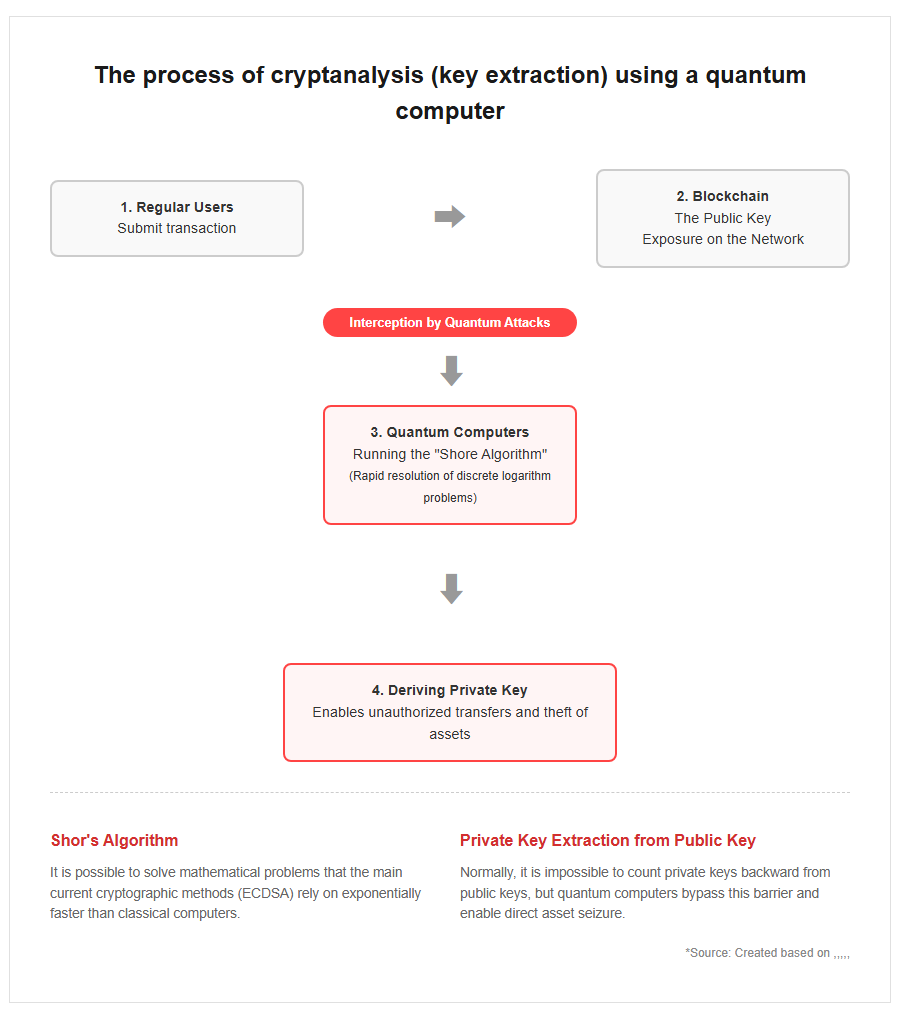
This pilot operation aims to avoid the risk of the Elliptic Curve Signature (ECDSA), which is widely used in many blockchains including TRON, being decrypted by quantum computers expected to be practical in the future. The timing when the quantum computer threat becomes a reality is generally predicted to be around 2029 (Q-Day), but TRON DAO, which supports the TRON ecosystem, has set a goal to complete countermeasures about three years ahead of schedule. In this way, by advancing quantum-resistant protocols ahead of advances in quantum technology, the commitment to ensuring the network’s long-term reliability and security has become clear.
The diagram below illustrates how quantum computers decode current cryptographic technologies.
Two Signature Methods Adopted and Their Technical Features
In this pilot operation, two signature methods that the U.S. National Institute of Standards and Technology (NIST) is working to select as standard specifications for post-quantum cryptography have been adopted. One is the “ML-DSA-44 (Dilithium2)” based on the formal standard “FIPS 204,” and the other is the “FN_DSA_512 (Falcon-512)” which is currently in the draft stage. By implementing these two methods in parallel, we have established a system that can flexibly respond to future changes in standards and safety verification status.
Falcon-512 is characterized by a relatively small signature size and is positioned as the default method. Meanwhile, considering that Falcon is still in the draft stage, ML-DSA-44, which is already becoming an official standard, is also available as an option. These signing methods can be individually enabled or disabled through on-chain governance proposals, allowing users to select the optimal security level as needed. Technically, it relies on grid-based mathematical problems that can counter the powerful computational power of quantum computers using private key derivation (such as Shor’s algorithm), building a stronger defensive wall than before.
Impact on Existing Systems and Market Response
Challenges in maintaining compatibility and increasing transactions
In introducing quantum-resistant signatures, Tron is making efforts to minimize the impact on existing user experiences and ecosystems. Specifically, the new address derived from quantum-resistant signatures also adopts a design that maintains a 21-byte format starting with a “T,” similar to the traditional ECDSA. This ensures compatibility with existing block explorers, wallets, and peripheral tools, allowing users to prepare for migration without major disruption.
On the other hand, the technical challenges unique to quantum-resistant cryptography have also come to light. The biggest concern is the increase in data volume. According to the design documents, the combined size of the Falcon-512’s public key and signature is about 25 times larger than that of conventional ECDSA signatures. Additionally, the overall transaction size could increase by more than ten times compared to before. This not only puts a load on the network’s storage requirements and processing capacity, but can also impact the design of fees (gas fees). TRON Core Devs accepts this increase in data volume as a potential cost for future improvement, while highlighting fee design for PQ wallets and updates to SDKs and APIs as key challenges going forward.
TRX Price Trends and Dominance in the Stablecoin Market
In mid-2026, when this announcement was made, Tron (TRX) remains steady at around $0.33. This remains about 24% away from the all-time high of $0.43 recorded in December 2024, demonstrating remarkable resilience and stability compared to the period when Bitcoin fell 53% from its peak. In some parts of the market, Justin Sun’s announcement of the quantum resistance roadmap has been received positively, with short-term expectations of breaking through the $0.34 to $0.36 resistance zone and aiming for $0.40.
Tron’s strength is backed by its overwhelming supply of stablecoins in circulation. As of January 2026, the Tron network hosts over $80 billion worth of Tether (USDT), accounting for more than half of all global USDT transactions. For TRON, which has established itself as a global payment infrastructure, demonstrating its commitment to protecting these vast assets from future quantum threats is an essential strategy to maintain trust from institutional investors and payment providers.
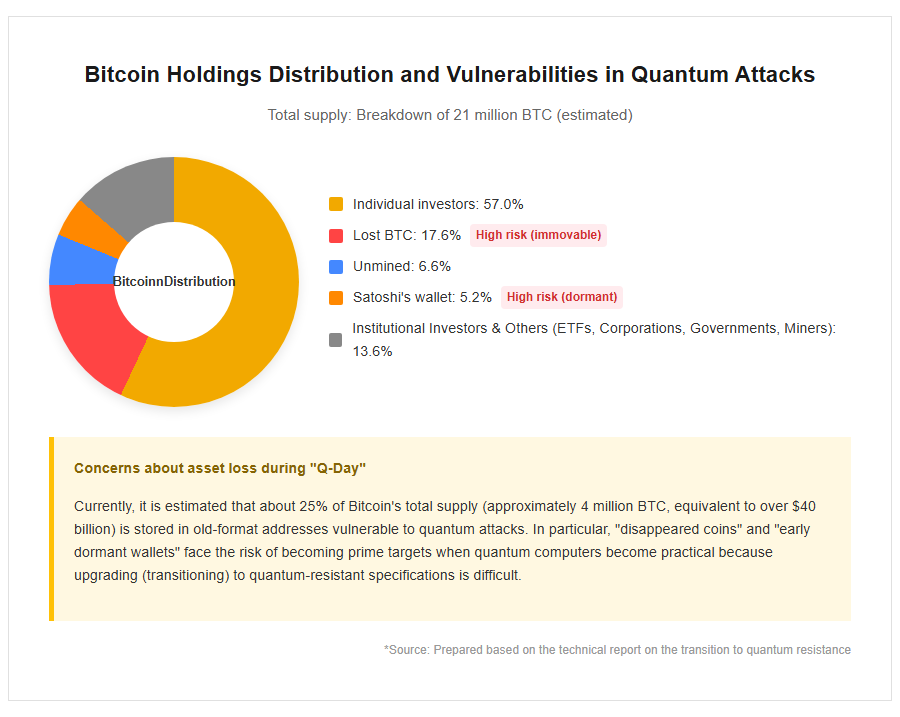
The chart below shows the asset holding distribution using Bitcoin as an example, but the importance of asset protection for the future is also increasing for TRON.
Future developments and survival strategies for the quantum era
Governance for Mainnet Migration and Other Project Trends
After trial operations on testnets, a step-by-step process is required before quantum-resistant signatures are officially introduced on Tron’s mainnet. The final decision on implementation is left to the governance process through the TRON Improvement Proposal (TIP), which must be approved by a vote by 27 super representatives (SRs) responsible for block generation on the network. Currently, verification of PQ transaction stability and network load is ongoing on the testnet, and TIP deliberations are planned based on this data.
Efforts toward quantization resistance are not unique to TRON, but have become a common challenge across the entire blockchain industry. For example, the Ethereum Foundation established a post-quantum security team in January 2026 and is advancing research such as precompilation (EIP-8052) to verify quantum-resistant signatures on the EVM. Additionally, the Solana Foundation has presented a three-stage transition roadmap centered on Falcon signatures, intensifying development competition across chains to address future threats. In this competition, Tron aims to quickly establish standard features for the quantum era by providing implementation environments ahead of other projects.
The importance of risk management ahead of the 2029 “Q-Day”
It is also pointed out that the progress of quantum computers may accelerate faster than currently anticipated. IBM has released a roadmap to build a fault-tolerant quantum computer with 200 logical qubits by 2029, making the emergence of machines with practical cryptanalysis capabilities increasingly realistic. A particularly serious risk is the “Harvest Now, Decrypt Later” strategy. This method involves attackers storing current encrypted communication and transaction data and deriving past private keys once powerful quantum computers are completed in the future.
The reason TRON began its pilot operation during this period is the determination that it is necessary to start protecting users’ assets early from such retroactive risks. Currently, about 25% of Bitcoin’s total supply (equivalent to over $40 billion) is analyzed to be vulnerable to quantum attacks due to exposure of public keys, putting chains without proper migration tools at risk of devastating damage. Tron’s push for quantization is not just a technical upgrade; it can be seen as a literal “survival strategy” for the entire crypto asset ecosystem, which has grown to a multi-trillion dollar scale, to survive the quantum era.
[#TRX #トロン #量子コンピュータ #耐量子暗号 #ブロックチェーン #セキュリティ #USDT #QDay]


コメント