」_en.png)
Kernel Consulting Inc. has launched a free AI consulting service called “Fukulot” to support the establishment of franchise headquarters. Behind this is a strong aim to prevent early decision-making errors in FC deployment and to strengthen governance across the entire industry.
- Section 1-1: The True Identity of ‘Fukurotto,’ a Collection of Over 80 Companies’ Expertise
- Section 1-2: Why is it ‘free of charge’ now? Challenges in the FC Industry and Development Motivations
- Section 2-1: The Boundary Between Automated Routine Tasks and Management Decisions Humans Should Handle
- Section 2-2: Practical navigation corresponding to the 2021 revised guidelines
- Section 3-1: Risks of Halcination and Lessons Learned from the Deloitte Case
- Section 3-2: From Pyramid to Obelisk Structure—Structural Transformation in the Consulting Industry
- Section 3-3: Future Outlook: Building a Sustainable Chain Where AI and Experts Coexist
Section 1-1: The True Identity of ‘Fukurotto,’ a Collection of Over 80 Companies’ Expertise
On June 23, 2026, Kernel Consulting Inc. began offering free of charge to companies considering building headquarters for franchise (FC), agency, and voluntary chain (VC) headquarters. This AI leverages ChatGPT’s GPT capabilities and leverages extensive knowledge accumulated from the company’s hands-on support over 80 companies in building headquarters and restructuring to date—including success, failure, and trouble cases.
The name ‘Fuku’ is a coined term combining the owl’s ‘Fuku,’ a symbol of wisdom, ‘Pilot,’ meaning guide, and ‘Lot,’ which means wishing for abundant success. Its most distinctive feature is that this AI is not just an information search tool, but is tuned to replicate the thought process of franchise-specialized consultants. Specifically, we will organize priorities in headquarters design, present minimum design points that should be addressed, and raise awareness of issues that could lead to future legal disputes, all from a practical perspective.
Please refer to the diagram below.
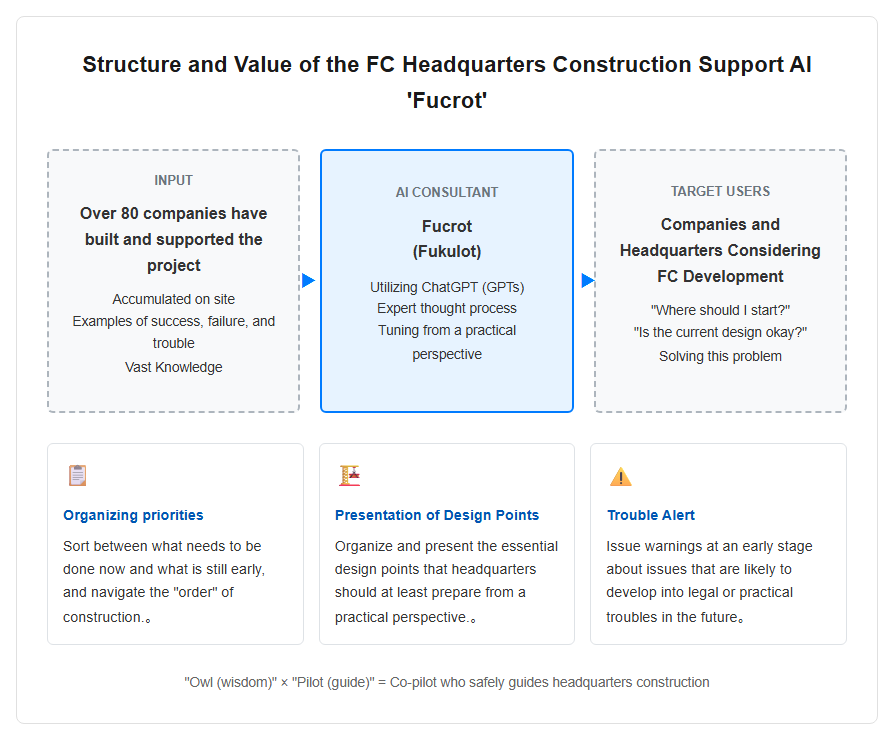
The service is available not only to companies considering FC expansion, but also to headquarters that have already started but are concerned about current design, and consultants supporting FC headquarters, making it available to a wide range of users for free.
Section 1-2: Why is it ‘free of charge’ now? Challenges in the FC Industry and Development Motivations
Behind Kernel Consulting’s free release of expert knowledge as AI that would normally incur high consulting fees lies a serious challenge facing Japan’s franchise industry: the “first barrier.” The company receives many inquiries daily, but many of them struggle with initial doubts, such as “not knowing where to start” or “unable to decide at what stage to start recruiting members.”
A franchise business is not simply about setting a membership fee and setting up a recruitment page. The headquarters and its members are independent business entities formed by contract, and should be a joint venture based on the spirit of coexistence and mutual prosperity. However, early design mistakes can directly lead to serious problems in the future. For example, there are countless cases where companies recruit members without sufficient revenue forecasts, which later lead to lawsuits, or cases where headquarters abuse their superior position is suspected of exhausting the entire chain.
The company believes that reducing such unfortunate “misjudgments” and “order errors” at the initial stage ultimately leads to lower risks for both headquarters and franchisees. First, it entrusts this AI with the public role of widely promoting correct thinking and the overall picture to society. Companies that have deepened their fundamental understanding through Fucrot are now establishing a new era of support processes where they choose more advanced individualized consulting by humans as needed.
Chapter 2: How AI Is Transforming Franchise Headquarters and Legal Risk Management
Section 2-1: The Boundary Between Automated Routine Tasks and Management Decisions Humans Should Handle
The evolution of AI is fundamentally transforming the operational structure of franchise headquarters. Tasks that consultants and headquarters staff have traditionally spent a great deal of time on—such as creating manuals, producing brochures for recruiting merchants, and creating income and loss simulations—are now areas that AI can process in just a few minutes. For example, it can automatically generate standard operating procedures from store operation videos or instantly output sales materials optimized for each target audience.
Please refer to the diagram below.
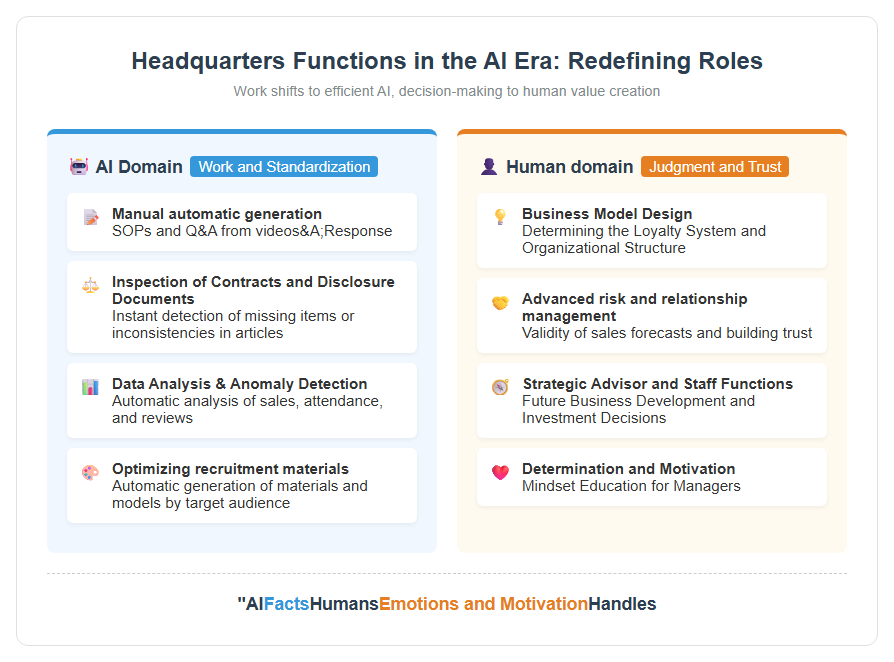
However, Fucrot’s role is not simply to handle such tasks themselves, but rather to focus on more advanced “support for decision-making.” The true value in building a franchise headquarters lies in the cluster of management decisions that require management decisions, such as which business formats to convert into franchises, how to design the loyalty system, and how to balance directly managed and franchise stores. These are areas beyond what AI can present from existing data patterns, requiring a company’s philosophy, vision, and a strategic advisory perspective for the future.
Thus, in the AI era, routine tasks are left to AI, while humans are expected to focus on high-value activities such as fundamental design of mechanisms and building trust with affiliates. AI is a tool for headquarters, not headquarters itself. The key to headquarters’ success lies in the sequence of establishing the headquarters’ philosophy and reproducibility for humans, and then integrating AI in the appropriate locations.
Section 2-2: Practical navigation corresponding to the 2021 revised guidelines
Fucrot places particular emphasis on compliance with legal governance. In Japan’s franchise industry, a major revision of the franchise guidelines was made in April 2021 (Reiwa 3). This amendment tightens information disclosure at the time of recruiting members, and it is clearly stated that insufficient explanation of expected revenue or data not based on actual conditions may constitute “aggressive customer attraction.”
According to the survey, 41.1% of owners said their actual situation was worse than the revenue forecast explanation they received before joining, making it a breeding ground for many troubles. Fucrot holds practical advice as knowledge to help avoid these legal pitfalls. For example, they navigate how to include notes when showing model revenue, as well as what considerations and information disclosures headquarters should make regarding issues like 24-hour operation and dominant store openings.
AI can also warn about risks related to “abuse of superior position,” such as headquarters forcing purchase quantities or refusing to negotiate shortened business hours. Compliance with antitrust laws and the Small and Medium Retail Promotion Act has no longer been a mere matter of compliance and is a lifeline that determines the sustainability of franchise chains. It is difficult for all business owners to perfectly grasp professional legal knowledge, but by serving as a practical check, Fucrot is expected to help prevent serious risks from being overlooked.
Chapter 3: Limitations of AI Consulting and the Future of the Industry
Section 3-1: Risks of Halcination and Lessons Learned from the Deloitte Case
No matter how advanced AI may be, taking its output at face value carries significant risk. In October 2025, it was revealed that a government report prepared by Deloitte Australia, a global consulting firm, included citations of nonexistent literature attributed to AI-induced hallucinations. As a result of this incident, Deloitte was forced to refund approximately 44 million yen, sparking major debate over quality control of AI utilization in the consulting industry.
Please refer to the diagram below.
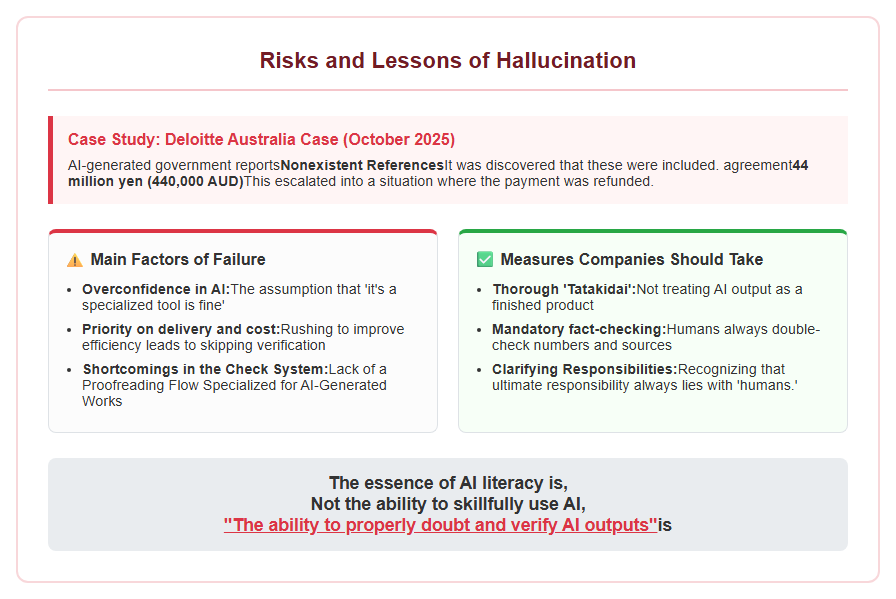
This case highlighted the characteristic of AI that can confidently output information that sounds plausible as if it were factual. In Fucrot as well, its role is clearly stated as “organizing judgment materials,” not to guarantee revenue, solicitation, or make a final legal decision. The essence of AI literacy lies not simply in skillfully using AI, but in critical thinking that appropriately doubts AI outputs and allows humans to perform final fact-checking.
Especially in areas related to contracts, official documents, and financial reports, it is essential to always verify AI-generated figures and sources with the original sources. When using specialized AI like Fucrot, it is important to recognize that it should not be treated as a “finished product” but as an advanced “hammering platform,” with the ultimate responsibility always borne by the human management. This cautious approach is the only way to master AI as a weapon while simultaneously protecting organizations from risk.
Section 3-2: From Pyramid to Obelisk Structure—Structural Transformation in the Consulting Industry
The emergence of Fucrot is not just a single service release but symbolizes a structural transformation across the entire consulting industry. Traditional consulting typically used a ‘pyramid-shaped’ model where a large number of juniors engaged in research and document creation, while seniors guided the strategy. However, now that AI can replace routine tasks previously handled by juniors with overwhelming speed and low cost, this structure is becoming unsustainable.
From now on, it is expected to shift toward a small-scale, highly specialized “obelisk-type” model. AI handles core tasks, while humans specialize in the high value-added areas of “insight, judgment, and relationships.” This change presents opportunities not only for major firms but also for small and medium-sized consultants and individuals. By utilizing AI, large-scale investigations and analyses that were previously insufficient due to resource shortages become possible, creating an environment where consultants deeply specialized in specific industries and challenges can thrive.
The way clients select companies has also shifted from the traditional “brand scale” to “clarity of value offered.” Consultants will need the ability to master tools like Fucrot and optimize practical workflows as an “AI facilitator,” and the human skills to build trust with management as a “client leader.” The advantage of scale is collapsing, and the entire industry is beginning to reorganize into an era where the quality of value is being questioned.
Section 3-3: Future Outlook: Building a Sustainable Chain Where AI and Experts Coexist
Looking ahead, Fukurot is expected to play a key role in standardizing basic education in the construction of franchise headquarters. By learning the correct construction sequence and legal considerations through this service, aggressive merchant recruitment in an immature state will be curbed, and the overall industry will become healthier. AI will raise basic knowledge while humans tackle specific and specific problems, clarifying role divisions will accelerate.
Furthermore, with the evolution of AI itself, more dynamic support will become possible in the future. For example, the company is also considering developing into an execution-support-type AI agent that analyzes real-time store data and customer reviews to propose specific support actions to supervisors (SVs). The combination of AI handling facts and humans handling emotions and motivations will also contribute to strengthening the human domains essential to FC business success, such as franchise ownership and staff motivation management.
However, it must not be forgotten that franchise headquarters in the AI era should not simply aim to be a “labor-saving headquarters.” What should truly aim for is a headquarters that uses the time freed up by AI to focus on “decision-making and design” that only humans can do, such as dialogue with members, future strategy formulation, and creation of social value. The ultimate goal of this technological innovation is to build a sustainable chain where AI and experts complement each other, making it easier for members to succeed and where headquarters are properly governed.

_en.png)
コメント