The U.S. government has set up a $17.5 billion conditional loan facility for new nuclear power installations and supply chain enhancement. Behind this are two major social demands: the explosive increase in electricity demand driven by the spread of artificial intelligence (AI) and the acceleration of decarbonization.
- 10 new targets with .5 billion in loans
- Support for Resuming Operation of Three Mile Island Nuclear Power Plant Unit 1
- Cost Determination and Barrier Reduction through Regulatory Reform
- The demand for 24-hour power supply from data centers
- Shifts in International Energy Policy and Decarbonization Targets
- Learning Cost Management from the Experience at the Bogle Power Plant
- The Rise of Small Modular Reactors (SMRs) and Market Caution
10 new targets with .5 billion in loans
On June 23, 2026, the U.S. Department of Energy (DOE) announced it would provide $17.5 billion in conditional financing to strengthen the domestic commercial nuclear supply chain. The main goal of this loan is to begin construction of 10 new large reactors by 2030. Director Wright Energy expressed the recognition that this support could bring the target achievement forward by three years. Specifically, the plan is to guarantee up to five projects to build two 1.1 gigawatt-class reactors manufactured by Westinghouse Electric per site. Already, seven power companies have shown interest, and each must commit $500 million in contributions to take advantage of the loan. For years, the nuclear industry has struggled to attract new investment due to massive construction costs, complex regulations, and competition with cheaper alternatives like natural gas, but the government aims to accelerate private investment by sharing risks.
Support for Resuming Operation of Three Mile Island Nuclear Power Plant Unit 1
As part of this government support, a symbolic project is underway. On November 18, 2025, the DOE’s Lending Program Office (LPO) signed a $1 billion loan agreement with major power company Constulation Energy. This funding will be used to support the resumption of operations at the Crane Clean Energy Center in Pennsylvania (formerly Three Mile Island Nuclear Power Plant Unit 1). The first unit was closed in 2019 due to worsening economic conditions, but aims for the earliest possible return by 2027. The following image shows the placement of nuclear power plants in the United States.
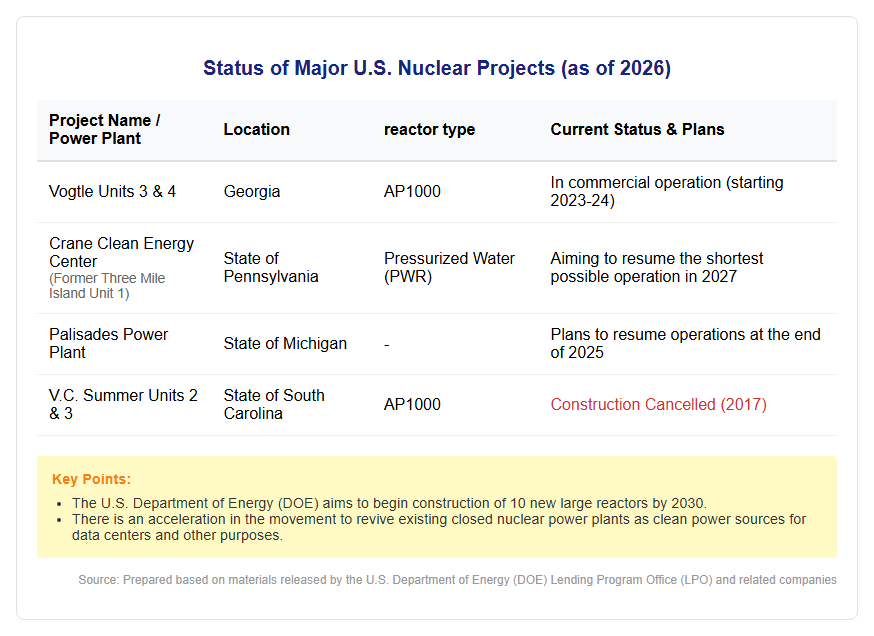
Once operations resume, it will be able to supply electricity equivalent to about 800,000 households, which is expected to contribute to strengthening grid reliability and job creation.
Cost Determination and Barrier Reduction through Regulatory Reform
The Nuclear Regulatory Commission (NRC) is also making institutional reforms to reduce barriers to new projects. For fiscal year 2026, the NRC has finalized new rules that set fixed caps on license issuance and service fees. This increases the predictability of costs associated with regulatory procedures for development companies, helping to curb opaque spending. This is a significant support, especially for startups with innovative technologies. In past large-scale projects, modifications to permits and permits due to design changes during construction were a major factor in rising costs, but establishing a highly transparent regulatory process is expected to eliminate such inefficiencies.
The Return of Nuclear Power Driven by AI Demand and Energy Security
The demand for 24-hour power supply from data centers
The biggest factor behind the rapidly growing interest in nuclear power is the power demand of data centers. With the spread of AI and cloud services, electricity consumption has increased at twice the rate of total energy demand over the past decade, ushering the world into the “age of electricity.” Unlike renewable energy sources such as solar and wind, nuclear power has the advantage of being able to supply large amounts of clean electricity stably 24 hours a day, unaffected by weather conditions. In fact, IT giant Microsoft signed a 20-year power purchase agreement (PPA) to coincide with the restart of the Three Mile Island nuclear power plant. Additionally, Amazon and Google have successively announced investments and orders for small modular reactor (SMR) development companies, positioning nuclear power as a key for tech companies to achieve their decarbonization goals.
Shifts in International Energy Policy and Decarbonization Targets
Global concerns over energy security are also driving a reassessment of nuclear power. At COP28 held in December 2023, more than 20 countries jointly declared their commitment to triple global nuclear power capacity by 2050. In the United States as well, a federal plan has been formulated to add at least 200 gigawatts of nuclear capacity by 2050. According to analysis by the International Energy Agency (IEA), total investment in nuclear power in 2023 reached approximately $65 billion, nearly doubling compared to ten years ago. With government policy support, tax credits, and direct loans combined, private financial institutions have begun to take a more positive stance on financing nuclear projects.
Lessons from the Past and Expectations for Next-Generation Technologies
Learning Cost Management from the Experience at the Bogle Power Plant
When discussing the return of U.S. nuclear power, the experience of constructing Units 3 and 4 at the Bogle Power Plant in Georgia is indispensable. This project attracted attention as the first new construction in decades in the United States, but it was significantly delayed from the original plan, with construction costs swelling from an initial estimate of about $14 billion to a final roughly $35 billion (2023 prices). Factors cited include starting work with unfinished designs, a shortage of skilled workers, and unfamiliarity with regulatory processes. However, through this “birth pain,” valuable insights were gained, such as restructuring supply chains, training workers, and establishing modular construction methods. According to a report from Idaho National Laboratory, applying these lessons to the next project could potentially reduce capital costs by more than 30%.
The Rise of Small Modular Reactors (SMRs) and Market Caution
The future focus will be on how widespread small modular reactors (SMRs) will be, in addition to traditional large reactors. SMRs can be mass-produced in factories, and since the initial investment is limited to about one-fifth of a large reactor (under approximately 2 billion dollars), it is a scale that is easy for private companies to invest in. However, some Wall Street analysts have warned that excessive expectations for unproven technology are causing a “nuclear bubble.” Some SMR startups’ stock prices are fluctuating, and risks such as supply chain bottlenecks and failures during the demonstration phase remain. The future focus will be whether the U.S. government’s $17.5 billion loan can dispel this uncertainty and lead the nuclear industry toward a self-sufficient commercial phase.
[#経済 #ビジネス #原子力発電 #エネルギー政策 #AI電力需要 #脱炭素 #米国経済]

コメント