The Financial Services Agency has launched an on-site inspection of Sony Life Insurance following a series of financial fraud cases totaling 120 million yen. Behind the improper policy cancellations and unauthorized fund solicitations by former sales representatives lie deep structural flaws, including an over-reliance on commission-based compensation and systemic governance failures.
- Financial Fraud Reaching 120 Million Yen Triggers FSA On-Site Inspection
- Malicious Tactics Inducing Policy Cancellations and the Reality of the 2.8 Million Customer Audit
- Commission-Based Pay and Long Tenure Creating Governance Blind Spots
- A Chain of Industry-Wide Scandals and Prudential’s Precedent
- Potential FSA Administrative Sanctions and Impact on Sony Financial Group
- Comprehensive Audit Timeline and Self-Defense Measures for Policyholders
Financial Fraud Reaching 120 Million Yen Triggers FSA On-Site Inspection
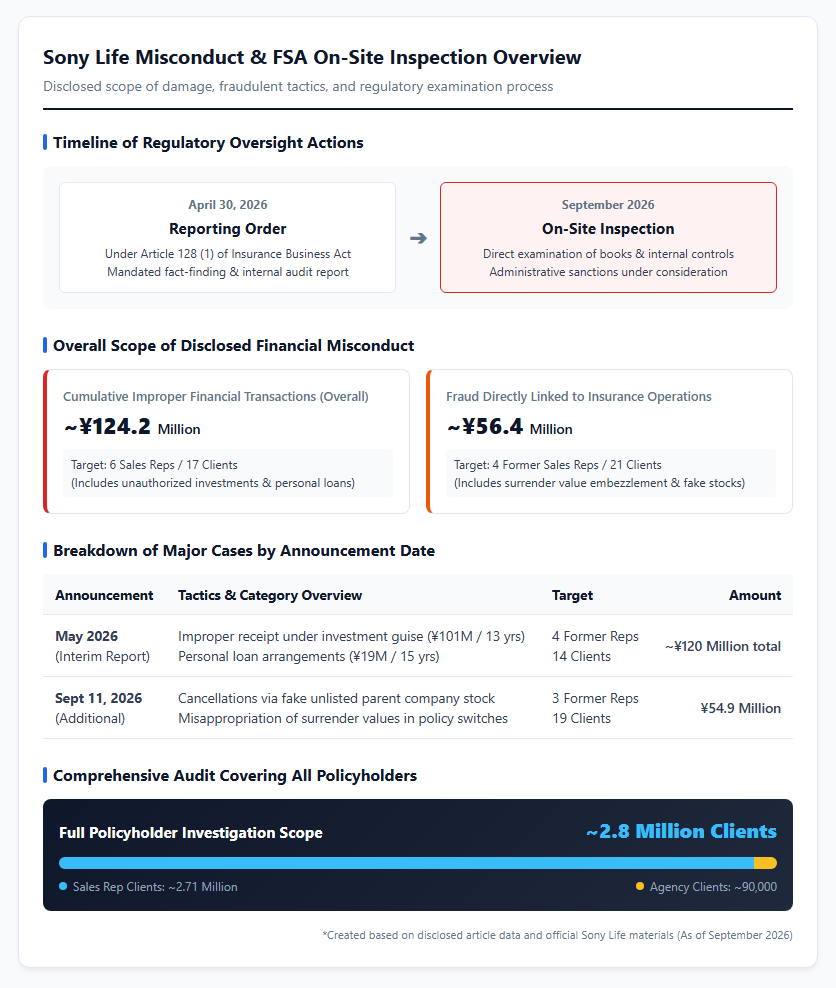
In September 2026, Japan’s Financial Services Agency (FSA) decided to conduct an on-site inspection of Sony Life Insurance under the Insurance Business Act. The decision follows a series of financial misconduct cases in which former sales representatives and exclusive agency personnel illegally obtained funds from policyholders. Although the FSA had issued a reporting order under Article 128, Paragraph 1 of the Insurance Business Act on April 30, 2026, regulatory authorities determined that written reports alone were insufficient to verify the accuracy of internal investigations and the full extent of customer damage, escalating oversight to a direct on-site examination of books and management controls.
The catalyst for this regulatory escalation was both the scale and nature of the uncovered fraud. In an interim report released in May 2026, Sony Life disclosed that four former sales representatives had improperly received approximately 120 million yen from 14 clients. On September 11, 2026, the company announced an additional 54.9 million yen stolen from 19 clients by three former representatives attached to branches in Chiba and Himeji. Fraud directly linked to insurance operations currently involves four former sales reps, 21 clients, and approximately 56.4 million yen. When including broader improper financial transactions—such as unauthorized investment solicitations and personal loan arrangements outside insurance duties—the cumulative total spans six sales reps, 17 clients, and approximately 124.2 million yen. Regulators view the underlying internal control failures with grave concern.
Refer to the diagram below.
Malicious Tactics Inducing Policy Cancellations and the Reality of the 2.8 Million Customer Audit
Qualitatively, the most critical aspect of the revealed misconduct is the exploitation of legitimate insurance administration processes. A former sales representative in his 50s attached to the Chiba Life Planner Center 5th Branch falsely claimed that clients could invest in unlisted shares of parent company Sony Financial Group through an employee stock ownership association. Between July 2023 and April 2026, he persuaded clients to cancel their life insurance policies and embezzled portions of their surrender values, stealing a total of 33 million yen from 13 clients.
While previous industry scandals primarily involved private borrowing or external investment schemes, this case saw fraud executed directly through official corporate documentation and system procedures, utilizing legitimate policy cancellation and reduction mechanisms. By leveraging the capital events and brand of its parent group as a deceptive pitch to extract cash from policy surrender values, the representative effectively weaponized the company’s reputation. In response, Sony Life is conducting a comprehensive audit covering approximately 2.8 million policyholders—2.71 million managed by sales reps and 90,000 managed by exclusive agencies—to screen for suspicious transactions. The investigation also revealed that seven exclusive agencies had introduced unauthorized external investment products to clients without prior regulatory notification.
Structural Flaws in the “Elite” Life Planner Model
Commission-Based Pay and Long Tenure Creating Governance Blind Spots
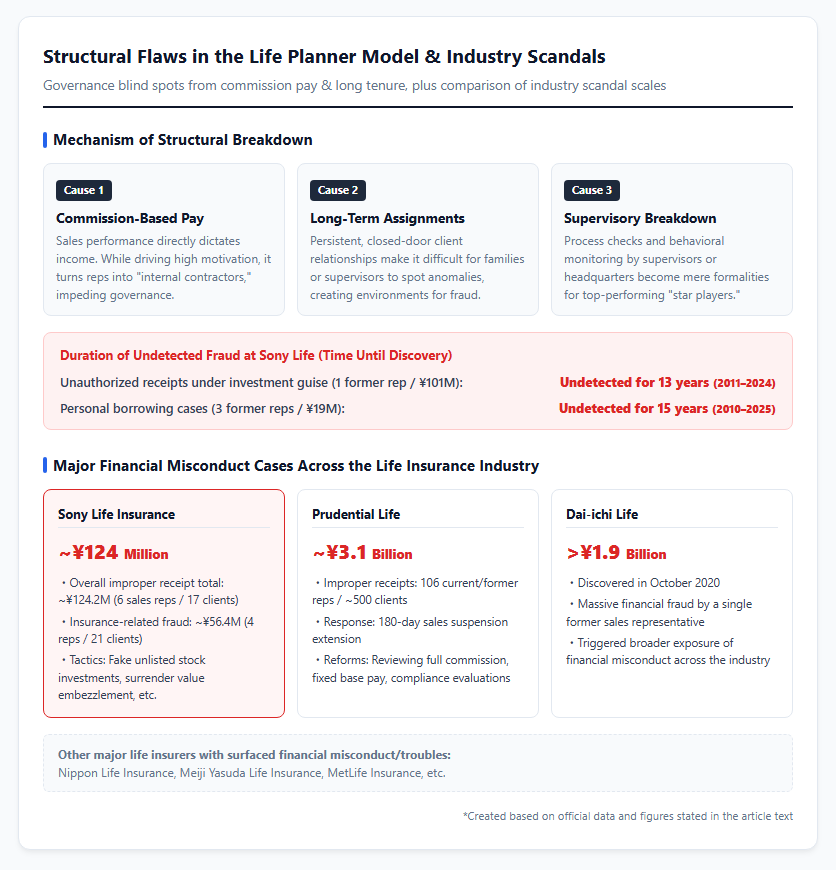
Since its founding in 1979, Sony Life’s core strength has resided in its “Life Planner” system—a specialized consulting sales force. However, this scandal highlights the inherent structural limits of the model itself. Sony Life’s Life Planner system relies heavily on a near-full commission compensation framework directly linking sales performance to income. While this structure drives high motivation, it turns sales personnel into pseudo-independent contractors rather than integrated corporate staff, making organizational governance and behavioral management exceptionally difficult.
Furthermore, long-term client assignments characteristic of life insurance created blind spots where misconduct could remain hidden for years. The unauthorized investment solicitations revealed in May went undetected for 13 years (2011 to 2024), while personal borrowing schemes persisted for 15 years (2010 to 2025). Supervisors and headquarters routinely hesitated to scrutinize the operational processes of top-performing “star players,” leading to a complete breakdown in supervisory oversight. This allowed fraudulent activities to continue within closed, highly personal client relationships, proving that immense management risks lurked behind a business model focused on high sales productivity.
Refer to the diagram below.
A Chain of Industry-Wide Scandals and Prudential’s Precedent
Financial misconduct by sales staff is not isolated to Sony Life; it represents a systemic issue shaking the entire Japanese life insurance sector. At Prudential Life Insurance, which formerly shared a joint venture history with Sony Life, a major scandal came to light in January 2026 where 106 current and former employees inappropriately received approximately 3.1 billion yen from around 500 clients. Prudential was forced into an extended sales suspension and initiated drastic reforms, including revising full-commission structures, introducing fixed base salaries, and linking compliance metrics to performance evaluations.
This follows a broader wave of industry scandals, beginning with Dai-ichi Life’s 1.9 billion yen fraud case in October 2020, followed by reported financial misconduct at Nippon Life, Meiji Yasuda Life, and MetLife. Traditional sales models relying on face-to-face pitchmen and aggressive commission incentives foster corporate cultures that prioritize revenue over compliance. The FSA views these incidents not as isolated personal lapses, but as systemic management failures, urging the Life Insurance Association of Japan and member firms to establish enforceable guidelines for sales force management.
Future Outlook and Key Focus Areas
Potential FSA Administrative Sanctions and Impact on Sony Financial Group
The focus of the FSA’s on-site inspection extends beyond verifying the existence of internal regulations to evaluating whether those rules actually functioned on the ground. Should the inspection uncover critical defects in internal controls or unreported incidents, the FSA is expected to issue administrative sanctions under the Insurance Business Act. Potential regulatory actions under consideration include business improvement orders requiring root-cause analysis and executive accountability, or partial business suspension orders halting specific sales channels.
The fallout could also extend beyond Sony Life to its parent, Sony Financial Group. Having completed its partial spin-off and re-listing on September 29, 2025, the group faces scrutiny over its corporate governance as an independent listed entity. The FSA has indicated it may extend inspections to the parent holding company if necessary. With a former FSA commissioner serving at the helm of Sony Financial Group, market observers are closely watching how strictly regulators will enforce governance reforms.
Comprehensive Audit Timeline and Self-Defense Measures for Policyholders
Sony Life’s comprehensive audit of roughly 2.8 million policyholders is expected to wrap up by the end of November 2026, with final investigation results, recurrence prevention plans, and customer compensation policies scheduled for release in mid-December. The substantial labor and external expert costs associated with reaching out to all policyholders, alongside compensation payouts, will weigh heavily on the firm’s financial performance. Moreover, the audit process itself—inquiring whether clients experienced fraud—risks stoking customer anxiety and depressing new policy sales.
For policyholders, proactive measures are essential to safeguard personal assets. Policyholders should contact official company call centers or dedicated hotlines directly—bypassing individual sales representatives—to verify policy validity, check for unauthorized cancellations, reductions, or lapses, and confirm address change histories. Refusing personal loan or external investment solicitations from representatives and reporting suspicious activities immediately remain key to fraud prevention. This series of events marks a turning point where consumers must move away from blind trust in individual advisors and rigorously evaluate the corporate governance of financial institutions.
Reference Pages
- [Sony Financial Group Disclosure Materials] https://kabuyoho-sls-disclose.ifis.co.jp/67f/140120260430515375.pdf
- [Sony Life Insurance Financial Results & Performance] https://www.sonylife.co.jp/company/corporate/results/
- [Financial Services Agency Comprehensive Supervisory Guidelines for Insurers] https://www.fsa.go.jp/common/law/guide/ins/03c.html
【#SonyLife #FSA #OnSiteInspection #CorporateGovernance #LifeInsurance #Compliance #FinancialScandal #SonyFinancialGroup】

コメント