QuEra Computing and Amazon Web Services (AWS) have announced that they will offer the fault-tolerant quantum computer “Libra” on Amazon Braket by 2028. Behind this lies a leap in error correction technology and a solid scientific path toward large-scale operations using neutral atom methods.
- Strategic Partnership Between QuEra and AWS: Roadmap for 2028
- Performance Metrics of the “Megaquop” Class: Power of 256 Logical Qubits
- Dynamic reconstruction using neutral atom methods and optical tweezers
- Empirical evidence of “error correction” backed by peer-reviewed papers
- Transforming Industrial Structures: Hybrid Computing Accelerated via the Cloud
- The National Strategy for 2028 and the Importance of ‘Quantum Readiness’
Strategic Partnership Between QuEra and AWS: Roadmap for 2028
QuEra Computing, a Boston-based leader in quantum computing, announced on June 15, 2026, that it will cloud the world’s first commercial-grade fail-tolerant quantum computer (FTQC), Libra, through Amazon Braket by 2028. This announcement significantly deepens the long-standing strategic partnership with AWS and clearly marks the shift of quantum computing from the “research phase” to the “practical roadmap.”
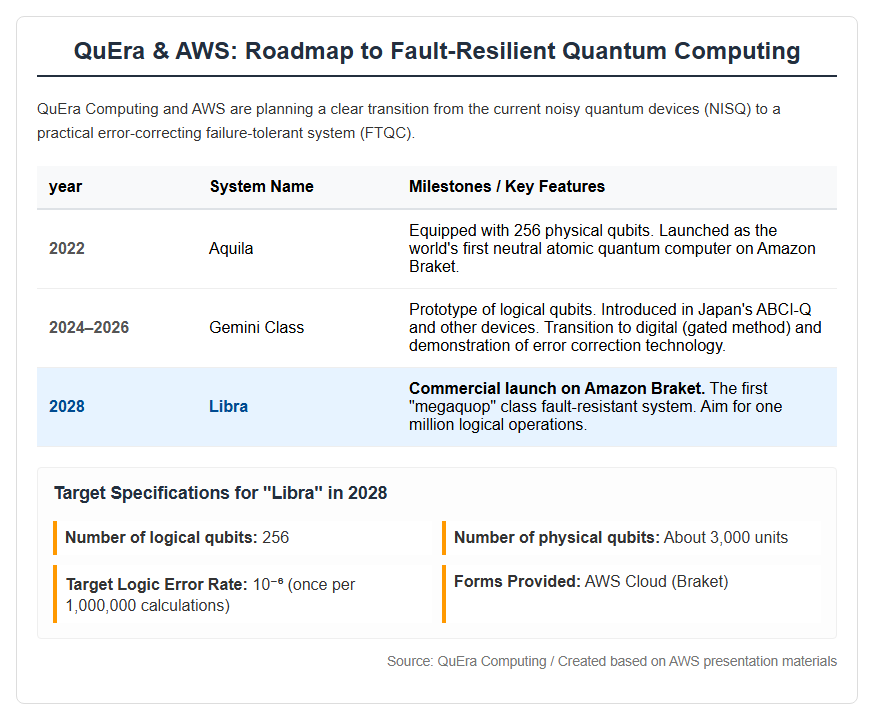
Libra distinguishes itself from the current noisy quantum systems (NISQ), designed to perform deeper, longer, and more reliable calculations. Breaking the industry convention that “practical application takes another 10 years” and presenting a concrete deadline of 2028, it caused a major shock to both the scientific community and industry. By integrating into AWS’s cloud infrastructure, millions of users worldwide are gaining access to cutting-edge quantum computing power without additional infrastructure investment. Please refer to the roadmap diagram below.
Performance Metrics of the “Megaquop” Class: Power of 256 Logical Qubits
The biggest feature of the Libra system is its inclusion of 256 logical qubits, aiming for an extremely high accuracy of 10⁻⁶ (one error per million operations). A logical qubit is a “stable” qubit formed by bundling multiple physical qubits that are sensitive to noise and applying error correction, serving as a core unit that guarantees computational reliability. QuEra defines this system as a “megaquop” class capable of one million logical operations.
This performance is overwhelming even compared to the results of leading competitors. For example, compared to other companies’ Level 2 error correction systems that have been hot topics as of 2026, Libra aims for an accuracy 1,000 times higher. By mobilizing about 3,000 physical qubits and efficiently controlling them, practical applications can be executed. This opens the door to large-scale molecular simulations and solving complex optimization problems that were impossible with conventional supercomputers.
Technical Basis and Scientific Validity
Dynamic reconstruction using neutral atom methods and optical tweezers
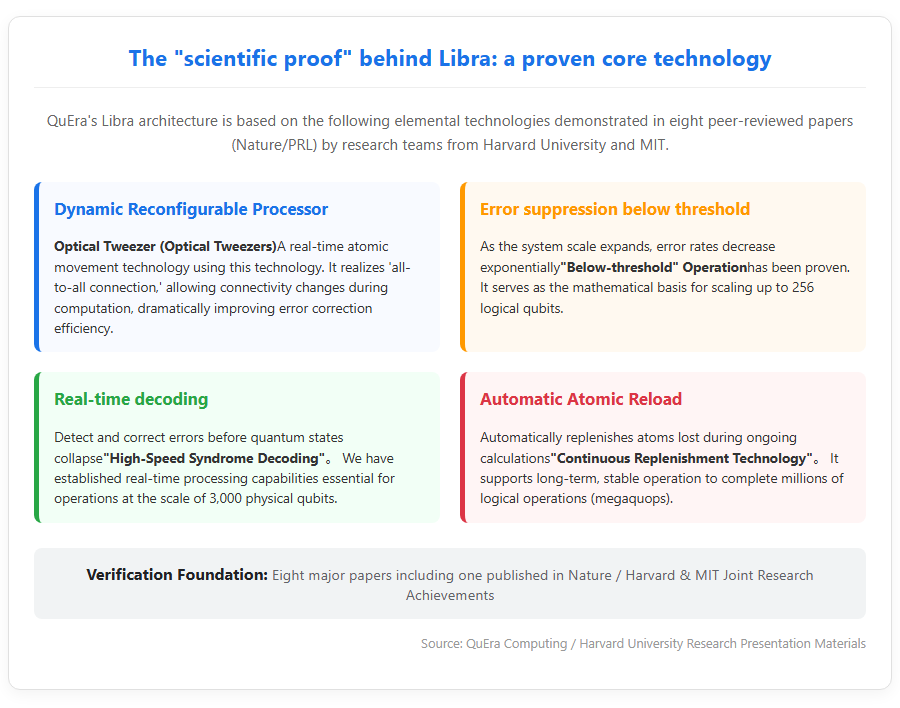
The core technology supporting Libra is the “neutral atomic qubit.” This method captures and manipulates atoms like rubidium in the air using a highly focused laser beam called an “optical tweezer (light tweezers).” Unlike other modalities such as superconductivity, its greatest strength is the ability to dynamically change atomic arrangements during calculations with “all-to-all connections.”
This flexible reconfiguration capability allows Libra to execute ultra-efficient error correction code without being bound by static topologies. As a result, it becomes possible to dramatically reduce the number of physical qubits needed to construct a single logical qubit. Additionally, thousands of identical atoms can be densely packed within a single module, allowing the system to scale up without facing complex wiring issues. In this way, the neutral atom method can be considered an extremely rational approach from a physics perspective to realize fault-tolerant quantum computing.
Empirical evidence of “error correction” backed by peer-reviewed papers
Libra’s architecture is not just a future prediction but is based on rigorous scientific verification. QuEra and its co-founder Professor Mikhail Lukin from Harvard University, along with MIT researchers, have published eight peer-reviewed papers on the elemental technologies of this system in prestigious journals such as Nature and Physical Review Letters.
These studies have successfully demonstrated scalable fault-tolerant architectures using 448 neutral atomic qubits, demonstrating that errors can be suppressed below critical thresholds. Additionally, technologies essential for large-scale operations, such as “automatic atomic reloading technology” to continuously operate 3,000 physical qubits, and “fast syndrome decoding” to reduce errors in real time, have already been experimentally confirmed. It is precisely because of this scientific foundation that the ambitious goal of commercialization by 2028 is gaining trust as a “concrete roadmap by a proven team.” The diagram below shows the control technology for neutral atoms.
Social Implementation and Future Highlights
Transforming Industrial Structures: Hybrid Computing Accelerated via the Cloud
Libra launching on Amazon Braket in 2028 will bring a paradigm shift to the industry. Sectors such as pharmaceuticals, materials development, and finance are the first to benefit from this. For example, complex electronic structure calculations for new drug candidates, material design for lithium-ion batteries, and optimization of large-scale portfolios can now be executed within realistic timeframes rather than the time that was previously thought to take decades.
Furthermore, Libra will be closely integrated with AWS’s existing legacy hybrid computing environment. Users can build a “hybrid workflow” that seamlessly combines traditional CPU and GPU computation with Libra-based quantum computing. This enables efficient operations where only the most difficult parts are solved by the quantum processor rather than leaving all calculations to the quantum computer, while the rest is handled by a classical supercomputer. This integrated environment will serve as a powerful catalyst for corporate R&D departments to integrate quantum technology into existing business processes.
The National Strategy for 2028 and the Importance of ‘Quantum Readiness’
The deadline of 2028 is beginning to take on significant meaning in terms of politics and national strategy. On June 22, 2026, U.S. President Donald Trump signed an executive order directing the deployment of research quantum computers by 2028. Additionally, the federal government’s deadline for transitioning to quantum-resistant cryptography (PQC) to 2031 is rapidly accelerating the international hegemony competition between the US and China over quantum technology.
In this context, QuEra’s management has sounded the alarm, saying, “Waiting until 2028 is a competitive risk.” To maximize Libra’s capabilities from day one of operation, it is necessary to start collaborating on algorithms and cultivating in-house quantum experts from this very moment. 2028 is not a “future that will come someday,” but rather a “already confirmed delivery date” that should be recorded on the calendar. Japanese companies are also at the critical point this year to begin budgeting and strategy formulation for an era where AWS users like Fujitsu and NEC can try quantum hybrid apps.
[#量子コンピューター #QuEra #AWS #誤り訂正 #AmazonBraket #中性原子 #FTQC #2028年]

コメント