
“GLM-5.3-MLX” has been released, enabling Z.ai’s open-weight LLM “GLM-5.3”, which exceeds 1.5TB, to be run locally on a single Mac. Behind this are the establishment of a proprietary and breakthrough quantization technology, “OrcaSAQ”, and the presence of a framework optimized for Apple Silicon.
- The Shocking Arrival of “GLM-5.3-MLX” Running on a Single Mac
- Basic structure of the base flagship model “GLM-5.3”
- The Mechanism of the Proprietary “OrcaSAQ” Method Achieving Approximately 79% Size Reduction
- Four Variants Offered from 2-bit to 6-bit and Accuracy Maintenance
- Physical Limitations of On-Package Execution and Requirements for Local Operation
- Local Execution and Distributed Configuration on a Mac with 512GB Memory
- The Future Outlook of the Open Source Ecosystem and Local Execution
The Shocking Arrival of “GLM-5.3-MLX” Running on a Single Mac
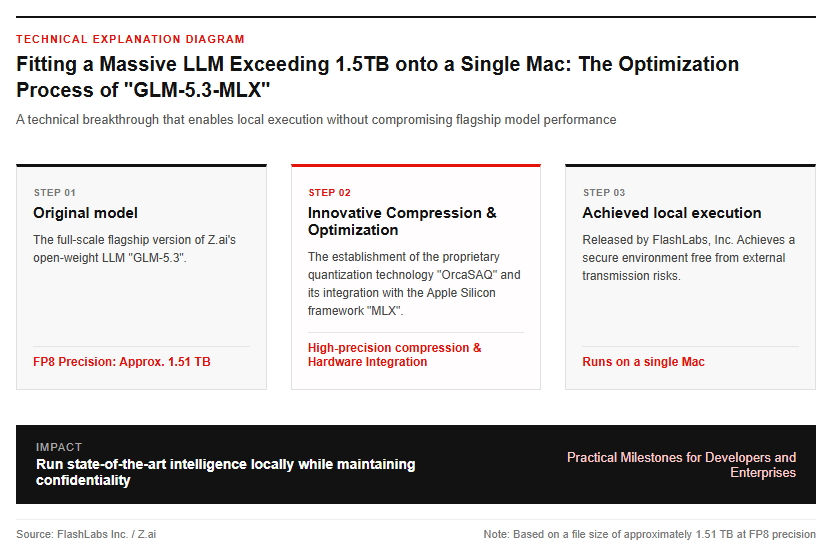
On August 31, 2026, Japan-based FlashLabs Inc. released “GLM-5.3-MLX,” an optimized version of Z.ai’s open-weight large language model “GLM-5.3” for Apple Silicon. The standout feature of this model is that it makes it possible to run a massive AI locally on just a single Mac—a task that previously required immense computational resources. Rather than being built on a lightweight “Flash” or “distilled” variant, the model is based on the full-scale flagship version. This LLM, which reaches a staggering size of approximately 1.51TB at FP8 precision, was compressed and optimized using proprietary technology and made publicly available on Hugging Face. For enterprises and individual developers who are reluctant to send data to external servers, the emergence of an option to run top-tier intelligence locally while ensuring confidentiality represents a crucial milestone in local AI development. Please refer to the diagram below for the optimization process.
Basic structure of the base flagship model “GLM-5.3”
“GLM-5.3” is a flagship open-weight LLM developed by Z.ai. It adopts an extremely massive and advanced Mixture of Experts (MoE) architecture with a total parameter count of approximately 743B (743 billion) and an active parameter count of approximately 40B (40 billion) per token processed. Furthermore, because it supports a vast context window of 1 million tokens (1 million tokens), it is capable of simultaneously referencing and processing entire massive source code repositories, multiple detailed design documents, and hundreds of thousands of lines of server system logs at once. Announced on August 14, 2026, this model boasts the pinnacle of reasoning capabilities and autonomous agent capabilities in text processing, as well as advanced security vulnerability analysis capabilities, and this full model has been targeted for this local execution optimization.
Proprietary Quantization Technology “OrcaSAQ” and Its Remarkable Compression Effects
The Mechanism of the Proprietary “OrcaSAQ” Method Achieving Approximately 79% Size Reduction
To make it possible to run massive models exceeding 1.5TB on a Mac, its developer, the US AI research institution Continuum AI, has developed a proprietary quantization method called “OrcaSAQ” (Orca Sensitivity-Aware Quantization). In conventional quantization processes, calibration data was required to prevent a drop in model accuracy, and executing it demanded significant time and resources. In contrast, “OrcaSAQ,” announced in August 2026, requires no calibration data at all. It directly analyzes the network structure of the model and automatically identifies tensors that play a decisive role in maintaining overall accuracy. By applying “mixed-precision quantization” that boldly compresses other parts while keeping those crucial parts at high precision, it achieves a dramatic, high-level balance in the trade-off between performance and memory usage, successfully compressing a 743B model.
Four Variants Offered from 2-bit to 6-bit and Accuracy Maintenance
In “GLM-5.3-MLX”, four variants—”2-bit”, “3-bit”, “4-bit”, and “6-bit”—are provided to suit the user’s execution environment and required accuracy level. The 2-bit version, which boasts the highest compression rate, successfully reduced the model size from approximately 1.51TB at the FP8 stage to about 322GB. Developer verification has confirmed that while this represents a dramatic downsizing of about 79%, it retains approximately 80.2% of the original model’s intelligence score. Furthermore, the top-tier 6-bit version achieves almost perfect accuracy reproduction, with a cosine similarity of 0.9997 or higher compared to the original FP8 version. Note that an 8-bit version is not available as of its release in August 2026. This is because converting to 8-bit causes a physical reversal phenomenon where the size of the model’s expert weights exceeds the original FP8 source weights.
Physical Limitations of On-Package Execution and Requirements for Local Operation
To run this large-scale LLM comfortably locally, Apple Silicon’s unique hardware architecture is a major key. Generally, M-series SoCs such as the MacBook Pro are designed such that the CPU, GPU, and NPU access high-bandwidth unified memory via the same ultra-high-speed bus. However, no matter how much compression is applied, to keep the 2-bit version’s weights, which reach approximately 322GB, resident in memory, and to further secure the operating area for the KV cache during processing and the system OS, one faces the wall of physical memory capacity. Therefore, to operate this model on a single device, a top-tier Mac equipped with 512GB of memory (such as an M3 Ultra) is a mandatory requirement. With this configuration, the 2-bit and 3-bit versions can be run extremely comfortably, and local inference can be executed for the 4-bit version as well by fitting it into the memory space.
Roadmap to Practical Application and Future Industry Impact
Local Execution and Distributed Configuration on a Mac with 512GB Memory
In addition to execution on a single device, approaches are also provided to run even higher-precision variants. The 6-bit version, which boasts the highest precision, exceeds the memory limit of a single Mac due to its size. To solve this, this model supports distributed execution by connecting multiple devices using “mlx.distributed.” Specifically, this configuration runs inference by networking two Macs equipped with 512GB of memory and logically integrating their memory spaces. Alternatively, as an enterprise-grade infrastructure, execution is also envisioned on a cluster equipped with eight NVIDIA H200 GPUs. Please refer to the diagram below for the mechanism of the distributed configuration.
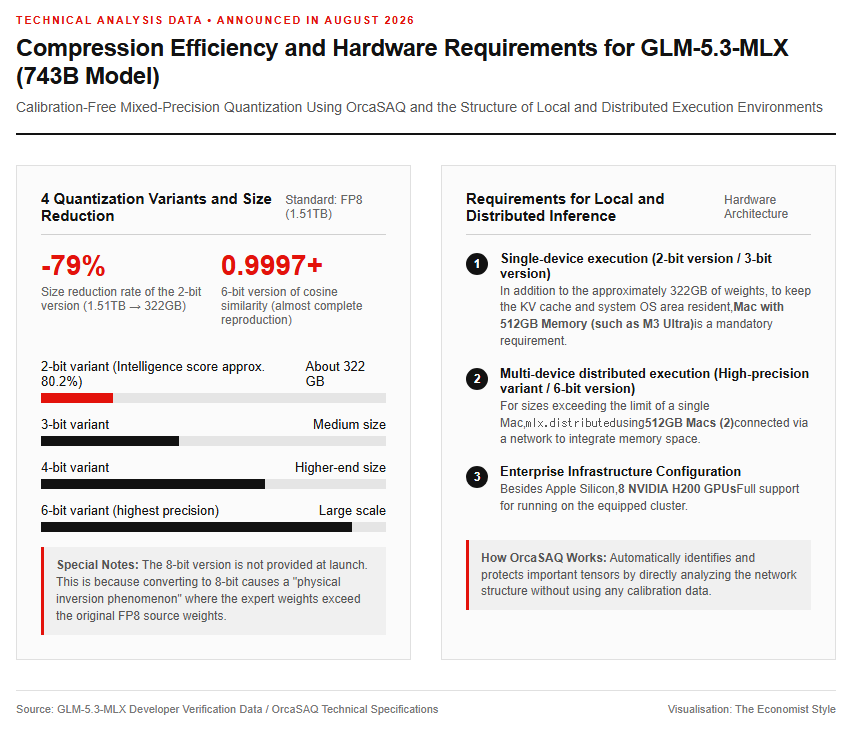
In this way, flexible scale-out is possible according to your desired execution speed and budget—ranging from a local workstation to a small-scale cluster linking multiple Macs, and even to cloud-based data center GPUs.
The Future Outlook of the Open Source Ecosystem and Local Execution
The release of “GLM-5.3-MLX” will have an extremely profound ripple effect on the developer community and the local AI ecosystem. The model weights have been made freely available on the Hugging Face repository under the MIT license, which permits unrestricted commercial use, modification, and redistribution. This enables fine-tuning with custom datasets and the development of proprietary assistants within completely independent private cloud environments. Furthermore, a GGUF version in collaboration with Unsloth is provided simultaneously, and testing is expected to progress across a diverse range of local platforms—including Windows and Linux—via widely adopted runtime environments such as llama.cpp. Moving forward, we are truly entering an era where anyone can directly integrate frontier-class, ultra-large-scale intelligence into their own infrastructure and operate it with all concerns about data leakage completely eliminated.
Reference Page
【#AITechnology #LargeLanguageModels #AppleSilicon #LocalAI #OpenSource #Quantization】


コメント