
Resonac Holdings has announced plans to list its wholly owned subsidiary, Krasas Chemical, which is responsible for the petrochemical business. Behind this is a clear strategy to concentrate management resources on our core semiconductor and electronic materials businesses to maximize corporate value.
- Specific schedule for Krasas Chemical’s listing plan
- Adopting a new method called partial spin-offs
- The Business Scale and Strengths of Krasas Chemical, Which Became Independent
- Transforming into a world-class semiconductor materials manufacturer
- Investor Requests and Portfolio Management Streamlining
- Obsession with eliminating conglomerate discounts
- Restructuring of the Domestic Petrochemical Industry and Krasas Chemical’s Position
- Challenges toward greening and carbon neutrality
- Resonac’s Re-evaluation and Future Outlook from an Investor Perspective
Specific schedule for Krasas Chemical’s listing plan
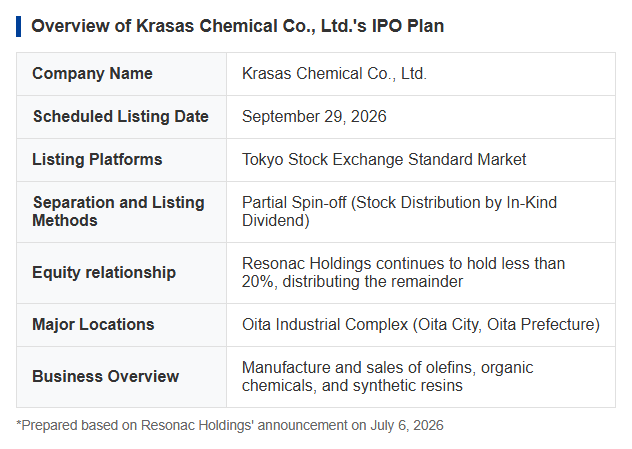
On July 6, 2026, Resonac Holdings (hereafter, Resonac HD) officially announced the listing plan for its wholly owned subsidiary, Krasas Chemical Co., Ltd. According to the press release, the company aims for a new listing on the Tokyo Stock Exchange Standard Market on September 29, 2026. Krasas Chemical is a company that inherited the petrochemical business, which was the traditional core business of the former Showa Denko, and its main production base is the Oita Industrial Complex in Oita City, Oita Prefecture.
A major feature of this listing plan is that its parent company, Resonac HD, aims to concentrate management resources on its core semiconductor and electronic materials business. Resonac HD was established in January 2023 through the merger of Showa Denko and Showa Denko Materials (formerly Hitachi Kasei), and it was in a ‘conglomerate’ state, combining high-growth semiconductor materials with a mature yet stable cash flow petrochemical business. This decision aims to separate these to build the optimal management environment tailored to the characteristics of each business.
Please refer to the diagram below.
Adopting a new method called partial spin-offs
A notable point in this plan is the consideration of a “partial spin-off” approach. This method allows Resonac HD to continue holding a portion of Krasas Chemical’s shares (less than 20%), distributing the remaining shares as in-kind dividends to Resonac HD shareholders, and at the same time, listing Krasas Chemical. This method allows you to allocate shares of subsidiaries directly to existing shareholders while effectively spinning off the business.
Behind this is the special measures based on the “Industrial Competitiveness Enhancement Act” established in June 2023. By using this system, it becomes possible to defer corporate and income tax assessments, allowing for smoother and more efficient business splitting. At the annual general meeting of shareholders in March 2026, Resonac HD proposed amendments to the articles of incorporation to allow the in-kind dividends accompanying this spin-off to be executed promptly solely by board resolution. The aim is to enable agile decision-making to maximize shareholder value while monitoring trends in legal revisions.
The Business Scale and Strengths of Krasas Chemical, Which Became Independent
Kurasas Chemical, aiming to go public, is by no means a small organization. In the fiscal year ending December 2025, sales revenue reached 300.3 billion yen, accounting for about 22% of the Resonac Group’s total revenue of 1.3471 trillion yen, making it a key pillar. The flagship Oita Industrial Complex boasts over 55 years of history since it began operations in 1969, boasting excellent maintenance and operational technologies. There have been no plant shutdowns due to troubles outside of scheduled maintenance periods for over five years, maintaining one of the highest operating rates in Japan.
We also possess strong competitiveness in terms of products, with high-purity allyl alcohol leading the global market share and ethyl acetate leading domestic market share. We also have strengths in diversifying raw materials, achieving cost reduction by flexibly using not only crude naphtha but also LPG, kerosene, and diesel oil. With such a solid foundation and stable profitability, it was determined that even after the separation and independence, we could compete fully in the market as a petrochemical-only manufacturer.
[Management and Strategy Background] Selection and Concentration on Semiconductor Materials
Transforming into a world-class semiconductor materials manufacturer
The main reason Resonac HD is rushing to list Krasas Chemical is to transform into a world-class functional chemical manufacturer. Since the integration in 2023, the company has positioned itself as a “second founding,” positioning its semiconductor and electronic materials business as its core growth business. Especially in the material field known as the “back-end process” of semiconductors, Resonac holds numerous products boasting the world’s No.1 market share. With the rapid adoption of AI semiconductors, the importance of packaging technologies that highly connect multiple chips has increased, raising expectations for Resonac’s material suite like never before.
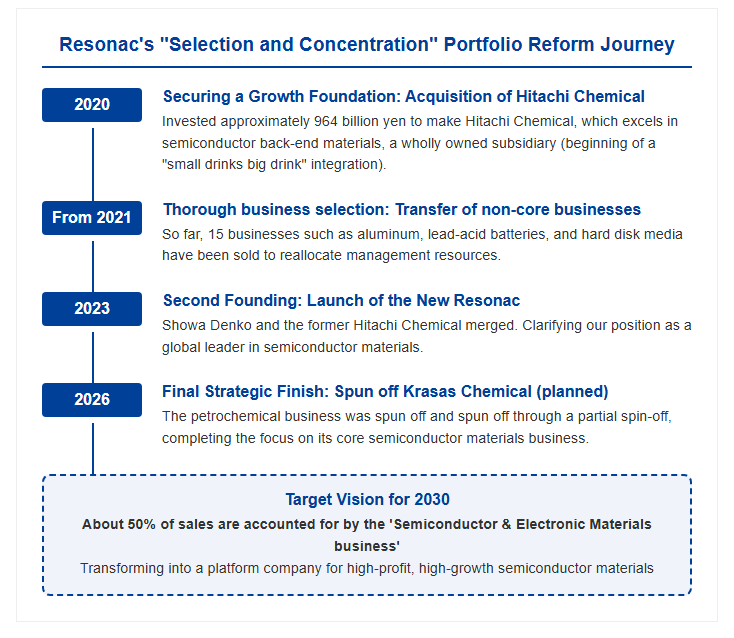
President Hidehito Takahashi has repeatedly stated that for Japanese manufacturing to succeed globally, it is necessary to raise the level of management and marketing and focus resources on growth businesses. In the past, Showa Denko was like a ‘department store’ with 13 business divisions, but profitability was low and growth businesses were unclear. Therefore, we acquired Hitachi Chemical for about 964 billion yen and built our current portfolio by repeatedly selling off unprofitable businesses. The separation of Krasas Chemicals can be seen as the final step in this “selection and concentration” strategy.
Please refer to the diagram below.
Investor Requests and Portfolio Management Streamlining
The separation of the petrochemical business is also a conclusion drawn from dialogue with shareholders and investors. While the semiconductor materials business has extremely high future growth potential, it is characterized by the rapid short-term performance fluctuations known as the silicon cycle. On the other hand, the petrochemical business, although a mature market, is characterized by generating stable cash flow. From the investor’s perspective, the coexistence of different types of businesses within a single investment destination was considered “noise,” causing the value of each business to not be properly evaluated.
Resonac’s management has set a goal of achieving a 10% ROIC (Return on Invested Capital) and is reviewing each business from a capital efficiency perspective. If the petrochemical business remained under Resonac’s umbrella, investment in the high-growth semiconductor sector would be prioritized, which would suppress capital investment and R&D expenses required for the petrochemical business. By separating and becoming independent, Krasas Chemical will be able to decide how to use its own earned funds and invest with mobility. This can also be seen as a result of seeking the “best owner” for subsidiaries.
Obsession with eliminating conglomerate discounts
Resonac HD is strongly committed to eliminating the so-called conglomerate discount, where its stock price is heavily discounted to its fair value. The company has set a target of a stock price of 10,000 yen, and to achieve this, it needs to raise its EV/EBITDA ratio from the current level to about 15 times, comparable to global semiconductor materials players.
Clearly recognizing in the market as a “semiconductor materials manufacturer” rather than a “comprehensive chemical manufacturer” is key to improving valuations. With Krasas Chemical’s IPO plan, if the petrochemical business is separated from the financial statements, Resonac HD’s revenue structure will become cleaner and more specialized in semiconductor materials. From 2025, we will change our accounting standards to IFRS (International Financial Reporting Standards), and by eliminating the profit cuts caused by goodwill amortization, we are also working to enhance our appeal to global investors. This spin-off listing can be seen as a “main mark” move to win reappraisal from the market.
[Future Developments & Points of Interest] Industry Restructuring and Medium- to Long-Term Outlook
Restructuring of the Domestic Petrochemical Industry and Krasas Chemical’s Position
Krasas Chemical’s independence could serve as a catalyst for restructuring not only Resonac alone, but also the entire Japanese petrochemical industry. Currently, domestic ethylene plants are accelerating restructuring across eastern and western Japan, driven by oversupply and shrinking domestic demand. CFO Hideki Somemiya mentioned that although the Oita industrial complex is geographically distant from other regions, it is worth considering the possibility of collaborating with other regions through shipping and attracting interested companies to Oita.
It is highly anticipated to see how Krasas Chemical, now an independently listed company, will behave amid this industry restructuring. President Koji Fukuda has set forth the mission of “creating a company that pioneers a bright future for Japan’s petrochemical industry.” By becoming independent from Resonac, the barriers to integration and collaboration with other companies are lowered, allowing for more flexible strategies. The question is whether the new company can fulfill its role as a “best practice” for the survival of Japan’s petrochemical industry.
Challenges toward greening and carbon neutrality
The biggest medium- to long-term challenge is responding to decarbonization (carbon neutrality) in the petrochemical business. Continuing with the traditional business model dependent on fossil fuels will not survive in the future. Krasas Chemical is already advancing numerous industry-government-academia co-creation projects, such as developing a “low-concentration CO2 separation system” in collaboration with Nippon Steel and universities, and demonstrating chemical recycling that decomposes waste plastics using microwaves to recycle them.
These environmental investments require huge amounts of capital, but listing opens the door to direct market funding, which is a major advantage. Whether we can recognize responding to the ‘greening’ demands of local communities and customers as growth investment and establish a local production for local consumption model will determine Krasas Chemical’s long-term corporate value. With the purpose of ‘Supporting tomorrow’s life through chemistry,’ the new company’s execution capabilities will be tested to see if it can completely renew the image of the petrochemical industry.
Resonac’s Re-evaluation and Future Outlook from an Investor Perspective
Looking at Resonac HD itself, the next focus will be revenue growth after the Krasas Chemical separation. In the earnings forecast for the fiscal year ending December 2026, the semiconductor and electronic materials segment is clearly shaping overall company profits. We have revised our core operating profit forecast for the first half of 2026 upward to 74 billion yen, but almost all of this comes from the semiconductor and electronic materials business. The growth engine is running strongly, with advanced packaging materials for AI servers recording record-high quarterly sales.
Going forward, attention will be focused on how much results these forward-looking preparations—such as next-generation optoelectronic fusion packaging and semiconductor material development in outer space—by utilizing co-creation hubs such as the “US-JOINT” established in Silicon Valley, will yield results. Once Krasas Chemical’s listing is successful and the conglomerate discount is resolved, Resonac aims to reign as a true “semiconductor materials platform company” at the core of the global semiconductor supply chain.
[#レゾナック #クラサスケミカル #半導体材料 #スピンオフ #上場計画 #ポートフォリオ経営 #石油化学]

コメント