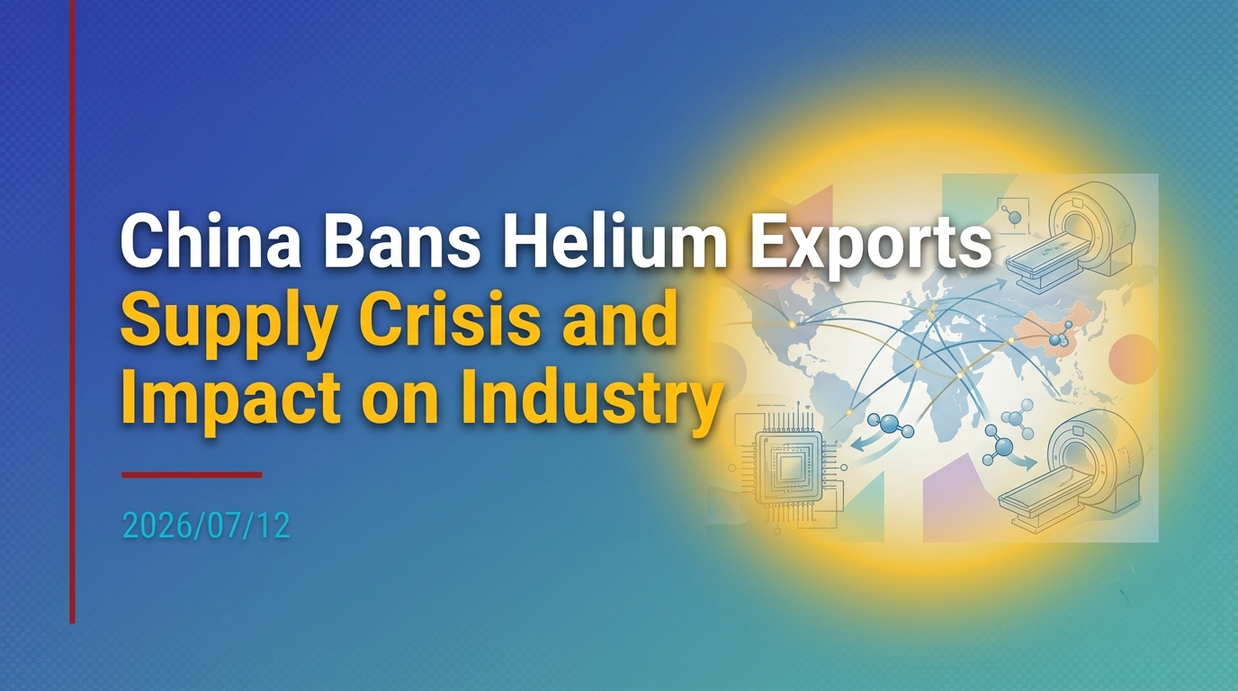
On July 10, 2026, the Ministry of Commerce and the General Administration of Customs announced a temporary ban on helium exports based on the Foreign Trade Law, effective immediately. The background is the global supply crisis caused by the escalating tensions in the Middle East, and it is believed that the company is prioritizing the inventories for its own semiconductor and AI industries.
- Key Points and Legal Basis of the Announcement
- The Chain of the ‘Triple Shock’ Shaking the World
- The irreplaceable role in semiconductor and AI manufacturing
- The operational crisis of medical MRI and its impact on diagnosis
- Japan’s procurement structure and concerns over soaring prices
- Long-term Outlook and Measures Companies Should Take
Key Points and Legal Basis of the Announcement
On July 10, 2026, the Ministry of Commerce of China and the General Administration of Customs jointly issued Announcement No. 29, making a sudden announcement of a temporary ban on the export of helium (customs code: 2804290010). This measure is based on the Foreign Trade Act and is positioned in the same lineage as the export restrictions prioritized by domestic demand that were previously imposed on fuel, fertilizers, sulfuric acid, and other products. Astonishingly, it was so thorough that not only did it take effect immediately, but there were no export license application processes, exceptions in target countries, or transition periods for existing contracts.
The announcement on July 10, 2026, coincides with the day the U.S. President declared the end of the ceasefire memorandum in the Middle East, reigniting tensions in the region. Market participants analyze that the Chinese government has moved to protect domestic supply in anticipation of further geopolitical turmoil. Since the announcement does not specify an expiration date and future adjustments will be announced separately, it cannot be ruled out that this could effectively lead to an indefinite ban.
The Chain of the ‘Triple Shock’ Shaking the World
This embargo imposed by China marks the final blow in a series of supply troubles that have occurred since March 2026, bringing a “triple shock” to the global market. The first shock was the Iranian attack on Qatar’s Ras Rafan Industrial City on March 2, 2026, which destroyed about 30–38% of the world’s supply and is expected to take 3 to 5 years for full recovery. The second shock is the export restrictions imposed by Russia in April of the same year, which will last until the end of 2027.
China is an importer dependent on over 80–85% of its helium, but at the same time, it has also acted as an “intermediary hub,” importing Russian helium and re-exporting it to Europe and Southeast Asia,,。 Please refer to the diagram below.
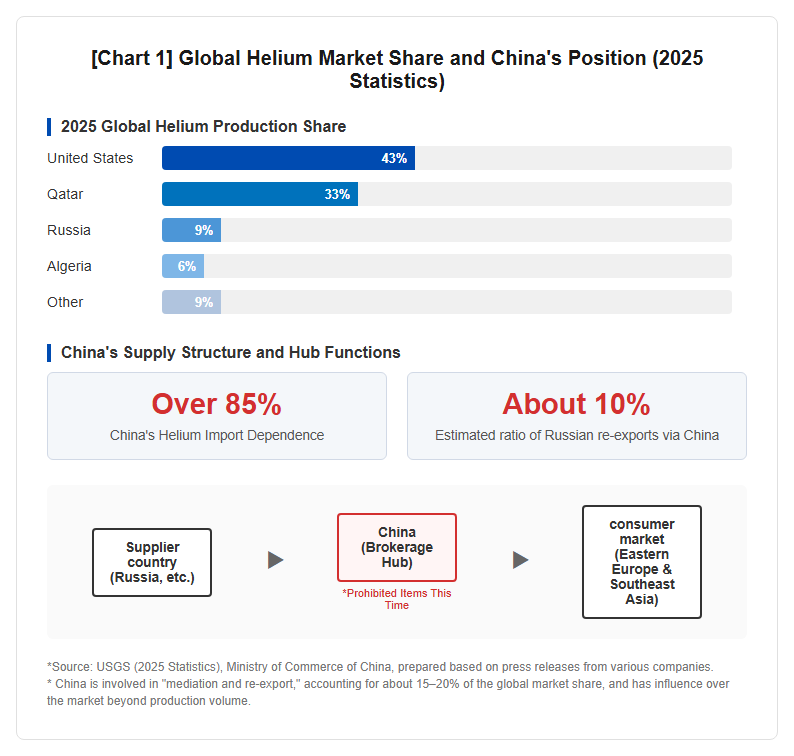
。 China’s suspension of this intermediary export has completely cut off distribution channels, especially in some Eastern European and Asian markets that relied on Russian products, and the demand for alternatives has concentrated on U.S. products, causing a global surge in spot prices.
The Impact of Strategic Material Helium on Industry and Healthcare
The irreplaceable role in semiconductor and AI manufacturing
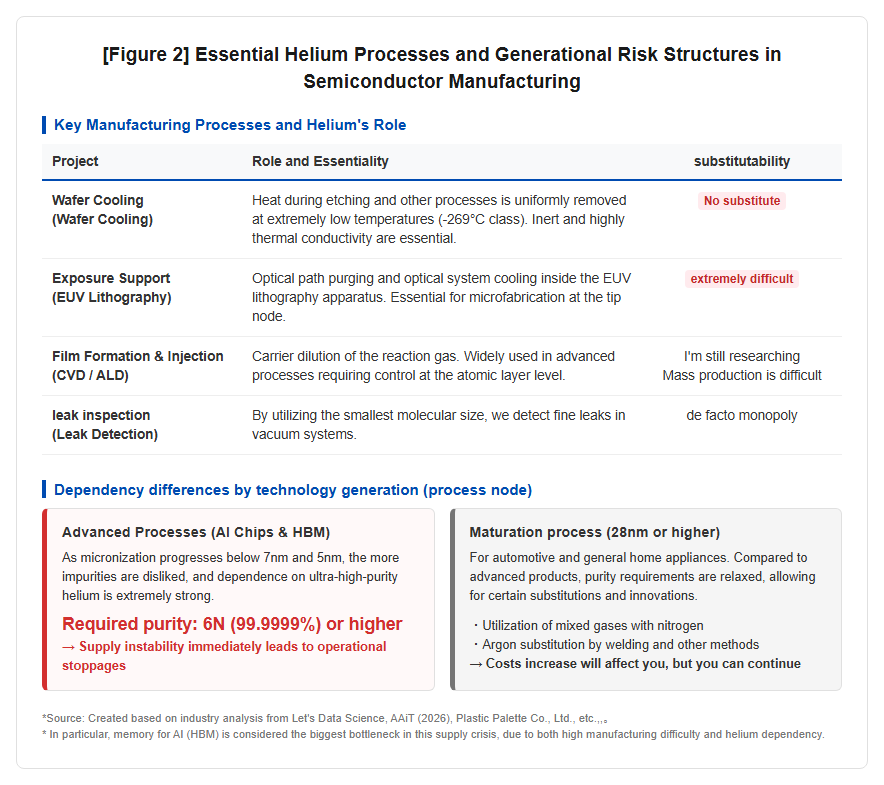
Helium is often associated with “party balloons,” but in reality, it plays an extremely important role deep within the semiconductor manufacturing process. Especially in silicon wafer etching and high-energy deposition processes, “wafer cooling,” which efficiently and evenly dissipates heat by inserting helium between the wafer and the cooling device, is essential. Helium’s boiling point is minus 268.9 degrees Celsius, an extremely low temperature close to absolute zero, and no other gas possesses both thermal conductivity and chemical inertness.
If temperature control becomes unstable, wafer deformation and process inhomogeneity may occur, potentially leading to a catastrophic drop in yield. The use of nitrogen and argon as alternatives is also being researched, but these have not reached practical levels for large-scale mass production in advanced processes. Especially in the manufacturing of advanced chips such as HBM (High Bandwidth Memory), where demand is rapidly increasing due to the spread of generative AI, helium supply instability directly constrains production capacity itself, creating a structural risk that causes overall supply delays for AI hardware. Please refer to the diagram below.
。
The operational crisis of medical MRI and its impact on diagnosis
The medical field is a concern for even more serious impacts than in the industrial sector. MRI (magnetic resonance imaging devices) used in hospitals require large amounts of liquid helium to continuously cool the superconducting magnet, their heart, to minus 269 degrees. If helium supply is cut off and cooling cannot be maintained, a phenomenon called “quench,” where the magnetic field disappears, occurs, causing the device to stop and restarting requires enormous costs and new helium refilling.
Since the conflict began in March 2026, the spot price of helium has already doubled to about twice its previous level, putting pressure on healthcare institutions’ operations. If China’s import ban makes it difficult to first fill the thousands of liters required for new equipment introduction, hospital openings and equipment upgrades will be delayed nationwide, and appointments for tests essential for early detection of cancer and stroke may be canceled months in advance, making it a reality. The introduction of “helium-free MRI” to reduce helium dependence is progressing, but it is impossible to immediately replace all existing equipment.
Current Status of the Japanese Market and Future Supply Network Strategy
Japan’s procurement structure and concerns over soaring prices
Japan’s helium procurement structure is diversified, with about 37% dependence on Qatar and about 60% from the United States. This puts Korea in a relatively advantageous position compared to South Korea, whose dependence on Qatar exceeds 65%, and Taiwan, which has reached 69%. The Ministry of Economy, Trade and Industry also announced as of April 2, 2026, that it is expected to secure a similar volume through alternative procurement from the United States, and about two months’ worth of domestic inventory is maintained.
However, if China’s embargo strengthens the European market’s dependence on U.S. products, a global battle for U.S. helium will become inevitable. Although the amount Japan imports directly from China is limited, a timeline is expected for secondary impacts such as rising spot prices and the reduction of allocation quotas, which will also affect Japan. In particular, small and medium-sized semiconductor equipment manufacturers without long-term contracts, research institutions, and medical MRI maintenance providers are prone to facing risks of price pass-through and procurement delays, so it is necessary to closely monitor recent price indicators.
Long-term Outlook and Measures Companies Should Take
This helium crisis is not a temporary phenomenon but highlights structural challenges such as Qatar’s three- to five-year recovery period and China’s strategic resource encirclement. Companies are being forced to restructure their business models, assuming that the era is no longer where helium is abundantly and cheaply available. In the short term, it will be necessary to review inventory levels and renegotiate supply contracts, but in the long term, investing in technologies to curb the consumption of helium, an “irreversible resource,” will be key.
Specifically, the introduction of a “recycling system” that recovers evaporated helium and reliquefies it is being mentioned, and some domestic manufacturers have already achieved high recovery rates of 80–90%. It is also important to accelerate research and development of alternative technologies such as cryogenic cooling using liquid nitrogen and transition to helium-free MRI. Since the Chinese government has not specified the conditions for lifting the export ban, building layered supply chains that incorporate geopolitical risks and establishing permanent defenses against resource weaponization will likely determine corporate sustainability,,。
[#ヘリウムショック #中国経済 #半導体サプライチェーン #中東情勢 #地政学リスク #MRI #AI産業]

コメント