
On July 8, 2026, the Ministry of Land, Infrastructure, Transport and Tourism announced that a total of 36 projects had been selected as the FY2026 ‘Model Projects for Vacant House Countermeasures.’ This project aims to directly support highly modeled initiatives by private businesses and NPOs to address Japan’s increasingly serious vacant house problem, and to spread the results nationwide.
- A full overview of 36 carefully selected projects from 117 submissions
- Strong financial support supporting both software and hardware
- Changes in the ‘Main Battleground’ for Vacant House Measures and the Government’s Objectives
- The Future of Vacant House Surveys Transformed by AI and Cutting-Edge Technology
- 2. New Utilization Methods Connecting Community Residence and Disaster Area Support
- Reorganization of Existing Residential Areas Anticipating the Rapid Increase in Inherited Vacant Houses
- Increased ‘risk of neglect’ due to the enforcement of the revised Vacant House Act
- Mandatory Inheritance Registration and Utilization of Tax Incentives
- Budget structure of the Comprehensive Support Project for vacant house measures
- Challenges for Small and Medium-sized Construction Companies and Private Operators in New Territories
- Nationwide deployment of success stories and actions owners should take
A full overview of 36 carefully selected projects from 117 submissions
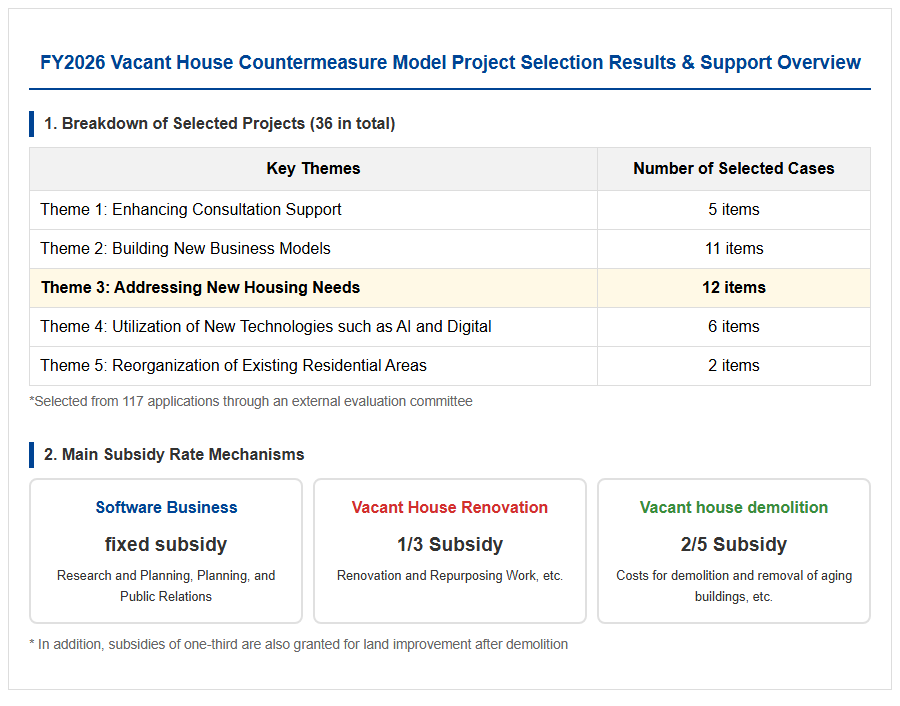
The Housing Comprehensive Development Division of the Housing Bureau of the Ministry of Land, Infrastructure, Transport and Tourism announced the results of the selection of the “Vacant House Countermeasure Model Project” on July 8, 2026. Applications for fiscal year 2026 were held from April 20 to May 20 of the same year, and a total of 117 ambitious proposals were submitted nationwide. After rigorous review by an evaluation committee composed of academic experts, 36 projects were ultimately selected as recipients for support. The selected projects are divided into five designated themes: Theme 1 focused on enhancing consultation support for 5 projects, Theme 2 on building new business models for 11 cases, Theme 3 on responding to new housing needs with 12 cases, Theme 4 on utilizing new technologies for 6 cases, and Theme 5 on residential area restructuring for 2 cases. A major feature of this project is that it is not merely an extension of existing measures but is backed by the government for highly model-oriented and groundbreaking initiatives that can be applied in other regions. Please refer to the diagram below.
Strong financial support supporting both software and hardware
Selected businesses will receive a wide range of subsidies, ranging from soft projects such as surveys and considerations of vacant house countermeasures to hard projects involving actual renovations and demolitions. The subsidy rate is also set in a very specific manner, with fixed-amount support provided for soft projects such as research, planning, and public relations. On the other hand, for hard projects involving construction, renovation work on vacant houses covers one-third of the cost, and demolition work (demolition) covers two-fifths of the cost. Additionally, a one-third subsidy is also granted for land development after demolition. The reason for setting such a high subsidy rate is to reduce the financial burden on vacant home owners and to accelerate stagnant measures. The selected projects will be promoted by a wide range of stakeholders, including NPOs, private businesses, and local governments, each tailored to their respective regional issues.
Changes in the ‘Main Battleground’ for Vacant House Measures and the Government’s Objectives
An important message to be taken from the adoption of this model project is that Japan’s vacant house measures have shifted significantly from the simple construction phase of “demolishing or repairing” to regional business design and the creation of sustainable systems. Until now, measures against vacant houses have mainly focused on ‘post-incident response,’ such as the government guiding and demolishing buildings at risk of collapse. However, many of the selected projects include ‘push-type’ consultation support that approaches owners before they take action, and ‘multifunctionality’ by utilizing vacant houses as evacuation sites during disasters. The government is working to build standardized solutions to the massive social challenge of vacant houses by compiling the insights and successful cases gained through these model projects into a database that local governments and businesses nationwide can refer to.
[Details of the Selected Projects] Five Key Themes and Key Projects
The Future of Vacant House Surveys Transformed by AI and Cutting-Edge Technology
In Theme 4, “Utilization of new technologies such as AI and digital,” efficiency improvements through technology are a major focus. For example, in Tanabe City, Wakayama Prefecture, infrastructure is being built that automatically determines vacant houses by collecting exterior images of buildings by utilizing 360-degree cameras installed on vehicles and pedestrians along with the latest AI. Additionally, another municipality adopted a model that combines water supply shutdown data, satellite data, and Street View analysis to extract candidate vacant houses. Previously, surveys required staff and volunteers to walk on-site and visually inspect the work, but digital technology could dramatically reduce their workload. This is expected to enable municipalities to detect vacant houses early and promptly implement utilization approaches for owners.
2. New Utilization Methods Connecting Community Residence and Disaster Area Support
In Theme 3, “Responding to New Lifestyles and Residential Needs,” projects that combine support for areas affected by the Noto Peninsula Earthquake with the utilization of vacant houses are attracting attention. Specifically, projects such as the “Noto-style Village Guesthouse and Related Population Creation Model Project” in Noto Town, Hōsu District, Ishikawa Prefecture were selected. This is an effort to revitalize vacant houses in disaster-affected areas, not just for simple housing reconstruction, but to serve as hubs for promoting the creation of dual-community residence and related populations. Additionally, in the “Sumuyadosumu” implementation demonstration project in Ibara City, Okayama Prefecture, a “one building, three roles” business model will be verified, operating as the owner’s dual regional residence or vacation rentals during normal times, and functioning as an emergency evacuation site for victims and owners during disasters. Efforts to capture the diversification of lifestyles and add value beyond just ‘housing’ to vacant houses are gaining momentum.
Reorganization of Existing Residential Areas Anticipating the Rapid Increase in Inherited Vacant Houses
Theme 5, “Restructuring of Existing Residential Areas in Anticipation of the Rapid Increase in Inherited Vacant Houses,” is an important area to prepare for the “massive increase in vacant houses” that will be seriously faced going forward. In the housing revitalization project in Hirose Town, Maebashi City, Gunma Prefecture, government agencies, local residents, universities, and private businesses collaborate to present a set of ‘future vision for the entire area’ and ‘business proposals for individual properties’ to vacant house owners using a method called ‘reverse presentation.’ The focus is not on the vacant house itself, but on how to redesign the entire block or complex. In large-scale existing residential areas developed during the period of rapid economic growth, we analyze the causes of individual owners’ inability to act, and by collaborating among multiple stakeholders to redefine the value of the region, we aim to reinstate vacant houses that tend to be left unattended after inheritance.
[Institutional and Legal Background] In 2026, the environment surrounding owners will undergo dramatic changes.
Increased ‘risk of neglect’ due to the enforcement of the revised Vacant House Act
As of 2026, the legal system surrounding vacant houses is stricter than ever before. A particularly significant turning point was the revised Vacant House Law, enacted in December 2023. With this legal revision, ‘poorly managed vacant houses,’ which were just before the definition of ‘specified vacant houses,’ have also become subject to administrative guidance. If poor management, such as cracked windows or overgrown weeds, persists, the municipality will issue improvement recommendations. If this recommendation is received, the special measure for residential land, which had previously reduced property tax by up to one-sixth, will be lifted, and the tax burden will soar to levels equivalent to vacant land. Furthermore, failure to comply with orders may result in fines, so leaving a vacant house unattended for now is essentially acknowledging economic risks.
Mandatory Inheritance Registration and Utilization of Tax Incentives
Another thing vacant house owners should be aware of in 2026 is the mandatory inheritance registration. This system is designed to prevent situations where neglecting to change the ownership leads to an unknown owner and a vacant house being left unattended. Failure to do so may result in fines. Meanwhile, the government is also preparing “candy” to promote the circulation of vacant houses. For example, when selling an inherited vacant house that meets certain requirements, a special measure allowing up to 30 million yen to be deducted from capital gains is continuously implemented. Additionally, many local governments have their own demolition and renovation subsidies, and understanding these correctly and taking early action is key to protecting your assets. This model project also includes establishing a system that supports owners in understanding these complex legal and tax systems and making appropriate decisions.
Budget structure of the Comprehensive Support Project for vacant house measures
The government’s “Comprehensive Support Project for Vacant House Measures” has received enormous budgets. According to data from the Administrative Project Review, budget requests have been on the rise in recent years, and in fiscal year 2026, several hundred billion yen in budget has been allocated to this field. There are two main pillars of budgeting. One is direct subsidies for the demolition and utilization of vacant houses carried out by municipalities. The other is support for highly modeled initiatives by NPOs and private businesses, as announced this time. The execution rate has also been maintained at a high level, showing that the government positions vacant house measures as one of the top priorities for disaster prevention, mitigation, and regional revitalization. Subsidies are required to be properly managed based on the municipalities’ “Vacant House Countermeasure Plans,” and operators are required to carry out their projects with high transparency.
[Future Developments and Focus] How to Build a ‘Regional Vacant House Route’
Challenges for Small and Medium-sized Construction Companies and Private Operators in New Territories
Following the results of this model project, the role of small and medium-sized construction companies and real estate companies rooted in the community is set to change significantly. There is a growing demand for a transformation from simply ‘a company that provides construction estimates’ to a company that provides decision-making materials to resolve owners’ doubts and anxieties. Among the selected excellent cases, many handle demolition, real estate, design, construction, and even waste disposal in one go, assembling vacant houses not as “one-off projects” but as “ongoing local projects.” As building material prices continue to soar, ‘resource-circulating renovation’—which uses reclaimed wood and fittings from vacant houses to reduce renovation costs—is likely to become a major trend going forward. Private businesses can start conversations early with local governments and community organizations and expand consultation channels, which will determine the quality of resolving vacant house issues.
Nationwide deployment of success stories and actions owners should take
Going forward, the 36 selected model projects will undergo demonstration and research until March 2027, and the results will be compiled into a report. The Ministry of Land, Infrastructure, Transport and Tourism plans to horizontally roll out these results to municipalities nationwide and promote the successful methods as a “standard package for vacant house countermeasures.” For vacant home owners, it is important to understand the current situation where these new support frameworks and local consultation services are becoming more established, and to make early decisions. By choosing to sell, lease, or properly remove assets while their value remains, it becomes possible to avoid leaving a negative legacy for future generations. 2026 will be a crucial year that not only imposes “restrictions” due to legal revisions but also wisely utilizes “support” from model projects to revive vacant houses into valuable stocks for the community and individuals.
[#空き家対策 #国土交通省 #改正空家法 #補助金 #地方創生 #AI活用 #二地域居住 #不動産]

コメント