Lawson, KDDI, and HashPort will begin a demonstration experiment using the Japanese yen stablecoin “JPYC” for over-the-counter payments starting August 2026. The underlying strategy is to reinvent existing retail models with digital technology and build next-generation lifestyle platforms.
- The Significance of Payment Flow at Physical Stores and ‘POS Integration’
- The Japanese Yen Stablecoin “JPYC” Supporting the Technology and the Role of Wallets
- Lawson, KDDI, and Mitsubishi Corporation envision a forced fusion of ‘real ×digital’
- Competition in the Point Economic Zone and the Synergy Effect with Ponta Points
- Forecasts of accelerated market growth both domestically and internationally
- System Improvements under the Revised Payment Services Act and the Establishment of ‘Intermediary Businesses’
- Automation Concept for “Agentic Payment (AI Payment)”
- “DVP” and “Programmability” enabled by blockchain
- Barriers and motivations to “mass adoption”
- Scenario One Year Ahead: Scenario aiming for a circulating amount of 1 trillion yen by 2027
The Significance of Payment Flow at Physical Stores and ‘POS Integration’
On July 13, 2026, HashPort Inc., KDDI Corporation, and Lawson Corporation signed a basic agreement for a technical demonstration of stablecoin payments in physical stores. This pilot will be conducted in August 2026 at the “Lawson Takanawa Gateway City Store,” and first, verification of in-store payments will be conducted with some employees of the three companies. Its biggest feature is that stablecoin payments are enabled in conjunction with existing POS terminals, making it a notable first in Japan.
Specifically, users display a barcode in the digital asset wallet “HashPort Wallet” installed on their smartphone, and store staff scan it at a regular POS register, thereby updating the balance of the Japanese yen stablecoin “JPYC.” The diagram below shows the payment process at a store.
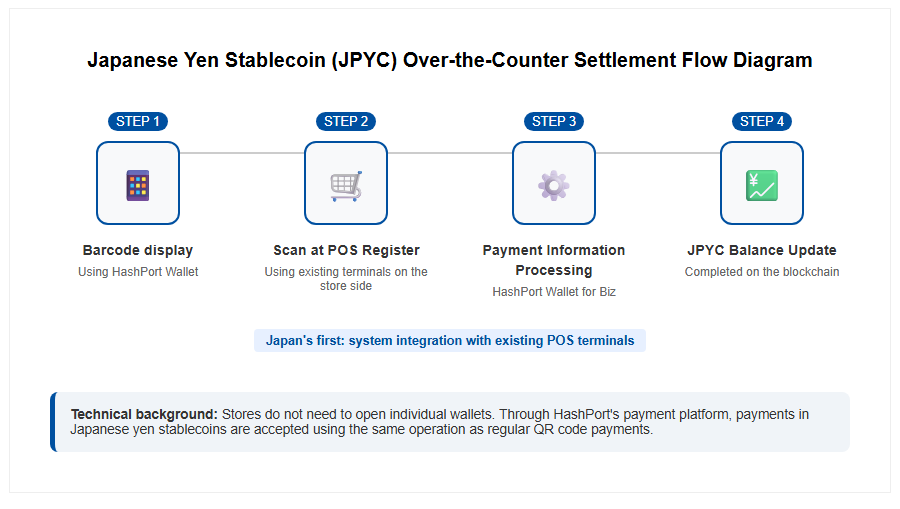
。 Stores do not need to install dedicated payment terminals themselves; by utilizing HashPort’s corporate and store service “HashPort Wallet for Biz,” stablecoin payments can be smoothly integrated into existing operations. In this demonstration, not only system integration requirements but also the time required for payment, operability at registers, and employee operational burdens will be thoroughly examined, and full-scale implementation will be considered based on the results.
The Japanese Yen Stablecoin “JPYC” Supporting the Technology and the Role of Wallets
The “JPYC” adopted as the payment method this time is a fund-transfer stablecoin linked to the Japanese yen at a 1:1 value, and legally classifies it as a “Type 1 electronic payment method.” JPYC Corporation became the first in Japan to obtain this license from the Financial Services Agency in August 2025 and began issuing it in October of the same year. As supporting assets, more than 101% of the issued amount of government bonds and deposits are secured through trust banks and other means, providing high reliability as digital cash. Additionally, JPYC’s collaboration with Elliptic, a leading AML (anti-money laundering) solution provider, has built an advanced transaction monitoring system, further supporting adoption at major retail chains.
On the other hand, the “HashPort Wallet” used by users is the No.1 wallet app in Japan, with about 84% of Japanese yen stablecoin users operating as of November 2025. This wallet is a “non-custodial” type where users manage their private keys themselves, offering a variety of features that allow users to experience the Web3 world more closely. KDDI formed a capital and business alliance with HashPort in October 2025, making it an equity-method affiliate, which is expected to create strong synergies between telecommunications infrastructure and digital asset management. This demonstration marks a significant milestone for stablecoins to become more widespread not just as an investment but as a means of payment in everyday life.
[Background of Management and Strategy] Transformation from ‘Retail’ to ‘Lifestyle Platform’
Lawson, KDDI, and Mitsubishi Corporation envision a forced fusion of ‘real ×digital’
The background behind Lawson’s embarkation on stablecoin payment experiments at this timing is the transition to a joint management structure between Mitsubishi Corporation and KDDI, the company supporting the company. The convenience store industry is currently facing a double burden: market saturation due to population decline, soaring labor costs, and the collapse of the cost structure due to the 2024 logistics problem. The “retail one-legged approach” of simply purchasing and selling products is now in a phase where it is difficult to generate profits. In response, Lawson is trying to change the very rules of competition by integrating KDDI’s digital technology, a telecommunications carrier.
By combining KDDI’s vast digital touchpoints via smartphones with Mitsubishi Corporation’s proud real logistics and store network, the company aims to evolve convenience stores from mere retail venues into “hubs for solving daily life.” For example, plans include distributing optimal coupons based on customer interests and location information, or turning stores into hubs for drone delivery. The introduction of stablecoin payments this time is a symbolic initiative based on the logic of “forced fusion of real ×digital,” which implements new digital infrastructure at the real-world payment site. Delisting and eliminating the need to monitor short-term shareholders have enabled large-scale structural reforms that do not shy away from years of deficits, further supporting such bold experiments.
Competition in the Point Economic Zone and the Synergy Effect with Ponta Points
The transformation of payment infrastructure will also affect the power structure within the point economy zone. According to the latest 2025 survey by MMD Institute, while Rakuten Points still hold a high share, the collaboration between KDDI and Lawson, centered around Ponta Points, demonstrates a very strong presence in offline consumer settings. In particular, convenience stores are a fiercely competitive area where companies aim to secure a spot in the point economy zone, and the combination of Lawson and au is key to user retention strategies.
HashPort Wallet is already integrating with Ponta Points and has implemented an “on-ramp” feature that converts accumulated points into digital assets. In the future, a circular model is envisioned where points can be exchanged for stablecoins like JPYC, and then used directly for over-the-counter payments. Stablecoins have the advantage of lower merchant fees compared to traditional credit cards or QR code payments, which strongly motivates merchants to adopt them. By integrating customer touchpoints in the point economy zone with stablecoin payments, next-generation financial synergies are being explored that reduce fees while enhancing user convenience.
[Market Environment and Regulations] The Rapidly Expanding Social Implementation of Stablecoins
Forecasts of accelerated market growth both domestically and internationally
The stablecoin market is expected to experience explosive growth both domestically and internationally. According to a survey by Yano Research Institute (published February 2026), the domestic stablecoin market (based on balances) is expected to rapidly expand from about 3 billion yen in fiscal 2025 to approximately 14.7 trillion yen by fiscal 2030. Including broad digital currencies such as tokenized deposits, the market size is expected to reach 30 trillion yen. Looking at the global market, it is estimated to reach about 45 trillion yen (282 billion dollars) by 2025, and by 2030, it will reach approximately 300 to 640 trillion yen (1.9 trillion to 4 trillion dollars), marking the beginning of a battle for dominance in payment infrastructure.
Against the backdrop of this market expansion, there has been a wave of entry into issuance within Japan. The three megabanks—Mitsubishi UFJ, Sumitomo Mitsui, and Mizuho—have begun discussions aiming for joint issuance within fiscal 2026, while for trust-type funds, SBI Holdings has already issued “JPYSC” and started managing it within its account. Additionally, Resona Holdings is collaborating with JCB and others to conduct demonstration experiments aiming for practical use in fiscal year 2027. The chart below compares domestic and international market growth forecasts.
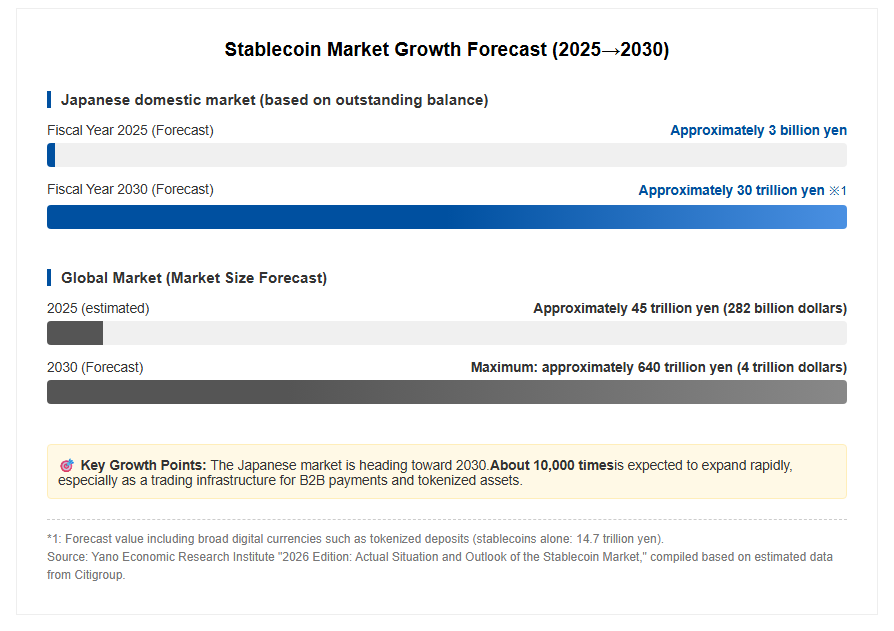
。 Lawson’s initiative serves as a practical example of retail payments closest to consumers among leading stablecoin projects, serving as a litmus test that will determine the overall market adoption rate.
System Improvements under the Revised Payment Services Act and the Establishment of ‘Intermediary Businesses’
Supporting the adoption of stablecoins is the strict and flexible legal framework enacted by the amended Payment Services Act, which came into effect in June 2023. This law defines stablecoins as electronic payment methods, clarifying requirements for issuers and rules for user protection. In addition to fund-moving businesses like JPYC, trust-type and bank-type stablecoins have emerged, each catering to different needs (such as unspecified mass settlements and large institutional investor transactions).
Furthermore, to further promote innovation, the Financial Services Agency continues to review regulations, such as establishing a registration-based “intermediary business” that brokers the buying and selling of crypto assets and electronic payment methods. This makes it easier for businesses without their own issuance licenses to facilitate stablecoin use under specific affiliates, leading to greater diversification of services. On the other hand, from the perspective of user protection, strict regulations on explanations, advertising regulations, and system safety management measures are strictly defined, ensuring both convenience and safety. Such regulatory transparency provides crucial reassurance for Lawson, a major retail chain, to take the step toward technology demonstrations.
[Technological Innovation for Next-Generation Payments] A future where AI agents handle payments on behalf of others.
Automation Concept for “Agentic Payment (AI Payment)”
What lies ahead of this pilot experiment is a world of ‘Agentic Payment,’ where humans do not intervene. HashPort is considering incorporating a mechanism in the future HashPort Wallet for Biz where AI agents automatically transfer and settle payments on behalf of individuals. This technology allows AI to complete payments at the optimal timing based on user instructions and situations, making it a groundbreaking technology that leads to complete automation of cashier and payment operations for the store.
Other companies such as Infcurion and DeCuret DCP have already agreed to implement payment platforms centered on tokenized deposits, anticipating an era where AI agents can autonomously make payments. Because stablecoins have the nature of being “programmable money” on the blockchain, they have an extremely high affinity for AI programs. In discussions at WebX 2026, stablecoins are positioned as the “blood” for AI agents to conduct economic activities in a world where all assets are on-chain.
“DVP” and “Programmability” enabled by blockchain
The technical advantage of stablecoins lies not only in payment speed, but also in the realization of “DVP (Delivery Versus Payment),” which completes transactions and payments simultaneously. Traditional payment systems often caused time lags and opacities between product delivery and fund receipt, but by leveraging smart contracts, funds can be transferred instantly and reliably the moment specific conditions are met. This not only dramatically improves capital efficiency in business-to-business (B2B) transactions, but also automates complex processes in retail settings, such as “completing payments immediately once product inventory is confirmed.”
Additionally, by “coloring” stablecoins—that is, programming their uses and durations—it becomes easier to issue local currencies valid only at specific merchants or public grants that can be used only for specific purposes. As Sota Watanabe points out, when stocks, government bonds, real estate, and intellectual property are tokenized on the blockchain, stablecoins are essential as infrastructure for direct trading of these assets. Lawson’s in-store payment experiment can be defined as the first step toward bringing this advanced on-chain financial gateway directly to ordinary consumers.
[Future Developments and Focus] Challenges in Social Implementation and the Challenge of the 1 Trillion Yen Market
Barriers and motivations to “mass adoption”
Lawson’s proof-of-concept experiments are highly anticipated, but there are still many challenges toward full-scale adoption (mass adoption). Convenient payment methods like PayPay and Suica are already deeply established in Japan, so how to create a “reason to use them” for consumers to deliberately adopt stablecoins or wallets will be crucial. Beyond simply providing payment functions, integration into the basic living infrastructure such as preferential point return rates, exclusive services only available with stablecoins, or receiving part of salary in stablecoins is required.
Additionally, it is essential to dispel concerns about the security of digital assets that do not depend on user literacy and to self-manage digital assets. Based on the results of this demonstration, the key to widespread adoption is whether it can be proven that the convenience of POS integration is as smooth as or even smoother than existing electronic money. Furthermore, the high difficulty of developing domestic merchant stores has been pointed out, and the future focus will be on whether a broad network can be built, not only for major chains like Lawson but also for small and medium-sized stores.
Scenario One Year Ahead: Scenario aiming for a circulating amount of 1 trillion yen by 2027
Looking ahead, the stablecoin industry has set an ambitious goal of reaching a circulating market of 1 trillion yen by around 2027. The current domestic circulation amount is about 13 billion yen, which is very small by global standards, but if the use of salaries for payroll, stock dividends, and intercompany transactions is permitted and widely used, the scale has the potential to expand rapidly. During discussions at WebX 2026, specific visions were outlooked, such as aiming for more than 30% of attendees to regularly use stablecoins on their smartphones by next year’s WebX 2027.
Furthermore, yen-denominated stablecoins are expected to play a role not only in domestic payments but also as infrastructure for improving the efficiency of international remittances and cross-border payments, especially in the APAC region. The Japanese yen is the fourth most used currency for international remittances, and the cost reduction effect of on-chain adoption is extremely significant. If the results of the experiment at Lawson are positive, stablecoin payments will spread across all aspects of daily life, including other major convenience store chains and utility bill payments, marking a turning point where Japan’s digital financial infrastructure is updated to global standards.
[#ローソン #JPYC #ステーブルコイン #KDDI #HashPort #Web3 #経済圏 #キャッシュレス]


コメント